
Call 01493 277103

Leaks, storms, make-safe

Emergency Roof Repairs in Great Yarmouth

Emergency roof repairs across Great Yarmouth, the Broads villages, Lowestoft and Norwich: a leak through the ceiling, tiles or ridges lifted by wind, a fallen pot, a torn flat roof. The opening is made safe first, then the whole roof is surveyed.

Get a written quote

Call 01493 277103WhatsApp us

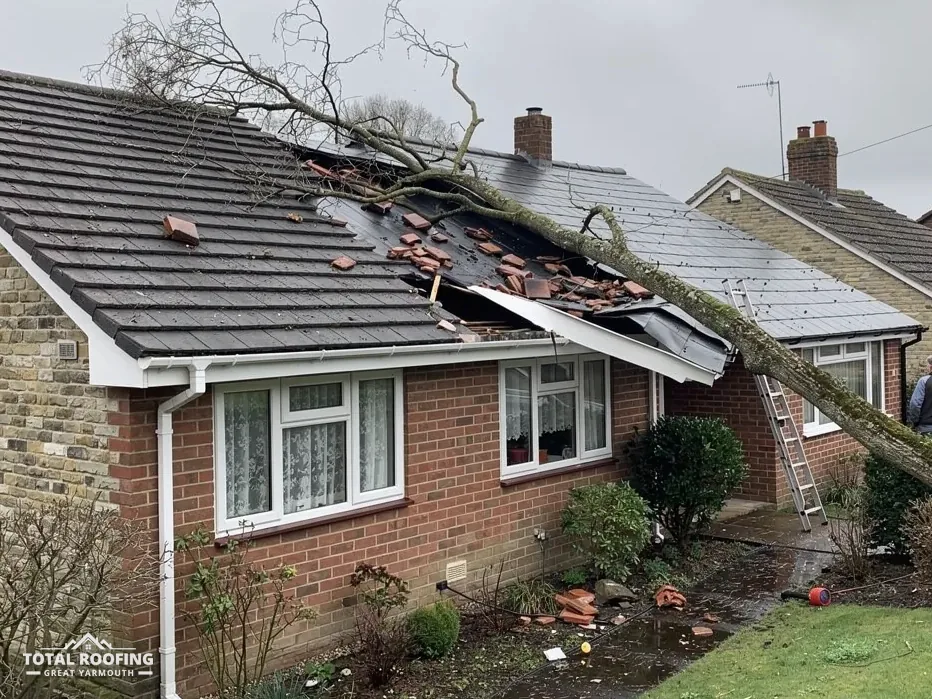
Fallen tree branch lying across a damaged bungalow roof
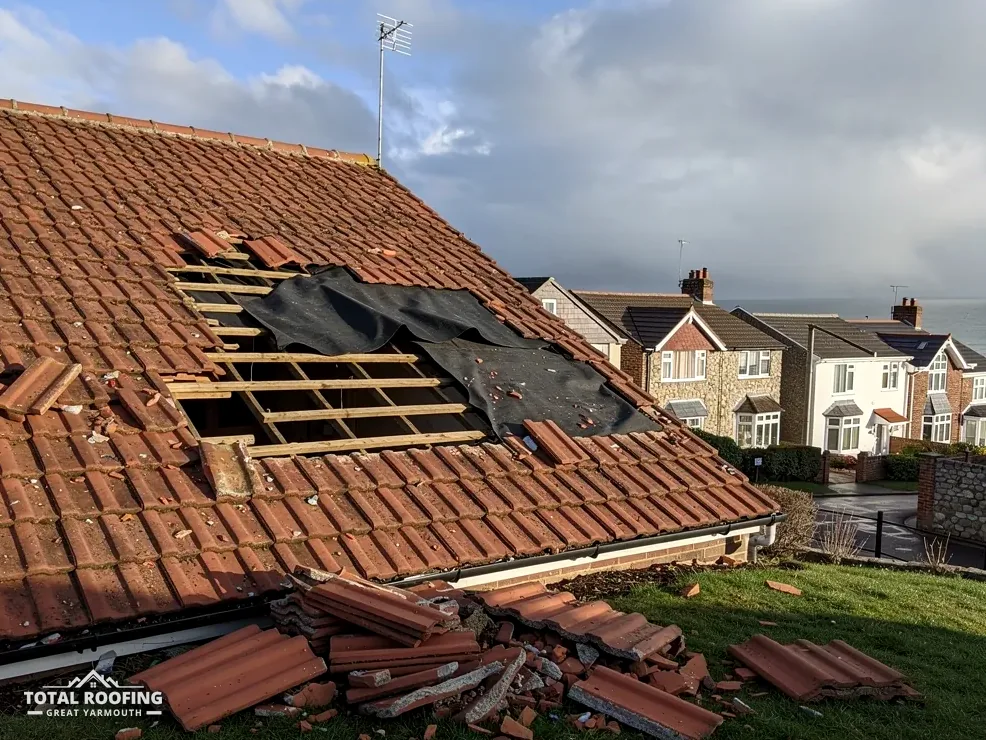
A gap of missing roof tiles after a gale with broken tiles on the lawn
  • 10-year workmanship guarantee, in writing
  • One written total price after the survey
  • Find us on Google

What we check after storm damage

What we check after storm damageLabelled parts: Ridge and hips, Verges, Tiles and slates, Underlay, Chimney stack, Flat roof edges.Ridge and hipsChimney stackTiles and slatesUnderlayFlat roof edgesVerges
What we check after storm damage
Ridge and hipsRidge and hip tiles lifted, cracked or loose on their bedding.
VergesThe gable edge, where wind gets under tiles and old mortar breaks away.
Tiles and slatesSlipped, broken or missing pieces, and the battens left bare beneath them.
UnderlayThe membrane under the covering, for tears that let driven rain through.
Chimney stackPots, flaunching and the lead where the stack meets the slope.
Flat roof edgesMembrane peeled back at the edges, split seams and torn upstands.

Ask it straight

Emergency roof repairs in Great Yarmouth, asked and answered

A roof emergency arrives with the weather: a gust that strips a ridge, rain driven in under a lifted verge, a chimney pot that comes down into the garden. The eight questions below work through what counts as urgent, what you can safely do before anyone climbs a ladder, how an opening is made safe, and how a temporary cover turns into a lasting repair, with the insurance and cost points along the way.

  1. Which roof problems count as an emergency, and which can wait?
  2. What should I do while I wait for a roofer?
  3. What does making a roof safe actually involve?
  4. Why do storms lift ridges, verges and tiles on this coast?
  5. What can a storm do to flat roofs, chimneys and gutters?
  6. How does a make-safe become a lasting repair or re-roof?
  7. Will my home insurance pay for storm damage to the roof?
  8. What does an emergency roof repair cost in Great Yarmouth?

Which roof problems count as an emergency, and which can wait?

The short answer

It is an emergency when water is coming into the house, when part of the roof is open to the sky, or when something loose could fall on someone below.

Signs that cannot wait

  • Water dripping or running through a ceiling or down a wall
  • A hole in the roof where tiles or slates have gone
  • Ridge, hip or verge tiles hanging loose after wind
  • A chimney pot leaning, cracked or already fallen
  • A flat roof membrane torn open or peeled back
  • A ceiling bulging downwards with water held above it

A roof emergency is judged by what happens next if nothing is done. Rain coming through a ceiling, a hole where tiles have gone, a ridge tile hanging over the gutter or a chimney pot leaning on its flaunching all carry a risk that grows with the next shower or the next gust. Water soaks the loft insulation, runs along the joists and can bring down a plasterboard ceiling once it has pooled above it. Loose pieces can drop onto a path, a parked car or the roof next door.

Some damage looks alarming from the garden and can still wait for a planned visit. A single cracked tile with dry timber under it, moss on the slopes, a gutter that spills over only in a downpour, or a stain that has not grown since last winter are faults to have surveyed and priced, not to make safe in the dark. The test is simple: is water getting in now, or could anything come down? Our guide to what counts as a roofing emergency works through more cases.

Water near electrics changes the answer. If it is dripping through a light fitting or running down a wall beside sockets, keep clear of it and, if you can reach the fuse box without passing through the wet, switch off that circuit, then have an electrician check it before the power goes back on. A ceiling that has bowed downwards with water above it is a hazard in its own right, so keep people out of the room underneath it.

Planned faults still matter, because a slipped tile left through a wet season can wet the battens and the underlay beneath it. For anything that is not urgent, our roof repairs page covers the planned side of the work, from slipped tiles and cracked ridges to worn valleys and tired flashing. The emergency side is about the next few hours of weather: keeping rain out of the rooms and keeping loose pieces from falling.
What should I do while I wait for a roofer?

The short answer

Keep everyone off the roof and away from anything loose, catch the water, move belongings out of its path, and photograph the damage before anything is moved.

Stay on the ground. A wet roof is slippery, a damaged one may not hold your weight, and a ladder in wind can slide or blow away from the wall. Some roofs are fragile by nature: HSE's guidance says "AC roofs are always fragile", meaning asbestos cement sheeting on a garage, lean-to or outbuilding, and it will not carry a person. If part of a roof or a chimney looks ready to fall, keep people and cars away from the ground below it.

Before the roofer arrives

  1. Keep everyone off the roof and away from anything loose
  2. Switch off any circuit where water reaches a light or socket
  3. Catch drips and move belongings out of the water's path
  4. Photograph the damage inside and out before anything is moved
  5. Tell your insurer and ask what the policy needs
  6. Send a photo on WhatsApp and say where the water shows

Inside, catch the water with buckets, bowls or a towel-lined box, and move furniture, rugs and anything electrical out of the way. In the loft, if you can get in safely and there are boards to stand on, a bucket under the drip and a plastic sheet over the insulation can stop the water spreading across the ceiling below. Never step between the joists, because plasterboard will not take your weight and a foot through it makes a second repair.

Then record what you see. Photograph the damage inside and out before anything is moved, cleared or thrown away: wide shots that show where on the house it is, then close-ups of the stain, the hole and any fallen pieces. Keep broken tiles or pieces of pot to one side rather than binning them, and note the date and the weather. Tell your insurer what has happened and ask what the policy needs from you before any repair goes ahead.

When you ring us, say what you can see: where the water is coming in, which part of the roof is damaged, whether anything is loose overhead and how many storeys the house has. A photo or a short video sent on WhatsApp shows more than a description can, and it lets us see the damage for ourselves before a ladder comes off the van. It also tells whoever comes out whether ladders will do or whether the job needs scaffold.

What does making a roof safe actually involve?

The short answer

Making safe means stopping the water and securing anything loose until the lasting repair: a sheet fixed over the opening, slipped tiles refitted, and loose ridges or pots taken down.

Make-safe words in plain English

  • Make-safetemporary work that keeps rain out and stops falls
  • Tarpaulinheavy waterproof sheet fixed over an opening
  • Battentimber strip, here used to hold a sheet down
  • Underlaymembrane under the tiles, a second barrier to rain
  • Vergethe roof edge running along a gable
  • Flaunchingmortar bed on a stack top holding the pots

A make-safe is a holding repair. Its job is to keep rain out of the house and stop anything falling, using what can be fixed in the weather on the day, and it leaves the proper repair for a dry spell and a full look at the roof. On a pitched roof where tiles or slates have gone, the gap can be closed by sliding sound tiles back into their courses, or covered with a heavy-duty waterproof sheet.

A tarpaulin on a roof only works if the wind cannot get under it. It is laid from above the damaged area, over the ridge where it can be, so rain runs over its top edge rather than behind it, and it is held with timber battens fixed through the sheet, never loose weights that can slide off and fall. A flapping sheet does more harm than none, because it can drag more tiles off the slope as it whips about.

Loose pieces are taken off or fixed. A ridge tile rocking on broken mortar can be lifted off and set aside, a cracked pot that could fall is taken down, and lifted flashing can be dressed back and held. On a flat roof, a split in the membrane can take a temporary patch, or a sheet held down along its edges, until the weather allows a repair that will bond. Our guide to making a roof safe follows each of these in more detail.

Access shapes what can be done. A make-safe on a bungalow or a single-storey extension can go ahead from ladders, but a three-storey house or a roof above a busy street may need a tower or a full scaffold. A scaffold that has to stand on the footway or the street is licensed by the county council under section 169 of the Highways Act 1980, and we arrange the licence with our scaffolder. Strong gusts stop roof work altogether, because a loose sheet turns into a sail.

Why do storms lift ridges, verges and tiles on this coast?

The short answer

Wind over a roof lifts as well as pushes, and ridges, hips and verges bedded only in aged mortar have nothing else holding them once that mortar cracks.

Myth

Fresh mortar is all a storm-lifted ridge needs to stay put.

Fact

Marley: since BS 5534's 2015 amendments, mortar alone is not relied on; ridge tiles should be mechanically fixed.

Great Yarmouth faces the North Sea, and on roofs along this stretch of the east coast, from Caister-on-Sea down through Gorleston-on-Sea to Lowestoft, new fixings are calculated for the exposure of each site. Wind over a roof does not only press on the slope facing it: it pulls upward on the far slope and along the edges, and it drives rain sideways under tiles and into joints that would shed it in still air. That is how a storm can leave the middle of a slope untouched and strip its edges.

Ridge and hip tiles were traditionally bedded on mortar, and verge tiles on older gables were set the same way. Marley, the tile maker, says that since the 2015 amendments to BS 5534 mortar "could no longer be relied upon as the only means of securing the roof covering", and that "In all cases, ridge or hip tiles should be mechanically fixed to resist the calculated wind uplift force." Once old bedding has cracked away from the tile, nothing else holds a ridge down.

When storm damage is put right, the tile fixings on a coastal site like this are worked out for its exposure under BS 5534, through a site-specific fixing specification that allows for how open the roof stands and the local topography around it. Marley notes that installing to BS 5534 isn't required by law, though tile makers base their own fixing guidance on that code. Dry-fix systems for the ridge, hips and verges, covered by BS 8612:2018, clip and screw those tiles down instead of leaving them on mortar alone.

Driven rain needs no broken tile at all. A storm off the sea can push water up under the laps of tiles on a shallow slope, through a torn underlay, past lifted lead or into a dry verge that has lost its caps. Inland, across the Broads villages and out to Norwich, the same forces act on a roof, and the same checks follow a gale: the ridge line, the verges, the lead and the underlay seen from the loft.

What can a storm do to flat roofs, chimneys and gutters?

The short answer

Wind can peel a flat roof membrane back from its edge, bring down a chimney pot or loosen the lead on a stack, and pull a gutter run off its brackets.

A flat roof meets the wind differently from a pitched one. Its weak points are the edges and upstands: where the membrane turns up a wall, where it is dressed over the drip at the gutter edge, and along any seam. Once wind gets under a lifted edge, it can roll a felt or rubber sheet back across the deck and leave the boards open to the rain. A split or blister that has let water into the deck is slower, but it still ends as a stain on the ceiling below.

Chimney stacks stand above everything else on a roof. A pot whose flaunching has cracked loose can rock in a gale and fall, and lead flashing that has worked out of its joint can lift and let rain run down behind it. A fallen pot leaves an open flue as well as broken pieces on the slope, and those pieces can crack tiles on the way down. Where the stack itself needs repointing, re-flaunching or rebuilding after the make-safe, our chimney repairs page covers that work.

Gutters and the roofline take the wind at the eaves. A run of guttering can be pulled off its brackets, a downpipe that has come loose can pour water against the wall instead of into the drain, and a fascia board that has rotted lets the brackets pull out. A fallen gutter is a safety question if it hangs over a door or a path, and a water question after that, because rain running down brickwork soaks into the wall and can show as damp inside.

Garages, sheds and lean-tos see the same storms. Corrugated sheets that lift at one corner can be torn off whole, and sheet roofs on older outbuildings may be asbestos cement. HSE's advice is plain: "If the building was built or refurbished before 2000, assume that there is asbestos in it." Leave broken sheets where they lie, keep children and pets away from them, and do not sweep, snap or bag the pieces, because breaking them up releases fibres.

How does a make-safe become a lasting repair or re-roof?

The short answer

A make-safe is a stopgap, not a repair: wind and sun work at any sheet or patch, so the lasting repair is surveyed and priced once the roof can be looked at properly.

Holding repair or lasting one

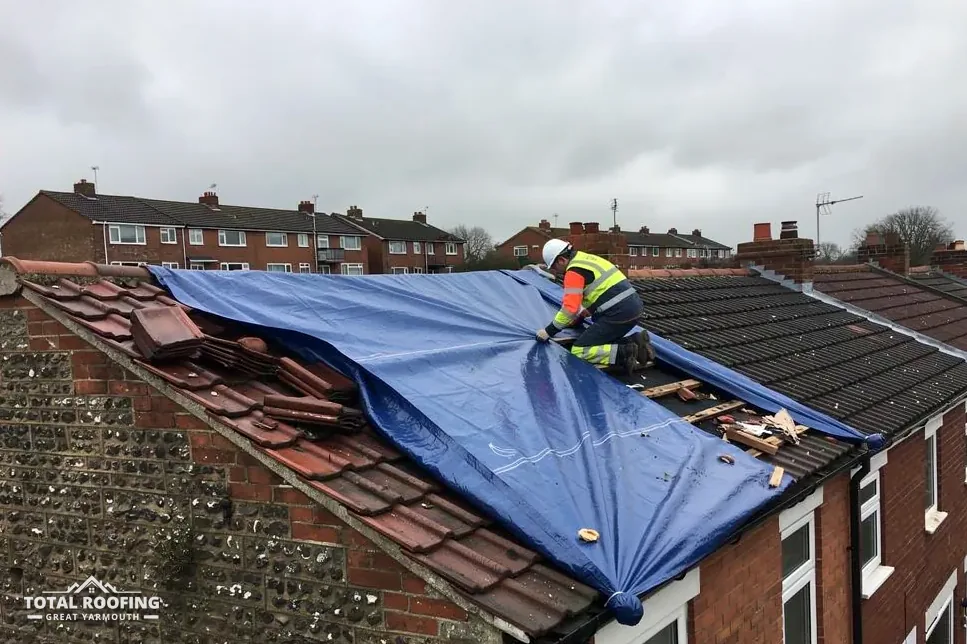
A blue tarpaulin fixed over a damaged section of tiled roof

Make-safe

  • Stops rain getting in now
  • Sheet, battens or temporary patch
  • Done in whatever weather comes
  • Checked again after each storm
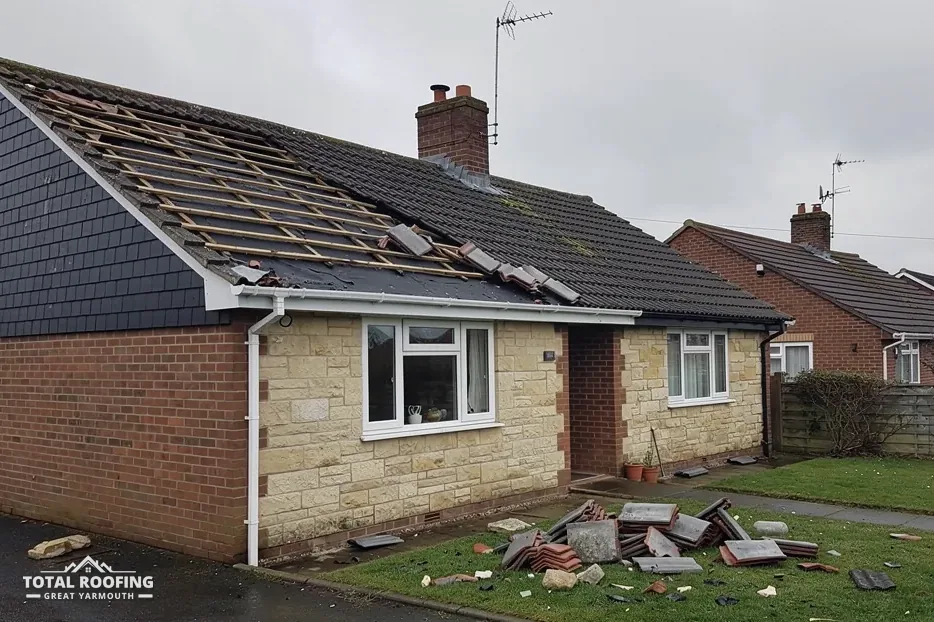
Storm-stripped concrete tiles exposing felt on a semi roof

Permanent repair

  • Surveyed in daylight, safe access
  • Fixings set under BS 5534
  • Tiles matched, underlay renewed
  • Built to last, not hold

No temporary cover has a set life, and nobody can say how long one will hold. A tarpaulin battened over a ridge can see out rough weather, but every gust works at its fixings, sunlight breaks the sheet down, and the battens screwed through it leave holes of their own. A patch on a flat roof membrane goes onto a surface that may be damp, so it is a holding measure rather than a bond that will last. The longer a make-safe stays, the more checking it needs after each storm.

The step from make-safe to permanent repair starts with a proper survey, in daylight and dry weather with safe access. We look at the whole roof, not only the part the storm opened up, because wind that stripped one ridge tile may have cracked the bedding along the rest, and a leak traced to one tile can have wetted battens further down the slope. You are told plainly what was found, including anything else we saw, and given one written total price for the repair.

The repair itself follows what the survey finds. A few tiles blown off a sound roof are replaced and fixed to match the rest; a ridge line that has lost its bedding is relaid and mechanically fixed, as Marley's guidance sets out; torn underlay is renewed under the lifted courses; and wet battens and insulation are replaced. Where the damage runs across a whole slope, or the covering was already near the end of its life, a re-roof of that slope or a full roof replacement is worth pricing alongside the repair.

Re-roofing brings the Building Regulations in. Under the Planning Portal's guide, no building regulations application is normally needed where the work affects "Less than 25 per cent of the total 'building envelope'" and where "Less than 50 per cent of the roof is affected", so a full re-roof sits outside that test. A new covering "15 per cent or more" heavier than the old one needs approval as well. Our guide from temporary to permanent repair follows the whole sequence.

Will my home insurance pay for storm damage to the roof?

The short answer

Cover turns on your policy wording and the cause of the damage, so read its storm and wear sections, photograph everything and tell your insurer.

Home insurance policies set their own terms, so the policy wording is the place to begin. Look for what it says about storm, about water getting in, and about wear and tear or gradual deterioration, and check the excess on a storm claim. The cause counts: a roof that a gale stripped of sound tiles is a different case from one where old mortar had been crumbling for years before the wind finished the job.

When a dispute about a storm claim reaches the Financial Ombudsman Service, it applies its own view of what a storm is. It says that "a storm usually involves violent winds, usually with rain, hail or snow", that "Rain, hail or snowfall by itself can constitute a storm", and that it takes the Beaufort Scale into account. It adds: "we'll usually look at expert reports and photos. Your insurer will normally ask a surveyor to write a report." If an insurer turns a claim down under an exclusion, the Ombudsman says "The insurer has to prove that the exclusion applies".

If you are unhappy with how an insurer has handled a claim, complain to the insurer first. The Financial Ombudsman Service says "For most complaints, a business has up to 8 weeks to consider a complaint", and that you have 6 months from the date of the final response to bring the complaint to it. The Financial Ombudsman Service's phone line is 0800 023 4567. Keep copies of every letter and email, along with your photos and the date of the storm.

The claim itself is between you and your insurer, and the insurer decides it. Keep the photos, any broken pieces and a note of the weather, and send the insurer the written quote for the repair if the policy asks for one. A make-safe carried out to stop further damage belongs in the claim too, so ask the insurer what it needs to know about one and keep the invoice. Our guide to storm damage and home insurance takes the claim further.

What does an emergency roof repair cost in Great Yarmouth?

The short answer

MyJobQuote says extensive storm damage repairs can cost £1,200 or more; smaller jobs cost less, and the access, the damage and what the survey finds set the figure for your roof.

Published UK figures for urgent roof work

Emergency roofer call-outtypically £150 to £300
Extensive storm damage repairs£1,200 or more
Replace one to six broken tiles£75 to £400, excluding VAT
Put in a new ridge tile£80 to £300, excluding VAT
Average roof repair in 2026around £650

MyJobQuote UK figures: emergency roofer page last updated 22/10/26, roof maintenance page last updated 06/10/26. Which? Trusted Traders survey of 11 traders, November 2025, excluding VAT.

Published UK figures give a guide. The call-out range and the storm figure in the table come from MyJobQuote's emergency roofer page (last updated 22/10/26), which says that extensive storm damage repairs can cost £1,200 or more. For smaller repairs once the roof is safe, Which? Trusted Traders put replacing one to six broken or missing standard roof tiles at £75 to £400 and a new ridge tile at £80 to £300, excluding VAT (November 2025). MyJobQuote gives an average roof repair cost of around £650 in 2026.

Height and access come first. A bungalow can be reached from ladders, while a three-storey house beside the road can need scaffold and a highway licence from the county council. Then comes the damage itself: how many tiles have gone, whether the ridge has to be relaid, whether the underlay and battens are wet, and whether the leak has reached ceilings and insulation that need another trade. Weather plays a part as well, because a wet or windy roof slows the work and some repairs cannot go ahead until it dries.

The permanent repair is surveyed and priced as one written total, after we have looked at the whole roof. Where you hold quotes from more than one firm, compare what each covers, such as scaffold, the ridge and any wet battens, so you are setting like against like. Our emergency roof repair cost guide sets out each published figure with its date, and what moves the price up or down.

Insurance can change who pays without changing what the work involves. If the damage is covered, the insurer may ask for the written quote, and the policy excess comes off what it pays. If the insurer decides the cause was wear rather than the storm, the roof still needs the same repair, so your photos and the written quote are worth keeping whichever way the claim goes.

Start with a photo of the damage

If rain is coming in or something is loose on the roof, ring us or send us a WhatsApp photo from the garden or an upstairs window. We look at it, the opening is made safe, and then the whole roof is surveyed so the lasting repair answers everything the storm did, not only the hole you can see.

Get a written quote

Emergency roof questions around Great Yarmouth

How much is a call-out for an emergency roofer in Great Yarmouth?

MyJobQuote's emergency roofer page (last updated 22/10/26) says "Emergency roofer call-out costs typically range from £150 to £300" across the UK. A call-out figure covers getting someone to the roof, so ask what it includes when you ring: whether materials for a sheet or a few tiles are part of it, and how the permanent repair will be priced. The lasting repair depends on what the survey finds once the roof is safe and dry.

Should I go up on the roof to cover the damage myself?

No. A storm-damaged roof can have loose tiles, wet surfaces and broken battens under the covering, and a ladder in wind can slide or blow away from the wall. Leave the outside to a roofer with safe access and do what you can from indoors: catch the water, move belongings and keep people out of any room where a ceiling is sagging. Rooflights and the glazing of a conservatory roof will not take a person's weight either.

Can I cancel an emergency repair once I have asked for it?

Not in the way you can cancel planned work. The Consumer Contracts Regulations give no cancellation right where "the consumer has specifically requested a visit from the trader for the purpose of carrying out urgent repairs or maintenance" (regulation 28(1)(e)). For planned work agreed at home after a survey, the normal rule applies: "the cancellation period ends at the end of 14 days after the day on which the contract is entered into". Our guide to urgent repairs and cancellation rights shows where the line falls.

How can you tell a dodgy roofer after a storm?

Be wary of anyone who knocks on the door after a storm saying they have spotted damage, wants cash before any work starts, or presses you to agree on the spot. Ask for a written quote, a full business name you can look up and a landline, and take time to compare. If you have a problem with a trader, the Citizens Advice consumer helpline is on 0808 223 1133, and it is the route for reporting a trader to Trading Standards.

What should I do if water is coming through a light fitting?

Keep away from the fitting and the wet floor below it, and do not touch the switch. If you can reach the fuse box without crossing water, turn off the lighting circuit for that part of the house, or the main switch if you cannot tell which circuit it is. Put a bucket under the drip from a safe distance, then have an electrician check the circuit before it goes back on, once the roof is covered.

Can a roof be made safe in heavy rain or high wind?

Rain alone does not stop a make-safe: a sheet can be battened down and slipped tiles slid back into place in the wet, with care on a slippery slope. Strong wind is different. Working on a roof in heavy gusts puts the roofer at risk, and a tarpaulin being fixed in a gale can be torn away along with more tiles. Then the inside is protected first, and the roof waits until the wind drops enough to work safely.

Which places around Great Yarmouth do you cover for emergencies?

Our area runs up to 30 road miles out from Great Yarmouth. That takes in the coast from Happisburgh down to Lowestoft and Kessingland, through Caister-on-Sea and Gorleston-on-Sea, across the Broads villages and the Waveney valley, inland to Acle and Norwich across east Norfolk, and over the county line into Suffolk around Beccles. If you are not sure whether your address is inside that, send a photo of the damage on WhatsApp with the name of your town or village.

Is one slipped tile on its own a roofing emergency?

Not if the roof below it is dry and the tile is lodged safely in the gutter or on the slope. It becomes urgent when the gap lets rain onto bare battens or torn underlay and a stain appears indoors, or when the tile is hanging over a path, a door or a parked car. Either way it is worth a photo on WhatsApp, because one slipped tile after a storm can be a sign that the nails along that course have rusted through.

Get a written quote

Tell us about your roof

Call WhatsApp Written quote