
Call 01493 277103

Loft foam, assessed first

Spray Foam Insulation Removal in Great Yarmouth

Spray foam insulation removal in Great Yarmouth, Gorleston, Bradwell and Caister, out through the Broads villages to Acle, Norwich and Lowestoft. We survey the roof inside and out, look at the timbers and covering around the foam, and give you an honest view and one written total price.

Get a written quote

Call 01493 277103WhatsApp us

  • 10-year workmanship guarantee, in writing
  • One written total price after the survey
  • Find us on Google

What we check on a spray-foamed roof

What we check on a spray-foamed roofLabelled parts: Rafters, Roof felt, Battens, Tiles and slates, Eaves, Cables and pipes.BattensTiles and slatesRoof feltCables and pipesRaftersEaves
What we check on a spray-foamed roof
RaftersTimber faces left visible, soft or dark wood, and how far foam runs.
Roof feltWhether foam is bonded to the underlay, and the felt's state beyond it.
BattensBatten condition where it shows, and the nails holding each row of tiles.
Tiles and slatesSlipped, cracked or loose pieces seen from outside, plus the ridge and verge.
EavesWhether foam has filled the ventilation gap along the bottom of the slope.
Cables and pipesWiring, pipework and light fittings running through or buried in the foam.

Ask it straight

Spray foam in a Great Yarmouth roof: eight plain questions

Spray foam is applied to the underside of a roof, between and over the rafters, so it touches the timbers, the felt and on some roofs the tiles themselves. The questions below run from why a lender has asked about it, through the two types of foam and the ways it comes out, to the timbers, what goes back, published costs and what to do about a cold caller. A brief reply comes first under every question, then the detail.

  1. Why has my lender or surveyor raised the spray foam?
  2. Is the foam in my loft open-cell or closed-cell?
  3. Does spray foam always have to come out?
  4. How is spray foam actually taken off a tiled roof?
  5. What damage could be hiding in the timbers under foam?
  6. What goes back on the roof once the foam is gone?
  7. How much does spray foam removal cost in Norfolk?
  8. Someone cold-called offering spray foam removal: should I agree?

Why has my lender or surveyor raised the spray foam?

The short answer

Foam over the rafters hides the timber from view, and RICS has reported concern within specific sectors of the lending market, such as equity release mortgages.

What spray foam can hide in a loft

  • The faces and joints of the rafters
  • Damp or soft timber behind the foam
  • The condition of the felt or underlay
  • Batten ends and the nails that hold them
  • An eaves ventilation gap filled in
  • Cables and pipes buried in the foam

A mortgage valuation or a building survey depends on seeing the roof structure. RICS, the body for chartered surveyors, says in its consumer guide: "If the timber roof structure is covered with spray foam it cannot be fully seen or inspected." A surveyor who cannot see the rafters, the purlins or the back of the felt cannot say what condition they are in, so the report flags the foam and leaves open the question of what lies behind it.

In a press release of March 2023, RICS said that "there has been concern within specific sectors of the lending market, such as equity release mortgages, which is now having a wider impact on lenders." Its guide also tells homeowners: "Do check with your mortgage provider whether their lender policy allows the installation of such products." Each lender applies its own requirements, so the first call belongs to the lender or broker handling the mortgage, before any removal firm.

The picture is not one of blanket refusal. The government's policy paper on spray foam, published by DESNZ on 22 October 2026, says: "Many mortgage providers are open to lending on properties with spray foam, subject to their own requirements." The Energy Saving Trust, in advice last updated on 5 November 2026, says that having spray foam "doesn't automatically prevent you from getting a mortgage, but some lenders may ask for extra checks."

Those extra checks are where a roofer has something to add. A lender may want to know whether the timbers are sound, whether the foam is open-cell or closed-cell, and whether it was sprayed onto a felt underlay or directly onto the tiles. Our survey looks at the roof from outside and, where it can be reached, from the loft hatch, and we tell you what we could see and what stayed hidden. For a house in Gorleston, Bradwell or out towards Acle, the questions are the same.
Is the foam in my loft open-cell or closed-cell?

The short answer

Open-cell foam is soft and gives under a finger; closed-cell foam is hard and rigid. The Energy Saving Trust says closed-cell foam doesn't let moisture pass through it easily.

Two kinds of foam

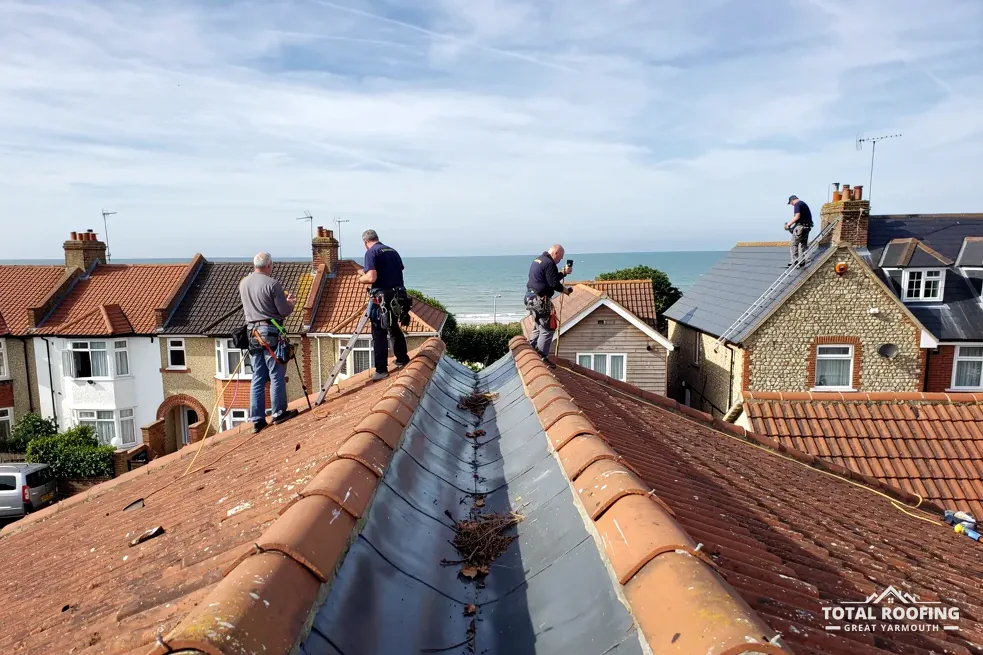
Lead-lined roof valley between two clay-tiled slopes, a few leaves caught in it

Open-cell

  • Soft, spongy and light
  • Tears and cuts by hand
  • EST: rot risk should be lower
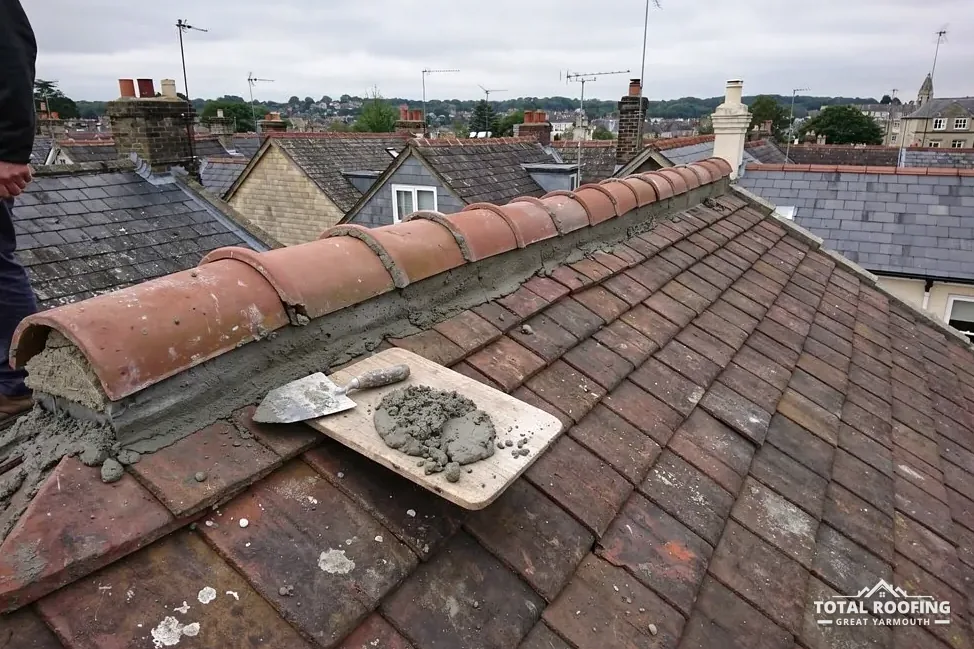
Half-round ridge tiles being re-bedded on a tiled roof

Closed-cell

  • Hard, dense and rigid
  • Grips felt, tiles and timber
  • Moisture passes through less easily

Spray foam is sold in two broad types, and they behave differently once they are on a roof. Open-cell foam cures into a light, spongy layer that a thumb can press in and a hand can tear. Closed-cell foam sets into a dense, hard layer that is far tougher to cut and grips whatever it was sprayed against. Pressing a gloved hand on an exposed patch in the loft gives a first idea of which one you have, and the survey confirms it.

The Energy Saving Trust explains the difference in terms of moisture. Of closed-cell foam it says: "Its main drawback is that it doesn't let moisture pass through it easily." Damp that rises from the house into the roof space, or that gets in through a leak, can then have less chance to dry out of the timber the foam is pressed against. On the risk of rot, the Trust adds: "But this risk should be much lower with open-cell foam."

Lower is not the same as none. Open-cell foam still covers the rafters, so the RICS point about timber that "cannot be fully seen or inspected" applies to both types. Questions about the structure from a buyer or their surveyor apply to both as well. Where the type does change things is removal: soft foam can be cut and scraped back from the timber, while hard foam bonded to felt or tiles may mean taking the covering off from outside.

Our guide to open-cell and closed-cell foam goes through the differences in more detail. When we survey, we look at which type is there, how thick it has been laid, and whether it went onto a felt underlay or onto bare tiles and battens, because those three facts decide the route the job takes and what it will cost.

Does spray foam always have to come out?

The short answer

No. The government's advice is to speak to a specialist surveyor before deciding, and its paper warns that removal "will not always guarantee that they will still lend".

Nothing in the government guidance says that every roof with foam in it has to be stripped. The DESNZ policy paper of 22 October 2026 is direct about the order of things: "Before making any decision about your spray foam, you should take advice from a specialist surveyor." A specialist survey looks at the foam, the timbers it covers and the moisture in them, and it gives you something to put in front of a lender or a buyer.

The same paper is careful about what removal achieves: "Removing the foam will not always guarantee that they will still lend, and improper removal could lead to further issues." Those further issues are real on a roof. Foam pulled off roughly can tear an old felt, split battens or loosen tiles from below, and a roof that kept the rain out with foam in it can start to leak once the foam has gone and the felt beneath turns out to be failing.

So the decision has three parts. The first is what the lender or buyer wants to see, which only they can tell you. The second is what a specialist survey finds in the timbers and the foam. The third is the state of the roof covering, which is the part our survey answers. If the tiles, felt and battens are near the end of their life anyway, taking the foam out with the old covering and re-felting can make sense; if the covering is sound, careful removal from inside may suit better.

Whatever the answer, it should come before anyone starts cutting. Foam taken out cannot be put back to see whether a lender would have accepted it, and a roof opened up in a hurry is exposed to the weather until it is closed again. We give you our reading of the roof and a price for the work it needs, and the decision stays with you and your lender.

How is spray foam actually taken off a tiled roof?

The short answer

One of two ways: cut and scraped back from inside the loft, or taken off from outside with the tiles, battens and felt lifted, after which the roof is re-felted and relaid.

Removal with the covering off

  1. Scaffold erected round the roof, licensed where it meets the highway
  2. Tiles or slates lifted and set aside for reuse
  3. Battens, felt and attached foam taken off together
  4. Foam cleaned back from the rafters and the timber looked over
  5. New underlay and battens fixed across the rafters
  6. Tiles or slates relaid and fixed to the specification

Which route a roof takes depends on how the foam was put on. Where it was sprayed between the rafters against a felt underlay, and that felt is in fair condition, the foam can be cut back from inside the loft, one rafter bay at a time, and scraped off the timber faces. Soft open-cell foam comes away more readily than hard closed-cell foam, which can need cutting tools and far more time for each bay.

Where the foam was sprayed onto the underside of bare tiles or slates with no felt between, or where closed-cell foam has bonded hard to the felt, working from inside risks pushing tiles out of place and tearing what keeps the roof dry. On those roofs the covering comes off from outside. The tiles or slates are lifted and set aside, the battens and felt come away with the foam attached, and the rafters are cleaned back from above. Our guide to how spray foam is removed sets out both routes.

Working from outside needs scaffold around the roof. If any of that scaffold has to stand on a public footway or carriageway, section 169 of the Highways Act 1980 requires the county council's say-so in the form of a licence. We arrange the licence with our scaffolder. For Norfolk addresses, Great Yarmouth included, the licensing body is Norfolk County Council; for Lowestoft and the north-east Suffolk villages, it is Suffolk County Council. Scaffold is part of the written quote.

Removal also brings the rest of the roof to light. With the covering off, slipped tiles, worn ridge bedding and tired lead flashings are in plain view, and any roof repair they need, done while the scaffold is up, saves putting it up a second time. So the survey covers every slope, and not only the loft, before any figure goes on the job. Our pitched roofing page covers the tiles and slates that go back on.

What damage could be hiding in the timbers under foam?

The short answer

Damp, decay or splits in rafters and battens can sit unseen behind foam, and nobody can say what is there until the timber is exposed and looked at.

Roof timbers, named

  • Raftersloping timber running from eaves to ridge
  • Battenthin timber strip the tiles hang on
  • Purlinhorizontal beam under the rafters, partway up
  • Underlayfelt or membrane laid beneath the battens
  • Wall platetimber on the wall top where rafters sit

Rafters are the sloping timbers that carry the roof; battens are the thinner strips fixed across them that the tiles hang on. Both are wood, and wood that stays damp for long enough can decay. Foam pressed against a rafter hides its face, and closed-cell foam, which in the Energy Saving Trust's words "doesn't let moisture pass through it easily", can hold damp against the timber. That is why a surveyor, a lender and a roofer all want to see the wood itself.

Until the foam is off, the signs are indirect: a musty smell in the loft, staining on a bedroom ceiling below, a dip in the roof line seen from the street, or tiles that have slipped where battens have weakened. None of these proves rot, and the lack of them does not prove the timber is sound. Probing the exposed ends of rafters at the eaves and gables, where the foam stops short, gives a partial view and nothing more.

Once the timbers are exposed, each rafter and batten can be looked at along its length. Staining that is dry and firm is a different thing from wood that is soft when pressed or crumbles at the edges. Sound timber stays; damaged lengths are replaced or strengthened alongside, and battens are renewed when the covering comes off. Our guide to what turns up in timbers under foam explains what each finding means for the roof.

A full report on the condition of the timber belongs with a specialist surveyor, as the government guidance advises, and the Energy Saving Trust notes that some lenders may ask for extra checks. What we bring is the roofer's side of it: what the covering, felt, battens and fixings need, and a price for that work. If timber repair reaches beyond rafters and battens into purlins or the wall plate, it needs a structural engineer's or surveyor's opinion before work starts.

What goes back on the roof once the foam is gone?

The short answer

New underlay, new battens and the tiles or slates relaid, with ventilation and insulation planned together so the loft stays dry as well as warm.

Re-felting is the heart of it. The old felt comes off with the foam, and a new underlay is laid over the rafters, lapped and held down by new battens set out to the gauge the tiles need. The tiles or slates then go back to the fixing specification that BS 5534 calls for, worked out for that particular site. On the seafront at Gorleston or Caister, as anywhere, fixings are calculated for the site's exposure, and Marley's guidance is that "In all cases, ridge or hip tiles should be mechanically fixed to resist the calculated wind uplift force."

The underlay decides how the roof space handles damp. Marley, writing on BS 5250, gives eaves ventilation for a cold roof, with the insulation laid over the ceiling joists, under high-resistance (HR) underlay: 25 mm along the eaves at a pitch of 15° or less, and 10 mm at steeper pitches above 15°. HR underlay is not vapour-permeable, so that air path is what keeps the loft from collecting moisture. Low-resistance underlays work to other rules, and the choice is made roof by roof.

Under the Planning Portal's guide, re-roofing does not normally need a building regulations application when "Less than 25 per cent of the total 'building envelope'" is affected and "Less than 50 per cent of the roof is affected". A full strip after foam removal affects more than half the roof, so we check the route with the council's building control team, Great Yarmouth Borough Council's for a home in the borough, before work starts. Our guide to re-roofing after spray foam removal goes further.

New insulation goes back in as well, to hold heat in the rooms below. Approved Document L 2021 treats renovation of over half a roof's surface as the trigger for improving all of it, where feasible, to Table 4.3: a threshold of 0.35 and an improved value of 0.16 W/(m²·K). Where the foam sat between the rafters, the replacement can go between or over them, or on the loft floor with the roof ventilated as a cold roof. Our roof replacement page covers a full re-roof from start to finish.

How much does spray foam removal cost in Norfolk?

The short answer

Published UK guides put removal at £40 per m² on average, or £50 to £75 per m² for open-cell foam, and around £3,200 for a three-bedroom house.

Published UK figures for spray foam removal

MyJobQuote average rate£40 per m²
MyJobQuote, roughly 80m² of roof spacearound £3,200
Checkatrade, three-bedroom detached housearound £3,200
Checkatrade, open-cell foam rate£50 to £75 per m²

MyJobQuote spray foam removal page last updated 17/09/26; Checkatrade cost guide last updated July 2026. Neither states a VAT basis. Re-felting and timber repair are priced after a survey.

Two cost guides give figures for spray foam removal, and they measure it in slightly different ways. MyJobQuote, on a page last updated 17/09/26, says "The average cost of spray foam removal is £40 per m²" and gives its own worked example: "For a standard 3-bedroom property with roughly 80m² of roof space, total removal costs typically come to around £3,200." The page does not say whether VAT is in that figure.

Checkatrade, in its guide last updated July 2026, says: that for a three-bedroom detached house the whole removal cost can be expected to come to "around £3,200". It gives open-cell foam its own rate: "The cost to remove spray foam typically runs between £50 and £75 per m² for open-cell foam." A rate per square metre describes a job in general, not your loft, and it does not turn into a total for your roof by multiplying it out.

Those guide figures are about the foam. What a roof in Great Yarmouth or Beccles costs depends on local details a national average cannot see: the type and depth of foam, whether it is bonded to felt or tiles, whether the covering has to come off, the scaffold, the timber found underneath and what goes back on. A loft cleared from inside and a full strip and re-felt are very different jobs, and figures for one tell you little about the other.

Our guide to spray foam removal costs walks through each of those drivers in turn. After the survey we give you one written total price for the work your roof needs, covering the foam, the felt and whatever goes back on, and you can set it beside whatever the lender or the specialist surveyor has asked for before you decide.

Someone cold-called offering spray foam removal: should I agree?

The short answer

Take your time. DESNZ records an increase in cold calls or unsolicited offers to sell or remove it, and a contract signed at home carries a 14-day cancellation period.

Myth

Every loft with spray foam has to be stripped back to bare rafters.

Fact

DESNZ advises a specialist surveyor first, and warns improper removal could lead to further issues.

The government paper puts it plainly: "The growth of the spray foam removals sector has also led to an increase in cold calls or unsolicited offers to sell or remove it." A caller may claim the house cannot be mortgaged, that the timbers are failing, or that a grant will pay for the work. None of that can be known from a phone call, and nothing in the government guidance says the foam in your roof must come out.

Before you agree to anything, speak to your lender or broker, and follow the DESNZ advice about a specialist surveyor. Ask any firm, us included, what it saw on the roof, which route it would take and what its price covers, and have the answers in writing. A firm that names a figure without having looked at the roof is pricing a job it has not seen, and the foam, the felt and the timbers behind them are exactly what it has not seen.

A contract agreed in your own home falls under the Consumer Contracts Regulations, where "the cancellation period ends at the end of 14 days after the day on which the contract is entered into". You can ask in writing for the job to begin before those 14 days are up; doing so leaves the right to cancel in place, but any work carried out by then may have to be paid for. The Citizens Advice consumer helpline, 0808 223 1133, can help if a firm is pressing you.

Our guide to spray foam cold callers lists the claims to be wary of and the questions worth asking. For a plain look at the roof itself, send a photo of the loft on WhatsApp, or ask us to survey it, and we will tell you what the foam, the felt and the timbers show and what, if anything, they need.

Start with a photo through the loft hatch

A photo taken through the loft hatch, showing the foam and a rafter or two, is enough to start the conversation. We look at it on WhatsApp, then survey the roof from outside and in, and tell you what we found, what we would do and what we would leave alone.

Get a written quote

Before you decide about spray foam

Can you have spray foam insulation removed?

Yes. Both open-cell and closed-cell foam can be taken off a pitched roof, either cut back from inside the loft or removed with the covering lifted from outside, and the timbers cleaned back. How easily it comes away depends on the type and on what it was sprayed onto. The DESNZ paper says removal "will not always guarantee that they will still lend", so speak to your lender before you commit. The survey shows which route your roof would take.

How difficult is it to remove spray foam insulation?

That depends on the foam and on the roof. Soft open-cell foam between the rafters, with a sound felt behind it, can be cut and scraped back from the loft. Hard closed-cell foam bonded to felt, battens or the underside of tiles is a far bigger job, and on those roofs lifting the covering from outside does less harm than forcing the foam off from below. Cables, pipes and loft boarding buried in foam add time and care to either route.

How much does it cost to get spray foam insulation removed?

MyJobQuote gives an average of £40 per m² (page last updated 17/09/26). Checkatrade puts open-cell removal at £50 to £75 per m² (July 2026). The two guides put a three-bedroom home at around £3,200. Those are national guide figures for the foam itself. Re-felting, battens, scaffold and any timber repair come into the job where a roof needs them, and the figure for your house is set once the roof has been surveyed.

What happens after the foam is removed?

The timbers are looked over along their length, damaged lengths are repaired or replaced, and the roof is made weathertight again. Where the covering came off, that means new underlay, new battens and the tiles or slates fixed back. New insulation then goes in, and Approved Document L 2021 expects a roof renovated over more than half its surface to be upgraded where feasible. Where bats use the roof, a Natural England licence can be needed, because "repairing or replacing a roof" is among the activities GOV.UK lists.

How do you remove spray foam insulation safely?

Safety starts with access and with knowing what else is in the loft. Work from outside runs from a scaffold with edge protection; work from inside runs from boards laid across the ceiling joists, so nobody puts a foot through a ceiling. Cutting foam makes dust and fine debris, so masks and a closed-off loft hatch are part of doing it properly. HSE's rule for older homes applies too: "If the building was built or refurbished before 2000, assume that there is asbestos in it."

Why should I remove spray foam insulation from my property?

You may not need to. Good reasons to look at removal include a sale or remortgage where the lender has asked questions, a survey that could not see the timbers, signs of damp in the loft, or a roof that needs re-felting anyway. RICS points out that a timber roof covered with spray foam "cannot be fully seen or inspected". If none of those applies, the government's advice to speak to a specialist surveyor before deciding still stands, and leaving sound foam alone is a fair outcome.

How long does the spray foam removal process take?

It varies with the size of the roof, the type and depth of the foam, and whether the covering has to come off. A loft cleared from inside and a full strip, re-felt and relay are very different lengths of job, and the weather plays a part once tiles are off. The survey is where the scope of the work becomes clear, so you can plan around it with your lender, your buyer or your own diary.

Can spray foam removal increase my property's value?

Nobody can promise that. What removal can do is let a surveyor see the timbers, so a lender or buyer judges the roof on what is actually there. DESNZ is clear that removing the foam "will not always guarantee that they will still lend", and the Energy Saving Trust says some lenders may ask for extra checks either way. A roof left sound, re-felted and properly insulated is easier to explain to a buyer than one hiding unknowns behind foam.

Get a written quote

Tell us about your roof

Call WhatsApp Written quote