
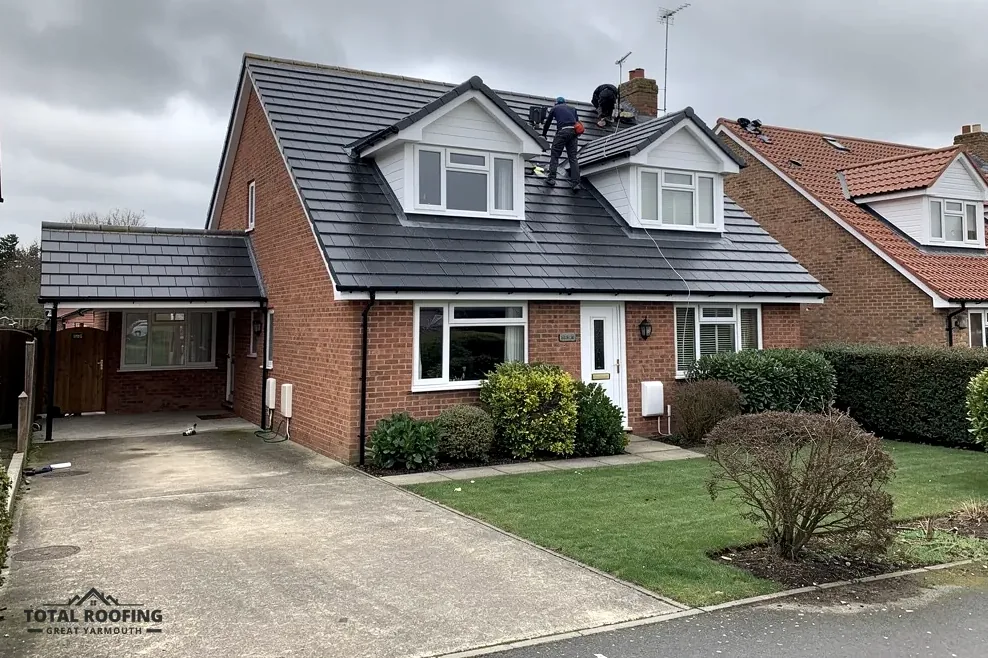
When removal ends and a re-roof begins
Foam goes on the underside of the roof, and the covering above it was not designed to have foam fixed behind it. Taking the foam off can therefore disturb the covering, the felt and the battens. Sometimes those parts come through in good order and the job ends once the foam is gone and new insulation is fitted. Sometimes they do not, and then repairing the roof means lifting the covering over a large area.
Whether a foam removal ends in a re-roof is not known until the foam is off, so any promise either way before then is a guess. What can be said is what decides it: how firmly the foam is bonded to the tiles or slates, what condition the felt and battens are in, whether the timber beneath has stayed dry, and how much of the roof has to be opened to put all that right. Our guide to rot and felt problems behind foam covers the timber side.
A re-roof is a bigger decision than a removal, because it brings in rules about how the new roof is built, who checks it, and what it costs. The sections below take those in turn, so you can judge the situation before anyone puts a figure in front of you. Our main page on spray foam removal gives the wider context.
Foam bonded to tiles and slates
Where foam has been sprayed up against the back of the tiles, it can grip them. Foam that has squeezed through gaps between tiles, or has set around the nibs and fixings, sticks the covering to the insulation, and pulling one away from the other can crack the tile or slate. Cracked pieces cannot go back on the roof, and lifting a bonded area can pull neighbouring pieces loose as well.
That is why the covering has to be assessed during a survey and again as the foam comes away. Whole tiles in good order can be cleaned and relaid, and broken ones need replacing. Replacement pieces are matched as closely as the product allows, but an older tile can differ in colour and profile from a new one, so a patch can show. Where the area affected is large, laying a complete new covering gives a more even finish than a quilt of old and new.
A foam-stuck covering also hides how the roof was behaving. A tile that has slipped or cracked can let water in unnoticed behind the foam, which is one more reason the survey looks at the outside of the roof as well as the loft. Our guide to how spray foam is removed explains the methods and what each does to the covering.
Why a covering can come off
- Foam set around tile nibs and fixings
- Tiles cracked as bonded foam is cut away
- Slates broken at the nail holes
- Torn felt exposed once the tiles lift
- Battens too soft to hold new fixings
- Gaps in the covering that let water in
Damaged felt and battens
The felt or underlay and the battens form the layer under the covering, and they are the parts hit hardest when moisture has been trapped. Felt that has stayed damp can turn brittle or tear, and battens can soften around the nails. The Energy Saving Trust (last updated 5 November 2026) says that closed-cell foam "doesn't let moisture pass through it easily" and that the rot risk "should be much lower with open-cell foam".
Once felt or battens fail, a repair cannot be made from underneath. The covering has to be lifted so the felt can be replaced and the battens renewed, and the old pieces are relaid, or new ones are used, afterwards. Over a small area that is a repair. Over a large area it is a re-roof in all but name, and it is priced and checked as one.
The replacement felt has to suit the roof too. Marley notes that underlay of the high-resistance type is not vapour-permeable, so in a cold roof it relies on eaves ventilation: 25 mm at pitches of 15° or less and 10 mm above 15°. Which underlay is chosen, and how the roof breathes afterwards, therefore belong in the quote and in the plan for the insulation that follows.
The Building Regulations tests for a re-roof
The Planning Portal sets a two-part test for re-roofing. Normally no building regulations application is needed while the work affects "Less than 25 per cent of the total 'building envelope'" and "Less than 50 per cent of the roof is affected." Both limits apply together. A full strip and recover goes beyond half the roof, which puts it outside that exemption whatever the covering is. A repair to one section is judged against the same two limits.
Two further points arrive with a re-roof. The Planning Portal lists a new covering material "which increases the weight of the roof covering by 15 per cent or more" as needing approval, and says to consult a structural engineer or surveyor first. Approved Document A treats it as a significant change when "the loading upon the roof is increased by more than 15%". Approved Document L paragraph 11.3 goes a step further. Renovate more than half of an element and the element as a whole is brought up "where feasible", which makes the insulation plan part of the same decision.
Building control is carried out by the council's building control team or by a registered building control approver. For a roof around Great Yarmouth, ask the building control team of the council that covers the address, and expect us to check the route with the council before work starts.
Myth
Foam removal always ends with the old covering going back on.
Fact
Only where tiles, felt and battens come through the work in sound condition.
Scaffold, access and old roofs
A roof that is being re-covered needs scaffold. Where scaffold obstructs the pavement or road, the county council grants a licence under section 169 of the Highways Act 1980, and we arrange the licence with our scaffolder. The scaffold forms part of the written quote, so there is no separate scaffold figure to compare.
An older roof raises one more check. HSE says: "If the building was built or refurbished before 2000, assume that there is asbestos in it." That does not mean a given roof contains any, since a roof of that age may have none, but it means the question is settled before sheets, soffits or boards are disturbed, not afterwards. HSE lists "asbestos cement products, (eg roof sheeting and rainwater goods) provided the material is carefully handled/removed without breaking up" as non-licensed work, while licensing covers most work on asbestos insulating board. Foam on a roof of that age can hide an older material beneath it, which is a further reason to survey before any stripping begins.
Weather needs a plan as well, and so does the house. Loft contents, water tanks and anything stored under the slope may need moving or covering before the roof is opened, and a surveyor can tell you in advance how much of the loft will be affected. A roof opened for repair is open to rain until it is covered again, and a foamed roof opened in sections gives a surveyor and a roofer the chance to cover each section as it is finished. Ask any firm you speak to how the roof is protected while sections are open, and what happens on a day when rain is forecast.
What a re-roof can cost, and what the figures leave out
Published prices for a whole roof depend on the size of the house, the covering and the access, and they say nothing about foam. They give a sense of the scale of the decision, not a price for yours. The sources cost foam removal on their own pages, so a re-roof after removal adds a second figure, and the combined total cannot be read off any guide.
Total Roofing Great Yarmouth surveys before quoting. Our survey takes in the whole roof, including parts you did not ask about, and we report what we saw without padding. The price after it is a single written total. Where removal turns up a failed covering, the quote says what that means for the work before it goes any further.
Treat every number in the table as a comparison point only, and ask each firm what its own price covers, so that two quotes can be set side by side on the same footing. Look in particular at whether the foam, the new felt and battens and the insulation to follow all sit within the one total. A bungalow and a three-storey house are priced differently, a steep roof costs more to reach than a low one, and a slate covering costs more than a concrete tile. None of that can be judged until someone has looked at the roof, which is why we survey first.
Published whole-roof figures
| Which?, entire roof | £7,000 to £21,000 excluding VAT, average three-bedroom house |
|---|---|
| MyJobQuote, new roof | average around £5,250 |
| HomeBuilding, 65m2 roof, plain concrete tiles | £10,000 to £15,000 |
Which? surveyed 11 traders in November 2025 and its prices exclude VAT. MyJobQuote's page (updated 3 November 2026) states no VAT basis. HomeBuilding was last updated on 30 September 2025. None of these includes foam removal.
Deciding before anything is opened
The order of decisions protects you. Take specialist surveyor advice first, as DESNZ recommends. Then let a roofing survey settle what the covering, felt and battens are like. Then ask for a written total price that says what happens if more of the roof has to come off than planned. Doorstep signing cuts across all of that, so decline it. If you sign at home once the survey is done, 14 days are open for cancelling, and a start before they run out needs a written request from you.
Lending belongs in the same conversation, and it is easy to leave until last. Ask your provider early which documents it wants about the roof and the foam, and whether it distinguishes between a roof that has had foam removed and one that still carries it. Keep every answer in writing, so you can show it to a surveyor or a later buyer, and do not assume that one provider's view is another's. DESNZ says removing foam "will not always guarantee that they will still lend", so ask your provider what evidence it wants about the roof before the work starts, because a re-roof that fixes the covering may still leave the lender with questions.
Once the roof is sound, the next step is insulation, and the choices there are separate ones about material, thickness and ventilation. Our guide to insulating the loft after spray foam removal takes them in order.
Order of decisions
- Get specialist surveyor advice on the foam first
- Have the covering, felt and battens assessed
- Ask what the quote says if more roof comes off
- Check the building control route with the council
- Ask your lender what evidence it wants
- Sign only after you have had time to read it
