
Why the survey comes before any decision
Spray foam goes onto the roof's underside as a liquid, then expands and sets in place. Once set, it covers the surfaces you would otherwise inspect: the rafters, the battens, the underside of the tiles or slates and the felt. That is why a survey matters. Until someone has examined what lies behind and around the foam, the choice between leaving it and taking it out is a guess, and a guess is a poor basis for spending thousands of pounds or for talking to a lender.
The government paper that DESNZ published on 22 October 2026 puts it plainly: "Before making any decision about your spray foam, you should take advice from a specialist surveyor." It adds: "The growth of the spray foam removals sector has also led to an increase in cold calls or unsolicited offers to sell or remove it." A survey you asked for, from someone with no wish to sell you a job on the doorstep, is the safer order of events. If an offer has already arrived by phone or at the door, our guide to spray foam cold callers covers what to do next.
Nothing here means the foam has to come out. Whether it should is a judgement about the timber, the covering, the type of foam and the lending position, and a survey is how those four get checked. Our main page on spray foam removal sets out the whole picture, and this guide stays with the survey step.
What a surveyor looks at on the roof
Surveying a foamed roof means looking at the whole roof and treating the foam as one element among several. The foam can be perfectly sound and still sit over a failing covering, or the covering can be fine while the timber beneath has a problem. Looking at the pieces separately is how a surveyor keeps the findings clear, and it is why the visit covers more than the foam itself.
The loft side comes first: where the foam has been applied, how thick it is, whether it runs over the rafters or only between them, and where it stops at the eaves and the gables. The outside follows, because a roof that leaks shows it there, and a leak behind foam can run unseen for a long time. A surveyor also notes the type of foam, since that changes the moisture question covered below.
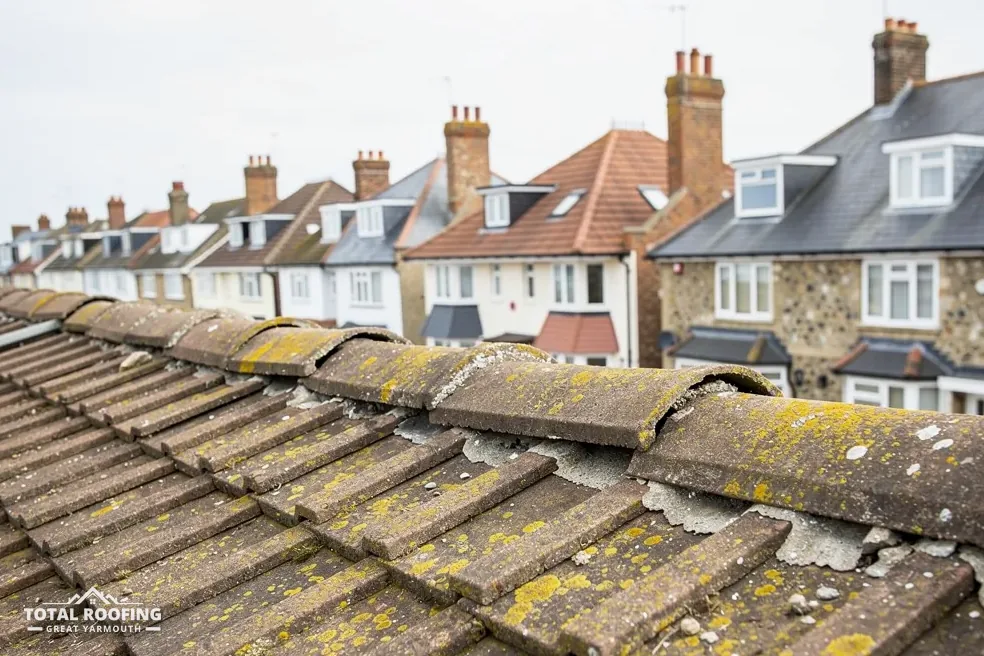
Roofing is not only about the foam, and neither is the report. Slipped tiles, cracked slates, loose ridge or failed flashings can all let water in behind insulation, so they belong in the same visit. Where foam has been sprayed hard against the back of the covering, a surveyor also records whether it appears to be holding tiles or slates in place, because that bears on how any later work is done.
What a foamed-roof survey covers
- Foam type, thickness and where it starts and stops
- Rafters and battens visible at the edges of the foam
- Felt or underlay condition where the foam can be seen
- Eaves, gable ends and the junction with the walls
- Slipped, cracked or bonded tiles and slates
- Signs of damp, staining or mould in the loft
What a survey cannot see
RICS, the professional body for surveyors, is direct about the limit. Its consumer guide states: "If the timber roof structure is covered with spray foam it cannot be fully seen or inspected". The report covers what can be reached and notes what cannot. A length of rafter that is wholly under foam is a length nobody has examined, however thorough the visit.
That limit decides what a surveyor writes down. Where foam hides the timber, the finding is that the condition is unknown, and the surveyor may recommend further investigation, such as opening a small trial area so a sample of timber and felt can be viewed. We describe how an area is opened in our guide to how spray foam is removed. Whether any sample is needed depends on the roof and on what the surveyor and the lender want to know.
For the owner the consequence is simple. A clean survey of a foamed roof does not show that the timber is sound, and a lender or a later buyer may read the report with that gap in mind. Equally, a survey that finds nothing wrong at the visible edges is useful evidence about those edges, and a reason to keep looking rather than a reason to panic.
Which foam is on the roof
The Energy Saving Trust (last updated 5 November 2026) names the drawback of closed-cell foam: it "doesn't let moisture pass through it easily". Moisture that gets into roof timber behind a layer like that has few ways out. For open-cell foam the Trust says "this risk should be much lower with open-cell foam", which is a statement about relative risk, not a statement that open-cell foam removes it.
So a surveyor wants to know which foam is on the roof. The type may be recorded on the paperwork from the original installation, or it may have to be judged on site from how the foam looks and feels when pressed. Our page on open-cell and closed-cell spray foam explains the two in full.
If you hold any paperwork from the installation, keep it to hand for the visit. The date of the work, the product name and the installer's details all help to settle the type of foam, and they help a lender or a buyer's surveyor too. A company that has since stopped trading leaves a gap in the trail, so gather what you have early rather than on the morning of the visit. Where nothing survives, say so to the surveyor, who can still judge the foam type from its appearance and from samples taken at the edges. A photograph of any label, tin or invoice that does survive is worth more than a guess from memory, and costs nothing to find.
Myth
Open-cell foam means there is no moisture risk to the roof timber.
Fact
In the Trust's words, "this risk should be much lower with open-cell foam", not gone.
Surveys, lenders and what removal does and does not settle
Lending is one reason for wanting a survey, so it helps to keep the sources apart. In March 2023 RICS reported "concern within specific sectors of the lending market, such as equity release mortgages". The DESNZ paper of October 2026 says: "Many mortgage providers are open to lending on properties with spray foam, subject to their own requirements." The Energy Saving Trust adds that spray foam "doesn't automatically prevent you from getting a mortgage, but some lenders may ask for extra checks".
A survey is one way of meeting an extra check. DESNZ also cautions that removing the foam "will not always guarantee that they will still lend", and that improper removal "could lead to further issues". A survey hands you facts to take to your own mortgage provider; it does not settle the lending outcome for you. Ask the lender what it needs, in writing where you can, before you pay for any work.
The same consumer guide has a line aimed at the earlier stage: "Do check with your mortgage provider whether their lender policy allows the installation of such products." Your own situation starts one step later, so put the question to the provider about the foam already in the roof, and ask what evidence it wants about the timber.
If you are selling instead of staying put, a buyer's surveyor will meet the same limit on what can be seen. Our guide to selling a house with spray foam takes that case on its own.
Survey cost, and how it leads to a removal price
MyJobQuote gives the average cost of a roof survey as around £300 (page last updated 12 October 2026). That is a general roof survey, not a survey of a foamed roof, and a house with foam across a large roof space or an awkward loft may be priced differently by whoever you ask. Treat the figure as a reference point and get the actual price from the surveyor before the visit is booked.
A survey and a removal quote are different jobs, and it is sensible to keep them apart. A specialist surveyor advises; a roofing firm that removes foam prices the work. When you are ready for a price, Total Roofing Great Yarmouth surveys the roof before quoting, covers the full roof instead of the single area you rang about, and reports plainly, adding any other fault we noticed. The written quote is one total price given after that survey.
The removal numbers in print come from third parties and are set out by the square metre, or for a stated house size, so they cannot price your own roof. MyJobQuote's average is £40 per m². For open-cell foam, Checkatrade (July 2026) puts the cost at "between £50 and £75 per m²". Neither is a total and neither should be multiplied by your roof area. Our page on spray foam removal cost gives each source with its date.
Getting ready for the visit
A little preparation makes a survey more useful. Clear a path to the loft hatch and to the foamed areas, so the whole roof space can be reached. Find anything from the original installation and any mortgage or insurance correspondence about the foam, because the lender's own wording tells a surveyor what the report has to answer.
If you want a first look before anyone visits, send photos of the loft and the underside of the roof by WhatsApp on 07880 284133 and we will look at what arrives. A photo cannot stand in for a survey, and it cannot show what lies beneath the foam, but it does show the colour, texture and spread of the foam, which helps to narrow down the type.
Write down anything you have noticed in the house: damp patches on ceilings, condensation on windows near the roof, a musty smell in a bedroom under the slope, or a drip after heavy rain. Those notes cost nothing and point a surveyor straight to the places worth a closer look. If the foam went on years ago, add what you remember of the roof before it: whether it leaked, whether the loft smelled damp, and whether any tiles had been replaced. A before and after picture of the roof's behaviour helps a surveyor judge whether a symptom belongs to the foam or was there already.
Before the survey
- Find the installation date, product name and installer details
- Ask your lender what it wants a survey to cover
- Clear the way to the loft hatch and the roof space
- Photograph the foam, eaves and any stains or mould
- Write down any leaks or condensation you have noticed
- Decline any firm that wants a signature on the doorstep
