
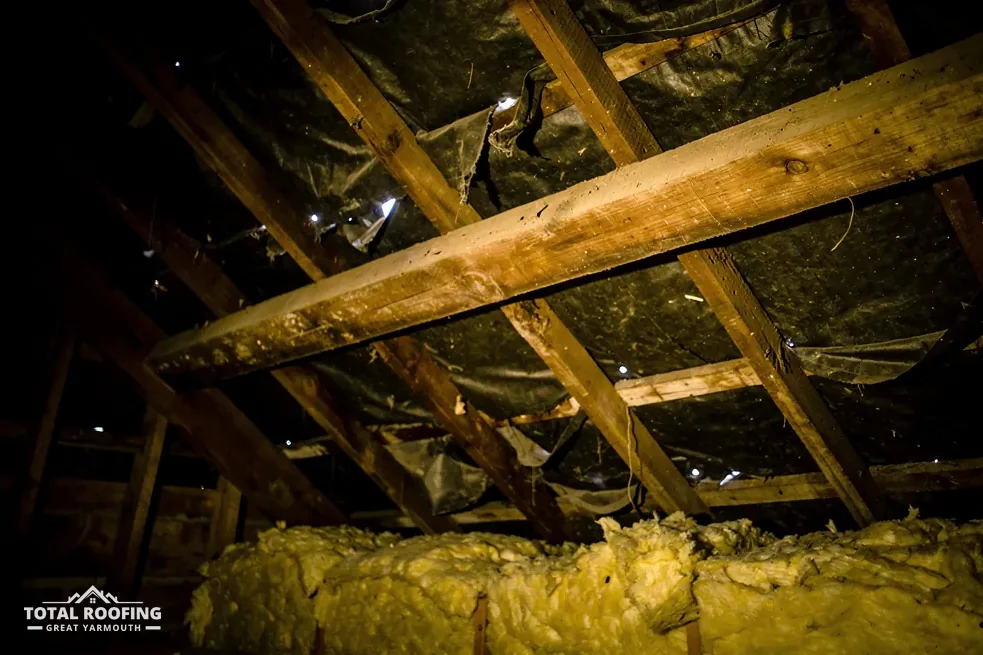
How timber ends up wet behind foam
Wood stays sound while it can dry. A roof timber that takes up a little moisture in winter and gives it back in spring is doing what timber does. Trouble starts when the moisture has nowhere to go for long periods. Warm air from inside a house carries water vapour, and where that air meets a cold surface the vapour turns to liquid. In a roof, the cold surface can be the back of the covering, the underlay or the face of a rafter. Foam applied to the underside changes where that happens and how well the area dries.
On closed-cell foam, the Energy Saving Trust (last updated 5 November 2026) puts it this way: "Its main drawback is that it doesn't let moisture pass through it easily." Moisture that reaches timber behind such a layer can stay there. For open-cell foam the Trust writes: "But this risk should be much lower with open-cell foam." Set against closed-cell foam that is a comparison, so open-cell foam is no cure, and each roof has its own mix of ventilation, house moisture and foam thickness.
None of this proves any particular roof has a problem. Foam on a well-built, well-ventilated roof may sit for years without any rot. Owners are told to take advice because the timber cannot be examined to settle the question: the RICS consumer guide states that a timber roof structure covered with foam "cannot be fully seen or inspected". Our guide to spray foam surveys explains how a surveyor works around that limit.
Signs that can point to a problem
A house can stay quiet until a problem is well along, which is why a foamed roof needs a deliberate check rather than a wait for a symptom. Even so, some signs are worth taking seriously. None of them proves rot, and each has other possible causes, such as a leaking tile or a blocked gutter, so treat the list as a reason to book a look, not a diagnosis.
Signs inside the house are the part an owner can see: staining on a ceiling below the slope, a smell of damp in an upstairs room, black mould in a corner, or condensation on windows beside the roof. In the loft, foam that has pulled away from a rafter, staining at the edge of the foam, or a rafter end that marks easily when pressed with a screwdriver are all worth noting. Do not poke at the foam itself, since a disturbed area gets harder to assess, and do not step between the joists in a loft that has no boarding: a foot through the ceiling below is a repair you did not need. Photographs taken from the hatch, with a torch held at an angle, show texture and staining well. Take them in the same spots now and again in a few months, because a change between two dated photographs tells a surveyor more than a single picture. Note too whether the stain is damp to the touch on the ceiling side, and whether it grows after rain or after a cold night, since those two patterns point to different causes.
Signs worth a survey
- Brown staining on a ceiling below the roof slope
- A damp smell in rooms beneath the slope
- Mould on walls or ceilings near the eaves
- Condensation on windows beside the roof slope
- Foam lifting away from a rafter or wall
- Soft, flaking or dark timber at the foam's edge
Felt, battens and the covering above
The timber is only part of what sits behind the foam. Over the rafters runs a layer of felt or underlay, then the battens that carry the tiles or slates. When foam is sprayed up to the underside, it can bond to the underlay and to the battens, and any moisture trapped there works on all three at once. Felt can go brittle or torn, and a batten can soften where it stays wet.
Ventilation is the other consideration. Marley's guidance on cold roofs, which follows BS 5250, sets out eaves ventilation of 25 mm at pitches of 15° or less and 10 mm above 15° where a high-resistance (HR) underlay is used, and adds that HR underlay is not vapour-permeable. A roof designed around a ventilated eaves path can have that path blocked if foam is packed against it, and checking whether this has happened is one of the jobs of a survey. CNC Building Control's easy guide to warm roofs says of a cold roof: "Ventilation is required for these roofs." Of a warm roof its wording is "No ventilation is required for these types of roofs."
A tile that has loosened above the foam also shows how the roof is behaving. The covering is not hidden, so a roofer can read it from outside: slipped tiles, cracked slates and ridge that has dropped may all let water in at points where the foam hides the evidence from the loft.
Roof layers in plain words
- RafterSloping timber that carries the roof
- BattenStrip of timber that holds the tiles
- UnderlayFelt or membrane beneath the battens
- CondensationWater vapour turning to liquid on cold surfaces
What is found when the foam comes off
Nobody can promise what lies behind a foamed roof until the foam is off, so if you are quoted a figure for how often damage is found, ask where it comes from and which roofs it was based on. What can be said is that the findings run from timber that is dry and sound, through surface staining that needs no work, to rafters, battens or felt that have to be replaced.
Foam that has bonded hard to the timber has to be freed from it, and that takes care, so the way the foam is taken off matters. Removal done badly carries its own risk, and the DESNZ paper says "improper removal could lead to further issues". The method has to suit the foam type and what the timber is like beneath it, and our page on how spray foam is removed sets out the approaches.
Because the outcome is unknown until the foam is off, a fair written quote leaves room for it. The firm explains what will be done if timber turns out to be sound, and what changes if it is not, before work begins. That is a better sign than a flat price that ignores the question altogether.
Two possible findings
Sound timber
- Dry, firm rafters
- Felt intact or easily replaced
- Battens hold fixings
- Covering reused where fit
Rot or decay
- Soft or crumbling timber
- Torn or brittle felt
- Battens fail at the nails
- Repair before recovering
How a timber repair is scoped
A repair starts with the cause. Timber that has been wet will not stay sound if the reason it was wet is still there, so a repair that replaces rafters and ignores the moisture path only restarts the clock. The cause may be a leaking covering, house moisture that has nowhere to go, or both, and the survey is meant to tell them apart.
Where a rafter or batten has decayed, the repair is local if the decay is local: the bad section is cut out and replaced, or a new timber is fixed alongside the weak one to carry the load. Where decay is widespread, a larger area of the roof structure and covering is opened. The size of the opened area, the difficulty of access and the condition of the felt above decide the cost, which is why nobody can responsibly price timber repair before the foam has been lifted. Damp wood needs time to dry before new insulation or a new lining goes over it, so the order of work needs planning along with the repair itself, and a roof opened to the weather needs covering again promptly. Ask any firm how it plans to protect the house while the roof is open, and what it does if rain is forecast on the day.
A repair on a few rafters is a different job from stripping and recovering the roof. Once a repair spreads past half the roof, the Planning Portal's re-roofing test stops covering it, and we check the building control route with the council before work starts. Our guide to re-roofing after spray foam removal covers when a repair grows into that.
From finding to repair
- Survey the roof inside and out before anything is opened
- Remove the foam from the areas the survey flags
- Examine the exposed timber, felt and battens
- Fix the moisture cause as well as the damaged wood
- Replace or reinforce what has failed, then recover the roof
Pricing, quotes and what to do next
Published prices for foam removal do not include rot, and they are not totals for your house. MyJobQuote's average is £40 per m² for spray foam removal, and it is a per-square-metre figure only, with no allowance here for timber work. Checkatrade's July 2026 guide gives £50 to £75 per m² for open-cell foam. Neither source says what repair costs, and neither number can be turned into a total by multiplying it up. Our page on spray foam removal cost gives each figure with its date.
Total Roofing Great Yarmouth surveys before quoting and covers the entire roof, even parts you did not mention, and then reports what was found in plain words. The written quote is one total price after the survey. Cancelling is open to you for 14 days if you sign at the kitchen table after a survey. An early start has to be asked for in writing, and asking does not take the right away. The one carve-out is an urgent repair visit that you requested yourself.
When you ask any firm for a price, ask how it deals with timber found to be decayed, and whether the quote says what changes if it is. A written answer you can read at home beats a verbal assurance on the day. To start with us, you can WhatsApp photos of the loft and any stains on 07880 284133. A photo cannot show the timber behind the foam, but it shows what is visible, and that is enough for a first look.
