
Call 01493 277103

Caister-on-Sea, 3.4 road miles north

Roofers in Caister-on-Sea

Caister-on-Sea is 3.4 road miles north of Great Yarmouth, seven minutes by road. A roof here is surveyed whole, the findings come back in plain terms, and Great Yarmouth Borough Council is asked which permission route fits the address before work starts.

Get a written quote

Call 01493 277103WhatsApp us

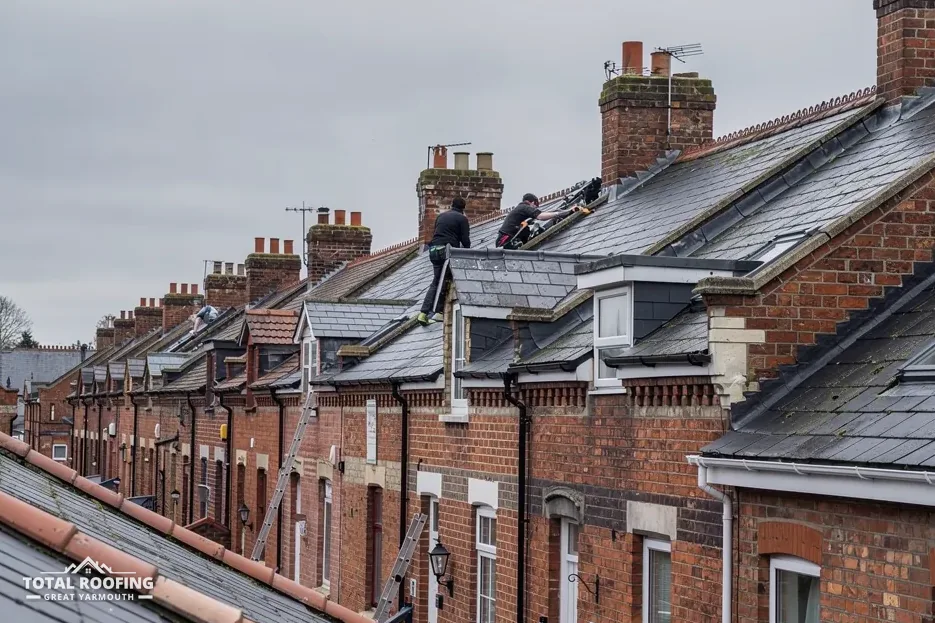
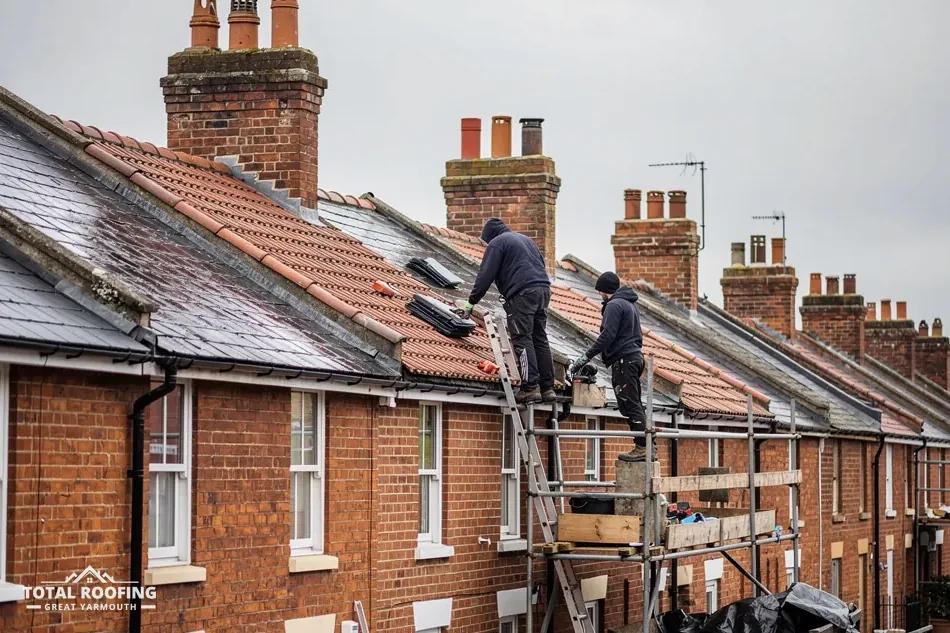
Roofers working along a row of brick Victorian terrace roofs
Victorian brick terrace street with slate roofs and chimneys

Caister-on-Sea: Holy Trinity, Caister House, a Roman fort

  • Nearby conservation areas

    Conservation areas lie nearby at Ormesby St Margaret and Halvergate Marshes. Whether a given Caister-on-Sea address is affected by one is for Great Yarmouth Borough Council to say, and it is worth asking before a covering changes. Check with the council whether an Article 4 direction applies.

    The survey proceeds either way: ridge, hips, verges, valleys, flashings, rainwater goods and the loft timbers, with a verdict on each part.

  • Holy Trinity and Caister House

    Holy Trinity, the parish church, holds a Grade II* listing (National Heritage List entry 1287563, first listed 4 March 1947). Caister House is Grade II (entry 1216588, first listed 4 December 1987), and so is the Cemetery Chapel at Caister Cemetery (entry 1216590).

    Seven listed buildings lie nearby. Where a property has a list entry, roof works that would alter its character need listed building consent.

  • A scheduled Roman fort

    The Caister-on-Sea Roman fort and Saxon settlement is a scheduled monument (National Heritage List entry 1015268). A scheduled monument is governed by its own consent regime, separate from listed building consent.

    Caister-on-Sea is a coastal town. GOV.UK's coastal erosion map shows the estimated risk for an area, and its long-term flood risk service describes an area, not an individual property.

Caister-on-Sea permissions: council, church, river edge

  • Planning: Great Yarmouth Borough Council decides; riverside or marsh land at the edge can be Broads Authority land.
  • Building control: check with Great Yarmouth Borough Council's building control team, or use a registered building control approver.
  • Conservation areas lie nearby at Ormesby St Margaret and Halvergate Marshes; ask whether an Article 4 direction applies.
  • Church of Holy Trinity, Grade II*: Church of England faculty system, not listed building consent.
  • Caister House and the Cemetery Chapel, both Grade II: listed building consent for works altering character.

The planning guide explains the permission tests, and a Caister-on-Sea property's route gets confirmed with the council before work.

Map of Caister-on-Sea and the places nearest to it. Map tiles © Esri; map data © OpenStreetMap contributors.

Ask it straight · Caister-on-Sea

Scaffold fees, asbestos, Holy Trinity and the river edge in Caister-on-Sea

Caister-on-Sea parish had 8,617 usual residents at the 2021 Census, which makes it a large place for a roofer to cover. Four rules can shape a roof job here: the scaffold licence, asbestos, the church and the edge of the Broads. Scratby and Ormesby St Margaret are the nearest, with Filby and Hemsby a little further out.

What does a scaffold licence involve for a Caister-on-Sea roof?

The short answer

Norfolk County Council issues it, charging £178.33 for the first 28 days; we arrange the licence with our scaffolder.

Scaffolding that stands on the footway, or reaches out above the carriageway, is caught by section 169 of the Highways Act 1980, which calls for a licence. The county council grants it, not the borough, and in Caister-on-Sea the county is Norfolk. Great Yarmouth Borough Council, which decides planning in the town, takes no part in it.

Norfolk County Council's fee is £178.33 for the first 28 days, and that figure again for every further 28 days. Its page asks applicants to "Please allow 7 calendar days for applications to be processed", and each time a scaffold is erected, a new application goes in. Finishing a chimney after a first phase, weeks later, therefore starts the process again. We arrange the licence with our scaffolder.

For a householder, that means a needed scaffold comes within the one total you are quoted. How the frame is laid out depends on the eaves height and the width of the pavement below, which is why the survey takes in the front elevation from the street as well as the loft. Our roof repairs page covers smaller jobs, some of which need only a short run of frame, and the licence period is set against how long the work will take.

Norfolk licence terms

Fee

  • Norfolk County Council: £178.33, 28 days
  • Same for each further 28
  • Set by Norfolk County Council

Timing

  • Allow 7 calendar days
  • New application each time
  • Frame laid out from the survey

Where can asbestos from a Caister-on-Sea garage roof go?

The short answer

Norfolk's recycling centres will not take it: Norfolk County Council does not accept any asbestos at its recycling centres.

Norfolk County Council states "We do not accept any type of asbestos at any of our recycling centres", and it points householders to a licensed specialist contractor for taking it away. For a Caister-on-Sea garage with a cement sheet roof, that rules out the recycling centre and leaves a question for the survey first: what is the material, and what condition is it in?

HSE's starting point is "If the building was built or refurbished before 2000, assume that there is asbestos in it." Where cement sheeting comes off whole, handled carefully, the work is non-licensed, and weathered sheeting that is otherwise sound counts the same way. Cement smashed by fire or flood damage moves into the notifiable non-licensed category (NNLW), while most work on asbestos insulating board (AIB) is licensed. HSE adds "AC roofs are always fragile", so no one stands on a sheet.

For scale, MyJobQuote's average asbestos removal for a roof in the UK is around £2,750 and an asbestos survey around £325, on a page last updated on 9 September 2026 with no VAT basis stated. MyJobQuote also puts the average 2026 garage roof replacement between £750 and £3,500. HSE says "Use a lockable skip for asbestos", and household asbestos is outside the consignment-note exemption. Garage coverings are covered on our flat roofing page.

Where asbestos can sit on a garage

  • Corrugated cement roofing sheets
  • Gutters and pipes moulded from cement
  • White board lining the soffit
  • Cement sheets hung as wall cladding
  • Sheets smashed by fire or flood

How is roof work at Holy Trinity, Caister-on-Sea, approved?

The short answer

Through the Church of England faculty system rather than listed building consent; outside alterations to Holy Trinity may still need planning permission.

Holy Trinity is listed Grade II* (National Heritage List entry 1287563). As a Church of England church in use it comes under the ecclesiastical exemption, so repairs go through the faculty system, and the church belongs to the Diocese of Norwich. That diocese is the first call for a parish with a leaking aisle roof or a failed length of lead.

The exemption replaces listed building consent only. Exterior changes that need planning permission go to Great Yarmouth Borough Council, and building control is the borough council's team or a registered building control approver. A scheduled monument follows another path altogether. The Caister-on-Sea Roman fort and Saxon settlement (entry 1015268) is scheduled, so any works have to be authorised as section 2 of the 1979 monuments legislation requires; Historic England receives the applications, and the Secretary of State decides.

Houses with a list entry take the secular route. Caister House (entry 1216588) and the Cemetery Chapel (entry 1216590) are both Grade II, so listed building consent from the council covers works "in any manner which would affect its character as a building of special architectural or historic interest". Whichever the building, every roof is read from ridge to gutter, with the findings reported in everyday terms. A church roof or a listed cottage is surveyed with the same attention to the leadwork and the timbers as any house, and the churchwardens or the owner are told plainly what each part needs.

Three heritage routes

  • FacultyChurch of England consent in place of listing.
  • Listed consentCouncil consent for works changing character.
  • Scheduled monumentAuthorised by the Secretary of State.

Who decides planning on Caister-on-Sea's river and marsh edge?

The short answer

Great Yarmouth Borough Council decides, but riverside or marsh land at the edge can be Broads Authority land, so check the address.

Caister-on-Sea lies outside the Broads executive area, though the boundary is close. Great Yarmouth Borough Council decides planning for the town. Riverside or marsh land at the edge can be Broads Authority land, so check the address: the Broads Authority says "We are the local planning authority for all land and properties within our executive area", and a plot on that edge may be covered. Whether a given address on the marsh side falls in or out is a question answered by the council and the Authority, not by the survey.

Where an address at the edge could lie inside the Broads executive area, the Broads Authority is the body to ask, and its planning line is 01603 610734. The Authority is not a building control body. Building control stays with Great Yarmouth Borough Council's team or a registered building control approver whichever planning answer applies, and the Building Act 1984 defines a local authority as the council of a district.

For the roof itself, nothing changes with the planning answer. The covering, the flashings, the gutters and the timbers get the same survey, and what it finds is put plainly. Our roof replacement page covers whole-roof work, and the price that follows is one total. The planning guide has the rules on enlargements, so a loft or dormer idea goes there first, before anyone draws it up or orders anything.

Checking an edge address

  1. Note whether the plot touches river or marsh
  2. Ask Great Yarmouth Borough Council about planning
  3. Ask the Broads Authority if land may be inside
  4. Building control stays with the borough council

Caister-on-Sea fixings, verges, safety duties and VAT

How are tile fixings set on a Caister-on-Sea roof?

Fixings are calculated for the site's exposure under BS 5534. Marley says the code's minimums give way to a fixing specification that is site specific, and that installing to BS 5534 "isn't required by law". Since the 2015 amendments, mortar alone is no longer relied on to hold a covering, and the ridge and hips are fixed mechanically against the calculated uplift. Exposure here is judged from the roof and its position on the site, not assumed from the town's name.

What does a dry verge system cost around Caister-on-Sea?

MyJobQuote says a dry verge installation usually falls between £500 and £2,000, on a page last updated on 8 October 2026 with no VAT basis stated. The standard for these systems is BS 8612:2018. A written price for a Caister-on-Sea house is one total after the survey, so it does not come from a range like that. The roof windows, verges and ridges on a house are each looked at on the survey, so the price covers the whole roof and not a single edge of it.

Who carries the safety duties on a Caister-on-Sea re-roof?

Under CDM 2015 the duties of a domestic client are carried by the contractor, or by the principal contractor if there is more than one, and a construction phase plan is drawn up for every project. HSE defines a domestic client as a person having construction work carried out on their own home, other than in the course of a business.

Will the VAT reverse charge appear on my Caister-on-Sea bill?

No. The domestic reverse charge only touches supplies of services reported within the Construction Industry Scheme, which means between VAT-registered businesses, and it never appears on a homeowner's bill. Insulation in roofs or lofts has its own zero rate under HMRC Notice 708/6 for supplies made between 1 May 2023 and 31 March 2027. A roof covering or repair is not on the HMRC Notice 708/6 list of energy-saving materials.

Can I cancel after agreeing to a roof job at home?

Yes, for 14 days starting the day after the contract is made, unless you asked us to attend an urgent repair. Citizens Advice describes that exception as inviting the business into your home for urgent repairs or maintenance. Your right survives a written request for an earlier start, and you could owe for what has been done.

A Caister-on-Sea roof priced in writing

Tell us about your roof

10-year workmanship guarantee, in writing

Call WhatsApp Written quote