
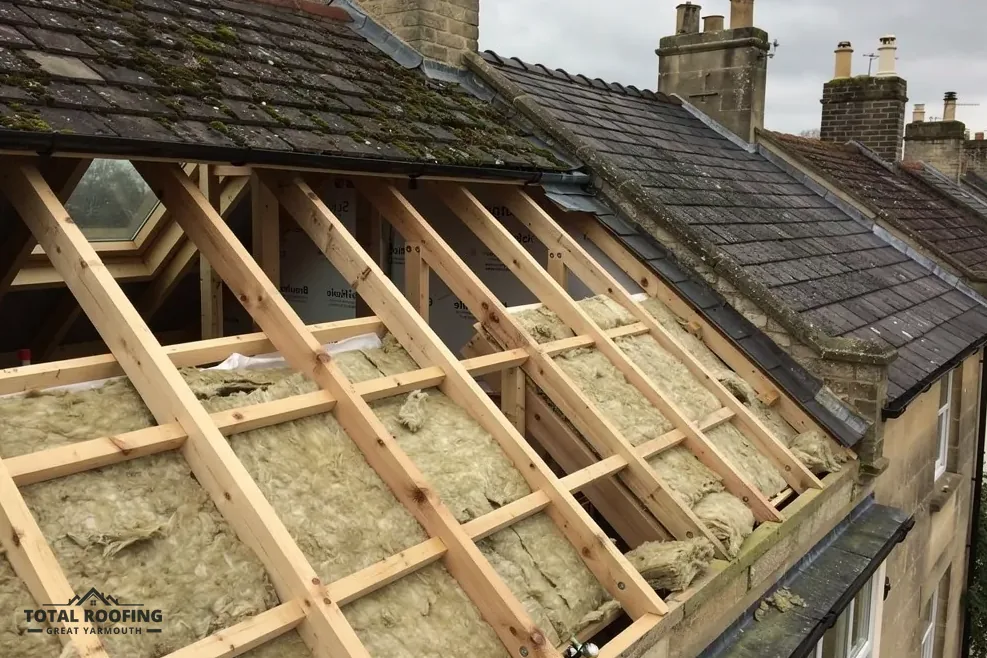
What the felt does on a pitched roof
On a pitched roof the tiles or slates are not the only thing keeping weather out. Beneath them sits a second layer, laid over the rafters and held down by the battens that the covering hangs from. In older roofs that layer is bitumen felt: a sheet soaked or coated in bitumen, rolled out in strips with overlaps between them. Its job is to catch wind-blown rain and snow that gets past the covering, and to let it run down to the gutter instead of into the loft.
That makes the felt a working part of the roof, even though nobody sees it from the street or from the ground. It is not the same thing as the torch-on felt used on flat roofs, which does the work of the whole roof covering and has its own guide under flat roofing. This page is about the felt behind a pitched covering.
When foam is sprayed up under the roof, it is applied to the underside of the rafters and, in many lofts, directly against this felt. Once the foam has set, the felt can no longer be inspected from inside. Where the foam is bonded to it, the felt is also no longer free to move or to dry out in the way it would in an open roof space.
Why you can no longer check it
A line in the RICS consumer guide on foam reads: "If the timber roof structure is covered with spray foam it cannot be fully seen or inspected". The same limit applies to the felt that lies against that timber. A survey can note the felt where the foam stops, at the eaves or at a gable, and can comment on a loose edge or a torn strip. It cannot report on a stretch that is wholly hidden.
That gap matters because old felt that fails will not announce itself. A leak through a worn strip may run down the face of the foam and soak into the rafter behind it, with no stain in the loft for a long while. By the time damp shows inside, the water may already have travelled some way. For that reason the outside of the roof deserves as much attention as the loft: a slipped tile, a cracked slate or a loose ridge matters more when the layer behind it cannot be relied on.
If the loft was foamed some years ago, the age of the felt is a question worth asking. Whoever had the foam applied may not have looked at the felt first, and the paperwork from the installation, if it survives, may not mention it. Our own approach is to survey the roof before quoting, and that survey covers the felt wherever it can be reached.
Where felt can still be checked
- Where the foam stops at the eaves
- Where the foam stops at a gable or party wall
- Around hatches, vents and pipes through the roof
- At the edge of any trial opening
- Underlay edges visible at loose or missing tiles
How old felt can fail behind foam
Felt can wear out for reasons that have nothing to do with foam. It can crack where it is stretched across a batten, tear at a nail, or go brittle with age. Foam can then add to the problem in two ways, and both are worth stating carefully. A leak behind it has fewer places to show itself. And the moisture that does get in has fewer ways out.
The Energy Saving Trust (last updated 5 November 2026) says of closed-cell foam that "Its main drawback is that it doesn't let moisture pass through it easily." It adds that for open-cell foam "this risk should be much lower". Those lines are about the foam, and they refer to timber rot, but they point at the same question for the felt: where does water go once it is behind the foam, and how long does it stay there.
The published felt lifespans are for flat roofs, a different product doing a different job. HomeBuilding gives felt 10-15 years, while Less gives torch-on felt 10 to 20 years and ties that to quality and installation. The two differ, and neither describes the layer hidden under tiles. Treat them as a reminder that bitumen products age, not as a date for your roof.
Because of that, the condition of the felt is judged by looking at it, never by working out its age. Where foam has made looking impossible, the honest finding is that the felt's condition is unknown.
Myth
Felt that was sound when the foam went on will still be sound now.
Fact
Behind foam nobody can see it, so its condition is unknown until a section is opened.
What removal does to the felt
Taking foam off is a hands-on job. Crews cut and scrape the foam off the rafters and the roof's underside, and where it has bonded to felt the two can part badly. A strip of felt that was already weak may tear or lift away with the foam. That is not a sign of poor work. It is a consequence of removing a material that has set against another one, and it is the reason a surveyor wants to know what is under the foam before a price is given.
The DESNZ paper adds "improper removal could lead to further issues", and a torn underlay is one example of what that can mean. Our guide to how spray foam is removed describes the stages, from access to a look at the timber once it is uncovered. The felt is judged at the same time, and the roof is then repaired or recovered according to what the opened areas show.
There are three broad outcomes for the felt once the foam is gone. It may be sound and can stay, with local patching of any torn laps. It may be failing across part of a slope, so that part of the underlay is replaced. Or it may be failing across the roof, in which case the roof needs new underlay and the covering has to come off to fit it. Which of the three applies is found by looking, not by guessing, and the written quote follows that look.
When new felt means lifting the covering
Felt sits under the battens, and the battens sit under the tiles or slates. There is no way to put new underlay beneath an existing covering without lifting that covering first. Where the whole roof needs new underlay, the work is a full re-cover: the tiles or slates come off and are checked, the old felt and battens are stripped, and new underlay and battens go on before the covering is fixed again or a new one is laid. Our guide to re-roofing after spray foam removal covers that decision.
A repair needs less. A section of torn felt on one slope can sometimes be dealt with by lifting only the tiles above it, and our guide to repairing roof underlay sets out when that is possible. A full re-cover is a bigger job, and it brings Building Regulations into the picture. Under the Planning Portal's guide, re-roofing does not normally need a building regulations application if it affects "Less than 25 per cent of the total 'building envelope'" and "Less than 50 per cent of the roof is affected." A whole-roof re-cover affects more than 50 per cent of the roof, so ask the council's building control team which route applies before anything is booked.
Approval is separately triggered, the Portal says, by a new covering that raises the weight of the roof covering by "15 per cent or more", and a structural engineer or surveyor check is advised beforehand. That matters if a different covering is being considered at the same time as new felt, and our guide to spray foam removal cost explains why the price of a recover cannot be stated before a survey.
Choosing the new underlay and the ventilation that goes with it
New underlay is not always another roll of bitumen felt. Modern roofs may use a breathable membrane, and our guide to breathable membrane against felt compares the two. The choice affects how the loft is ventilated, so it is made with the insulation in mind and not afterwards.
Marley's BS 5250 guidance shows how the two are linked. Where a cold roof carries a high-resistance underlay, it asks for an eaves opening of 25 mm up to a 15 degree pitch, and 10 mm above that pitch. Such an underlay is not vapour-permeable, which is why the opening matters. A different type of underlay brings a different requirement, so the product's own data sheet is the thing to read before anything is ordered.
This is also where the insulation question comes back in. If the foam has gone and the roof is being recovered, the loft will need insulating again, and the underlay and the ventilation have to suit whatever goes in. We deal with that in our guide to insulating the loft after spray foam removal, and the order is worth settling with whoever is doing the work before the covering goes back on.
Fixings come into it too. BS 5534 is the standard for slating and tiling, and Marley says that installing to it "isn't required by law". It also says that since the 2015 amendments, mortar "could no longer be relied upon as the only means of securing the roof covering". Fixings are calculated for the site's exposure under BS 5534, which is one more reason to treat a recover as a specified job and not a patch.
Order of work for a full re-felt
- Survey the roof, outside and in the loft
- Strip the covering and lift the old felt
- Fit new underlay and battens to the specification
- Set eaves and ridge ventilation to the product data
- Refix the covering to BS 5534
- Insulate the loft to suit the new layers
Questions to settle before any work on the felt
The foam, the felt and the covering are three separate questions, and they are worth answering in sequence. Start with what you know: when the foam went on, which type it is, whether any paperwork survives and whether any leaks have shown. Then have the roof looked at by someone with no interest in selling you a particular answer.
The DESNZ paper tells owners to see a specialist surveyor ahead of any choice on the foam, and it records a rise in cold calls, and in unsolicited approaches to sell the work or remove the foam. A caller who says your felt is rotten behind the foam cannot know that from the doorstep, because neither can anyone else without opening the roof. Our spray foam removal page sets out how the whole job fits together.
A visit from us starts with the full roof, foam and felt included, and any other fault we spot is reported to you as well. A photo of the loft or the eaves sent on WhatsApp on 07880 284133 gets looked at first. The written quote that follows the survey gives one total, which covers the work the roof needs, whether that is a patch or a recover. If the foam is staying, the survey can still say what the outside of the roof needs.
