
The short answer
It is a demanding job rather than an impossible one. Closed-cell foam grips harder than open-cell, tight eaves limit access, and foam bonded to tiles or battens has to be freed without breaking them. A roof survey shows which of these apply before a price is given.
The type of foam sets the first limit
Open-cell and closed-cell foam behave differently under a cutter. Open-cell foam is light and sponge-like, and it can be pulled and trimmed away in pieces. Closed-cell foam cures into a dense, rigid layer that holds fast to timber and to the backs of tiles, so it has to be cut through and worked off in strips.
The Energy Saving Trust gives the building-physics side of the same split. Closed-cell foam, it says, "doesn't let moisture pass through it easily", while for open-cell foam it says "this risk should be much lower" than with the closed kind, as far as timber rot is concerned. Our guide to open-cell against closed-cell spray foam explains how to tell them apart, and what that means once the cutting starts.
If you do not know which you have, a photograph of the foam in the loft sent to 07880 284133 on WhatsApp lets us see the foam before we visit.
Access and the shape of the loft
A roof with a generous loft, good headroom and a clear route to the eaves is easier to work in than one with a low pitch, a cramped crawl space or a conversion built around the rafters. Foam sprayed hard into the angle where the rafters meet the wall plate is the hardest to reach, because the cutter has to be worked in a space with almost no room to move.
The roof's shape also matters from outside. Hips, valleys and dormers add awkward corners, and each has foam packed into it. Where the underside of the roof is lined with boards or plasterboard, those linings may need to come away to reach the foam, which adds a stage before the real work begins.
A person with the right kit can work only so far in cramped spots. That is why a visit to the loft comes before a price: guessing at access from a photograph alone is how a quote ends up too low or the work stalls.
Foam bonded to tiles, battens and underlay
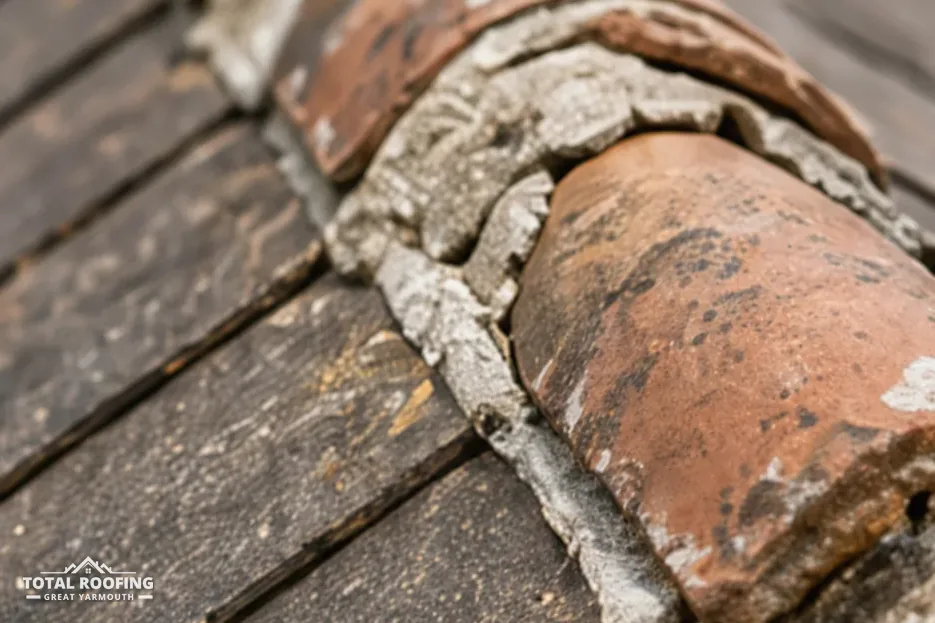
The hardest case is foam pressed right up under the tiles or slates by the spray gun. Once set, it can hold tiles in place and key itself into the underlay and battens. Removing it means freeing it without cracking tiles, tearing the underlay or splitting battens, and some of those parts may need replacing as the foam comes away.
The October 2026 DESNZ policy paper warns that improper removal "could lead to further issues". That is the reason these jobs are not left to the owner with a knife. Our page on how spray foam is removed sets out the stages in order, and the spray foam surveys page explains what a survey looks at before the work.
A roof where the foam sits only on the rafters, clear of the tiles, is a gentler job, and the survey tells you which of the two you have. One where it spreads over the tiles' backs is a slower and costlier one.
What the clear roof then needs
Difficulty does not end when the last piece of foam leaves the loft. The roof is then open for inspection, and the stage that follows needs as much care as the removal itself, and RICS says that where the timbers are buried in foam they "cannot be fully seen or inspected" while it is in place. Whatever has been hidden is now visible: sound wood, or wood that needs attention, along with any holes punched through the underlay by the spray. A second look at the covering from inside the roof is possible at last.
From there the work might include:
- refitting or replacing tiles, slates and battens that did not come away cleanly;
- patching or renewing the underlay;
- adding new insulation that suits the roof;
- checking that air can move through the eaves and ridge.
Cost follows the difficulty. Published figures for removal sit on our spray foam removal hub and its cost page, each with its source and date, and Total Roofing Great Yarmouth gives its own price as a single written total after the survey. The roof itself fixes that total, which is why the difficulty has to be seen before anything is priced.
