
Look after people before the house
A roof can be mended; a person hit by a falling slate cannot. Start by finding out whether anyone is hurt and whether the building is safe to be in. If somebody is injured or in danger, call 999. If the damage looks like a fallen chimney stack or a section of roof hanging off, keep everyone clear of the ground underneath and of the garden below it, because loose material can drop long after the gust that shifted it.
Inside, the main hazard is a ceiling that has taken in water. Plasterboard soaked through becomes heavy, and it can bulge and then fall with little warning. A ceiling that is sagging, or has a dark, swollen patch with water running from it, is not a place to stand. Move people and furniture out of the room, shut the door and leave it alone until a roofer or a builder has looked at it. If the ceiling is bowed, a small hole made well to one side with something long, standing out of the line of the bulge, lets the water run out into a bucket instead of coming down all at once. Only do this if you can stay clear of the drop.
Do not climb onto the roof, onto a flat extension roof or up a ladder to look. Wet slates and tiles are slippery, the wind may not have finished, and a person who falls from a roof in a storm has made the problem worse. Look from the ground, from an upstairs window or with binoculars, and let a roofer judge the rest.
Safety checks before anything else
- Check that everyone is accounted for and unhurt
- Keep clear of fallen or leaning chimneys and loose slates
- Leave bulging, wet ceilings alone and close the door
- Stay off the roof, the ladder and any wet flat roof
- Call 999 if anyone is hurt or in danger
Water and electrics: the second round of damage
Water and electrics do not mix, and a leaking roof puts both in the same place. If water is coming through near a ceiling light, a loft hatch with wiring above it, a socket or a fuse board, treat the circuit as live and unsafe. If the consumer unit can be reached without standing in water, switching off the affected circuit is a sensible step. If you cannot reach it dry, stay away and ring an electrician. A light fitting full of water should not be switched on to see whether it still works.
For the water itself, the aim is to catch it and move what it would ruin. Put buckets, bowls or a washing-up tub under each drip, and lay a towel in the bottom so that the noise does not drive you mad and the splash does not spread. Pull furniture, bedding, books and electrical items clear of the wet patch and cover what cannot move with plastic sheeting. Roll back a wet carpet if you can do it without hurting your back, because trapped damp is what leads to staining and mould later.
If water is running down a wall or through a chimney breast, or if damp has reached an upstairs light or the loft, note where it appears and roughly when. That information tells a roofer where to start looking. A roof leak need not show where the hole is: rain runs along rafters, battens and felt before it drips, and the stain on the ceiling can sit a metre or more from the opening. Photograph the damp area, and do not drill or poke a hole in the ceiling to find out more.
Photograph everything before anything is moved
Photographs are the most useful single thing you can do in the first hour, and they cost nothing. The Financial Ombudsman Service says that to decide whether a claim is covered it will usually look at expert reports and photos. Photos taken before anything is tidied or thrown away show what the storm did, and they show it to the insurer, to a roofer and, if there is a dispute, to the ombudsman.
Start with wide shots that show where each piece of damage sits, then move in for close-ups. Cover the garden and the street too, not only the roof: slates in a flowerbed, a gutter hanging off, a fence panel down, a neighbour's tile on your drive. Photograph the ceiling and walls inside, the wet carpet and the damaged belongings, before you move them. If you can read it, note the date and the time on the first picture. Do not climb up to take pictures; a phone zoom from the ground or a window does the job.
A roofer who looks at the photographs can also tell you something before the visit. A picture sent to 07880 284133 gets looked at by us, which gives a first idea of the size of the problem. It does not replace a survey, because the price is written after one.
How to build a photo record
- Wide shots of the house and garden first
- Close-ups of every damaged area, outside and in
- Photograph belongings before they are moved
- Note the date and what the weather was doing
- Keep the originals; do not edit or delete any
Tell the insurer, and know what counts as a storm
Read your buildings insurance policy, or find the policy number and the claims line, and tell the insurer about the damage. Insurers want to be told, and the policy may set out how and when. Contents cover can sit under a separate heading from buildings cover, so ask about both if carpets, furniture or electrics are wet. Keep a note of who you spoke to, the date and any reference number.
The wording of the policy matters because a policy can cover "storm" damage specifically. The Financial Ombudsman Service, which handles complaints about insurers, sets out how it approaches the word: "Rain, hail or snowfall by itself can constitute a storm." The Ombudsman adds "a storm usually involves violent winds, usually with rain, hail or snow". The insurer, it says, has to prove that an exclusion applies, such as with an inspection report. A claim is a matter between you and your insurer, and a roofer cannot promise how it will be decided.
If a claim is turned down or you are unhappy with the way it was handled, take the complaint to the insurer in the first instance. On timing, the Ombudsman Service gives a business up to 8 weeks to consider a complaint, and then allows you 6 months from the final response letter to take the matter further. The Financial Ombudsman Service can be reached on 0800 023 4567. Our page on storm damage and home insurance goes through the steps in more detail.
Making the roof safe: what a temporary repair is
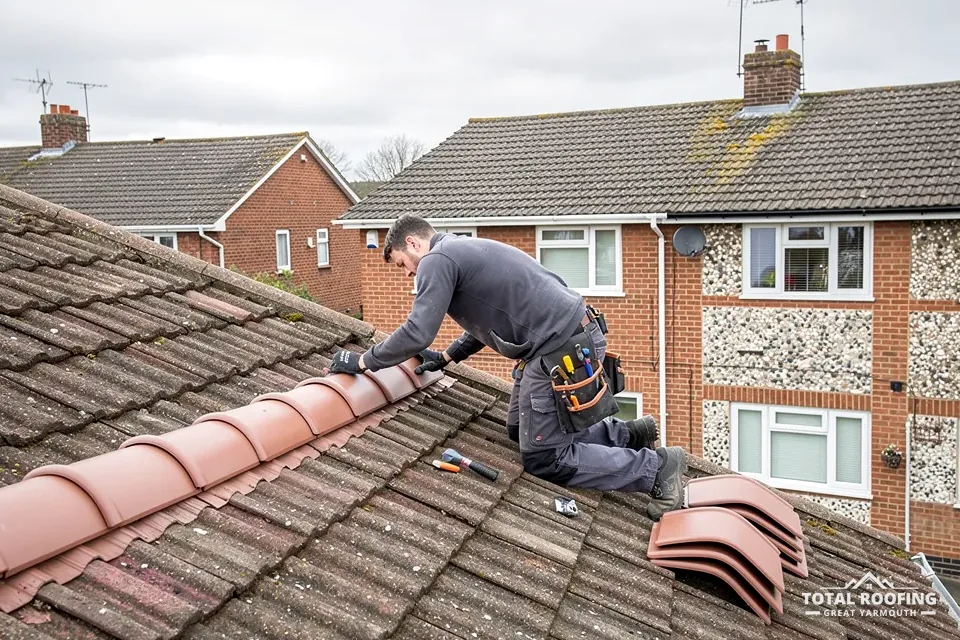
Once people are safe and the evidence is on a phone, the roof needs to stop letting rain in. A temporary repair is a make-safe job: a roofer covers the opening, refixes loose slates or tiles, or sheets over a section so that the weather stays out until the permanent repair can be done. It is a stopgap, and the price of the permanent job comes later. Our guide to making a roof safe describes what that covers.
MyJobQuote's page on emergency roofers (last updated 22/10/26) says that "Emergency roofer call-out costs typically range from £150 to £300, while extensive storm damage repairs can cost £1,200 or more." Those are third-party figures for the country as a whole, and the two numbers describe two different things: a call-out and a larger repair. The cost of your own roof depends on its height, its access and what the survey finds once the damage is opened up.
The question after a storm is whether a roofer can come out today. A time cannot be promised until the damage has been seen. What helps is a clear description: how big the damage is, where the water is coming in, whether there is access from the ground and whether anyone is at home. A photo on WhatsApp helps more than a long phone call. Ring 01493 277103 and describe what you can see.
Third-party figures for emergency roofing
| Emergency roofer call-out | £150 to £300 |
|---|---|
| Extensive storm damage repairs | £1,200 or more |
MyJobQuote, emergency roofer cost guide, last updated 22/10/26. No VAT basis is stated.
Your cancellation rights on an urgent repair
A roofer who is called out in a storm is in a different legal position from one who knocks on the door. Under the Consumer Contracts Regulations a contract that is signed with the roofer in your house can be cancelled within 14 days. The regulations put it this way: the cancellation period ends at the end of 14 days after the day on which the contract is entered into. To start work inside that window you must put a written request in, and you may still owe payment for the part already completed.
There is an exception. Regulation 28 removes cancellation rights if the consumer has specifically requested a visit from the trader for the purpose of carrying out urgent repairs or maintenance. Phone a roofer about a ceiling that is letting water through and ask for a visit, and you have requested an urgent repair yourself, so no cancellation right attaches to that visit. A roofer who calls at the door to say your roof is damaged is not in that position at all.
None of this stops you from taking a second opinion on a large permanent job once the roof is watertight. The temporary repair and the permanent repair are two separate decisions, and a calm look at the written description and the one total price before agreeing the second is sensible. Our page on urgent repairs and cancellation rights sets out the rules in full.
After the roof is covered
A make-safe job is the start. Once the weather settles, the roofer surveys the whole roof, because a storm that lifts one slate has put stress on the roof around it, and the damage you can see from the ground may not be the whole of it. The survey looks at the area that was hit and at the parts around it: ridge and hip tiles, the lead and flashing details where roof meets wall or stack, valleys, the felt or membrane under the covering, the battens and the gutters. The findings are told plainly, including anything else that was seen, alongside the written price. For a wider picture of this kind of work, see our emergency roof repairs section, which covers what counts as an emergency and how a temporary repair turns into a permanent one.
Hold on to every record. The photos, the policy number, the insurer's reference, any report from a surveyor the insurer sends and the roofer's written description all belong in one folder. If the insurer asks for a quote, the written description of the work and the one total price are what they need to see. The same folder is useful if the damage turns out to be wider than it looked on the night, and if you have to compare more than one quote, our guide to reading a roofing quote helps.
