
Defining a storm, for a roof
People use the word loosely, but insurers and the people who settle disputes with them use it with some care. The Financial Ombudsman Service says: "We say that a storm usually involves violent winds, usually with rain, hail or snow." It adds that "Rain, hail or snowfall by itself can constitute a storm". Both sentences matter to a roof. Wind is the force that lifts, twists and peels, but rain, hail and snow bring their own kinds of harm, and a roof can be damaged in several different ways in one weather event.
For a homeowner this means a roof can be damaged without the weather having a dramatic name. A strong gust can lift a ridge tile that was already loose. A long, hard spell of rain can run in behind a flashing that had cracked. Hail can crack old tiles. Because no wind statistic is a reliable guide to what happened to your particular roof, the useful step is to look at the roof itself, after the weather has eased, and note what has changed.
Storm damage can be a mix of visible and hidden faults. The tile on the lawn is visible, but the loosened tiles either side and the wet batten beneath may not be. That is why a repair after a storm starts with a survey covering each slope, and why we look beyond the single fault you noticed.
Lifted and blown ridge tiles
The ridge is the apex line where two slopes meet, capped by ridge tiles that shed water over the join. It stands at the highest and most open point, so wind acts on it directly. A ridge tile that has lifted, shifted or fallen leaves an opening along the apex, and rain can run onto the underlay and the timber below.
How a ridge is held matters. Marley's fixing guidance, which draws on BS 5534, says that "ridge or hip tiles should be mechanically fixed to resist the calculated wind uplift force". A ridge that was bedded in mortar and has cracked can therefore be rebuilt with a mechanical fixing, or with a dry-fixed system of the kind BS 8612:2018 specifies. The survey says which fits your roof.
A repair of one lifted ridge tile is a small job, while a ridge that has moved along a length of roof needs more work and more checking underneath. Which? Trusted Traders give £80 to £300 for a new ridge tile, excluding VAT (November 2025). MyJobQuote says an average ridge tile replacement costs between £225 and £550 in 2026. The next section sets them beside the other published ranges. Hips are priced after a survey.
Myth
A ridge bedded in mortar alone is held on securely.
Fact
Mortar, since the 2015 amendments, could no longer be relied upon as the only means of securing the roof covering.
Published ranges for storm repairs
Prices for storm repairs vary with the job. MyJobQuote's emergency roofer page (22 October 2026) says: "Emergency roofer call-out costs typically range from £150 to £300, while extensive storm damage repairs can cost £1,200 or more." The second half applies to extensive damage and not to a single broken tile, and the £1,200 figure is not a price for every storm repair.
Which? Trusted Traders, surveying 11 traders in November 2025, give £75 to £400 to replace one to six broken or missing standard roof tiles, with VAT left out of the figure. These are smaller jobs than extensive damage, which is why the ranges are so far apart. Ranges like these show the scale of a job; they do not replace a figure from someone who has seen your roof, and our quote is one total price in writing, set after the survey.
Keep in mind that a call-out pays for attending, while the lasting repair is a separate figure. Check the date on any cost guide, because prices move, and compare like with like: a ridge tile is not a stripped slope, and the repair of one tile is not the repair of a roof. Which? and MyJobQuote also gather their figures differently, so read each range as a rough guide to scale, never a quote for your own roof. The figures change over time, so read the dates in the note beneath the table along with the numbers.
Each range answers a different question. A call-out figure is for attending. A repair figure is for mending. The extensive-damage figure is for a roof that has lost large areas of covering, battens or flashings. Match the range to your own damage before you let it shape your expectations, and treat a figure that is far below or far above the published range as a prompt to ask what has been left out or added.
Storm repair ranges, as published
| Call-out for an emergency roofer | £150 to £300 |
|---|---|
| Extensive storm damage repairs | £1,200 or more |
| One to six broken or missing tiles | £75 to £400 |
| One new ridge tile (Which?) | £80 to £300 |
| Average ridge tile replacement (MyJobQuote) | average £225 to £550 |
MyJobQuote emergency roofer page, 22 October 2026, and ridge tile page, 1 October 2026 (no VAT basis stated). Which? Trusted Traders, 11 traders surveyed, November 2025, excluding VAT.
Verges, gable edges and blown tiles
A verge is where the tiles end at a gable wall, along the sloping edge of the roof. Wind can get under a verge tile and lift it, and a verge that has been pointed in mortar can crack or crumble and let the edge loosen. BS 8612:2018 specifies dry-fixed systems on ridges, hips and verges, where mechanical clips hold the tiles rather than mortar alone. After a storm, a gap along a verge is worth a look from the ground, for missing pieces and for a ragged edge.
Blown tiles are the next kind of damage: single tiles or several, slipped out of line or missing. Each tile is held by its own fixing and by the tile above, so one that has gone leaves the neighbours more exposed. The tiles adjoining the gap are the ones to check. A broken tile that is replaced with a matching one restores the covering, but the survey should look at the underlay and the battens below it, since a wet batten needs attention too.
Tile fixings are set by a site-specific fixing specification under BS 5534, which allows for how exposed the roof is. Marley lists location and local topography among the factors, so the survey looks at where the house stands and what covers it before any repair is specified. A wind speed or a map reference cannot stand in for that look.
Flashings, chimneys and flat-roof edges
Flashings are the metal strips that seal joints around chimneys, walls and roof windows. A storm can lift one, tear the edge of it or loosen the pointing it is tucked into, and rain can then run behind it. Lead is the lasting material: MyJobQuote says correctly installed lead flashing "can last for over 80 years", and Leadworx says code 4 "has become the standard choice for general flashing work". Which code a detail needs is a question for the survey.
A chimney stack is exposed on all sides. Its pots, its cowls, the mortar around the base of the pot and the flashing at the point where the stack meets the roof can each suffer. A pot or cowl that has shifted can drop. A stack that is leaning, or has fresh cracks, needs somebody to look at it, and nothing about it is a job for the homeowner. Keep people away from the base.
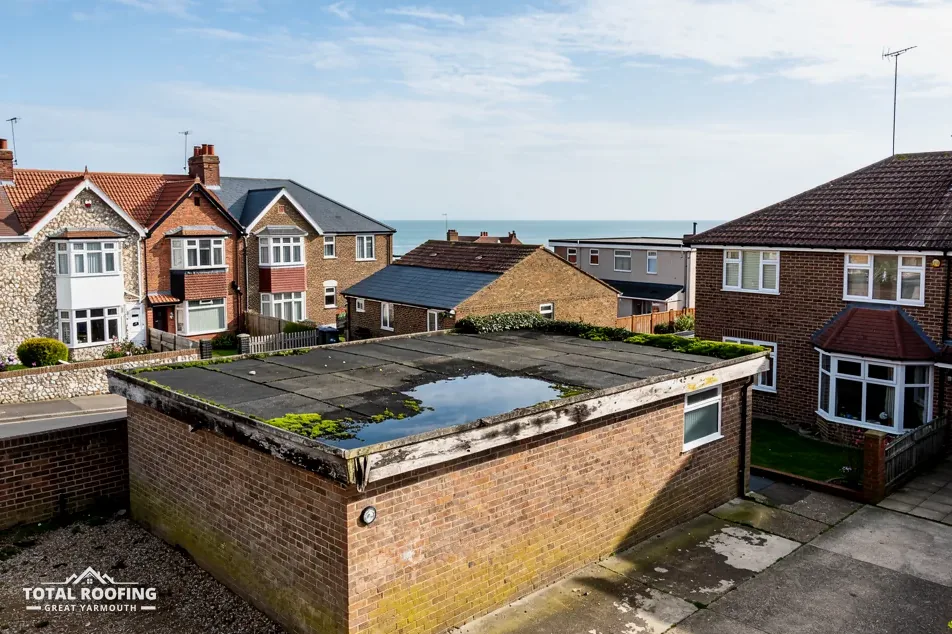
On flat roofs, the edges and the upstands give way first when the membrane is lifted by wind. BS 6229:2025 covers flat roofs with continuously supported flexible waterproof coverings. Once the membrane has peeled back at an edge, the rest of it may be loose under the surface, and a patch applied to the visible part can fail. A flat-roof repair after a storm therefore starts with a look at how far the lifted area goes.
Storm damage to look for from the ground
- Tiles missing, slipped or lying on the ground
- A ridge or hip tile sitting out of line
- Ragged edges or gaps along a gable verge
- Lead or flashing hanging free at the chimney
- A lifted or peeled edge on a flat roof
From the make-safe to the repair
The first visit after a storm is about stopping more harm. A tarpaulin over a stripped slope, a loose ridge tile secured or a barrier on the path below are all temporary. Our guide to making a roof safe goes through the methods. The lasting repair comes afterwards, with matching materials and, where it is needed, a scaffold. Where the permanent repair needs scaffold, the scaffold forms part of the same written quote, and the survey decides what the lasting work involves.
Scaffolding on the pavement or road needs a highway licence from the county council, and we arrange the licence with our scaffolder. That sits within the written quote for the job. The survey covers every slope, and we say what we found, faults you had not noticed included. The written quote that follows gives one total.
If you agree to the permanent repair at home after a survey, the usual 14-day cancellation period applies to that contract. The cancellation right does not apply to an urgent visit you specifically requested, which is regulation 28(1)(e) of the Consumer Contracts Regulations. Our page on going from make-safe to permanent repair explains the steps in order. Ask for the written total before you agree to the work, and read what it describes.
Photographs, insurance and what to do now
If you may claim on your home insurance, take photographs before anything is moved. The Ombudsman's storm guide says "we'll usually look at expert reports and photos" in weighing a complaint. Take pictures of the ground, the damaged parts and the inside of the house, and note the date, so the record is there if you need it. Tell your insurer. The insurer decides what is paid, under the terms of your policy, so treat any forecast with caution. Do not wait for the repair to be finished before you get in touch, because the insurer may want to see the damage as it stands.
Keep the broken pieces if they are safe to pick up, since a tile on the lawn is evidence. Do not throw away the cover or the invoice for a temporary repair. Our page on storm damage and home insurance sets out the steps. Staying in contact with the insurer matters, so ask what it needs and keep any reply.
Our WhatsApp number takes photos taken from the ground, and we look at them before a survey is booked. A photo shows the visible fault. It cannot show what lies beneath, which is why the survey comes first and the written quote after it.
After a storm
- Check the house and the ground from a safe place.
- Photograph damage inside and out, with the date.
- Catch drips and keep people clear of loose roof parts.
- Tell your insurer, then arrange a survey.
