How the Ombudsman defines a storm
The Financial Ombudsman Service settles disputes between consumers and financial businesses, home insurers among them. Its guide to storm damage sets out how it approaches a complaint about a storm claim, and the first thing it does is define the word. It says: "We say that a storm usually involves violent winds, usually with rain, hail or snow." The guide adds a second sentence that is easy to miss: "Rain, hail or snowfall by itself can constitute a storm." The guide also says it takes into account the Beaufort Scale, the measure of wind force.
Those sentences are written for complaints, so they tell you how the Ombudsman thinks about a dispute, and they are not a promise that an insurer will accept your claim. Your policy has its own wording, and the insurer's assessment comes first. What the Ombudsman's wording does show is that a storm for a claim does not have to be an event with a name or a headline. The Ombudsman says a storm usually involves violent winds, usually with rain, hail or snow, and that rain, hail or snowfall by itself can constitute a storm, so the weather on the day is worth writing down.
For a roof, it helps to record what the weather was doing when the damage appeared. Note the date and a short description, and keep any weather warning you remember. That gives you something to set beside the photographs. Whether a claim pays depends on the policy and the insurer's assessment, and nobody can promise the outcome in advance, including us.
The Ombudsman's wording also explains why insurers and homeowners can read the same event differently. One side sees a gale, the other sees a roof that was already tired. A calm record made on the day, with dates and photographs, is the clearest way to keep a disagreement to the facts. It stops memory from filling the gaps later, and it gives the insurer's surveyor something fixed to inspect.
Myth
Rain on its own can never be treated as a storm.
Fact
Ombudsman guide: "Rain, hail or snowfall by itself can constitute a storm."
The first steps, in order
The first priority is safety. Keep people away from anything loose, catch water inside the house and, if wiring is wet, turn that circuit off at the consumer unit, but only from dry ground. Our guide to making a roof safe describes what a temporary cover involves. Ask for the roof to be covered or secured so the damage does not get worse while the claim is considered.
The second step is evidence. Take your pictures before anything is moved or cleared. The Financial Ombudsman Service says that, in deciding a complaint, "we'll usually look at expert reports and photos". A picture taken before the tile is picked up from the lawn, before the debris is cleared and before the ceiling is mopped is worth more than any account of it later. Keep the broken pieces, if it is safe to do so, and keep the packaging and receipts for any temporary cover.
The third step is to contact your insurer. Read the policy for what it asks of you, and keep a note of when you called, who you spoke to and what you were told. Ask what the insurer needs from you and whether it would like to see the damage before repairs are made. The order matters because a repair done before the insurer has seen the damage can leave a gap in the evidence.
Order of play after storm damage
- Make people and property safe from the ground.
- Take photographs before anything is cleared away.
- Ring your insurer and note what you were told.
- Arrange a temporary cover and keep every receipt.
- Get a written quote for the permanent repair.
What to photograph
Photographs are clearest when they tell the story in order: the wide view first, then closer, then the detail. Start on the ground. Stand back far enough to show the whole house and the part of the roof affected, and take the same view from another side. Then move closer to the damage you can see from a safe place, such as fallen tiles, a leaning chimney, a hanging gutter or a lifted ridge.
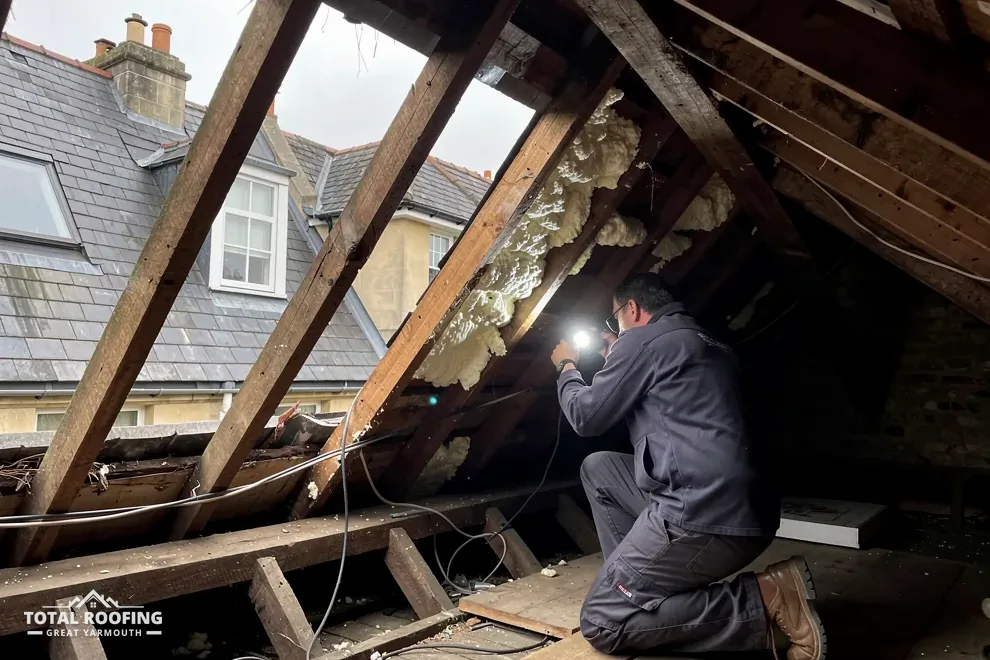
Inside, photograph each room where water has come in. Show the stain or the bulge, the floor beneath it and any belongings that were damaged. A close shot of a wet patch is more useful when a wider shot shows where in the room it sits. If you can reach the loft hatch safely, a picture of wet insulation or timber helps, though never climb into a loft with water near wiring.
Check that each photograph carries a date, and keep the originals as well as copies sent to anyone. A zoom lens or binoculars will show you the roof from the ground, but they will not show what is hidden under the covering, and a roofer cannot see that from a photograph either. The survey looks beneath.
Write the date and time on a note and photograph that too if you wish, but take care that nothing in the picture is altered. Do not clean up a damaged area before the pictures are taken, and do not tidy loose items into a pile. If something has to be moved for safety, take a photograph first and a second one after, so the change is on record.
Photographs worth taking
- The whole house, from two or more sides
- The damaged part of the roof, from the ground
- Fallen tiles, pieces and debris where they landed
- Each wet ceiling, wall or floor inside
- Damaged belongings, before they are moved
Wear and tear, and what the insurer has to show
A roof that is old or poorly maintained can fail in a storm, and insurers distinguish damage caused by the weather from damage caused by the roof's age and condition. Many policies exclude wear and tear and gradual deterioration, and a claim can run into that distinction. A tile that blew off because its fixing had perished will be looked at differently from a tile struck by a branch.
The Ombudsman's guide gives a rule for the dispute. It says: "The insurer has to prove that the exclusion applies - for example, with an inspection report." So where an insurer declines a claim because of an exclusion, such as wear and tear, the burden of showing it applies sits with the insurer. The guide adds that your insurer "will normally ask a surveyor to write a report".
That makes the report the key document in many storm disputes, and it is the insurer's surveyor who writes it. Read it when you receive it. If it says the damage was caused by age or poor condition, and you disagree, you can challenge it. Our role as roofers is to survey the roof for a repair and give one written total price for the work. The cause of the damage, for insurance purposes, is for the insurer and, if there is a complaint, the Ombudsman to weigh.
If a roof was recently inspected or repaired, keep any invoice or written quote you hold for it. A written quote describes work that was priced; it says nothing about the cause of a later failure, and an insurer will not treat it as a report on one.
Repairs, receipts and the written quote
Temporary work can be done while a claim is considered, and it is sensible to have it done: an open roof lets more water in, and a policy may expect you to limit further damage. Keep the invoice for the cover and for anything else done to make the roof safe, with the date. If you have asked for an urgent visit to stop water coming in, that visit stands outside the 14-day cancellation right, because regulation 28(1)(e) removes it where the consumer has specifically requested the visit for urgent repairs. Keep every invoice and note, and ask for the temporary work and the permanent repair to be described separately in writing, so each can be shown to the insurer if it asks.
The permanent repair needs a survey and a quote. Our written quote is one total price, with any scaffold that the job needs part of it, and it describes the work in plain words. It gives your insurer something to read when it decides what it will pay. A quote does not mean a claim will be accepted, and the amount an insurer pays is its own decision, made under the terms of the policy.
Do not sign for the permanent repair on the strength of an assumption about what the insurer will pay. Ask the insurer in writing what it will cover and whether it needs to see the damage first. A contract signed at your home once a survey is done carries a cancellation period of 14 days. Our page on the damage a storm can do to a roof goes through what the repairs involve.
If you disagree with the insurer
Start with the insurer's own complaints process. Write to it, set out what you think is wrong and enclose the photographs and any documents that support you. Keep a copy of everything. For most complaints, the Ombudsman says, a business has up to 8 weeks to consider a complaint, so the insurer gets that time first. A clear record of dates and conversations is what keeps a complaint specific.
Where the insurer's final response leaves you unhappy, or 8 weeks pass without an answer, the matter can go to the Financial Ombudsman Service, and where a final response was sent, the 6 months for bringing the complaint are counted from the date on it. The Financial Ombudsman Service can be reached on 0800 023 4567. The Ombudsman will usually look at expert reports and photos, so the pictures you took on day one carry weight at this stage.
The Ombudsman's guidance says nothing that can guarantee a result, and neither can we. What it gives you is a stated way to approach a dispute: your evidence is weighed, the insurer must prove an exclusion, and your complaint goes in writing. Our guide to what an emergency roof repair costs gives published price ranges, with dates, which can help you judge the repair figures in front of you.
Terms in a storm claim
- StormOmbudsman: usually violent winds, usually with rain, hail or snow
- ExclusionA cause the policy says it will not pay for
- Wear and tearDamage from age and condition, not from weather
- Final responseThe insurer's last word on your complaint