
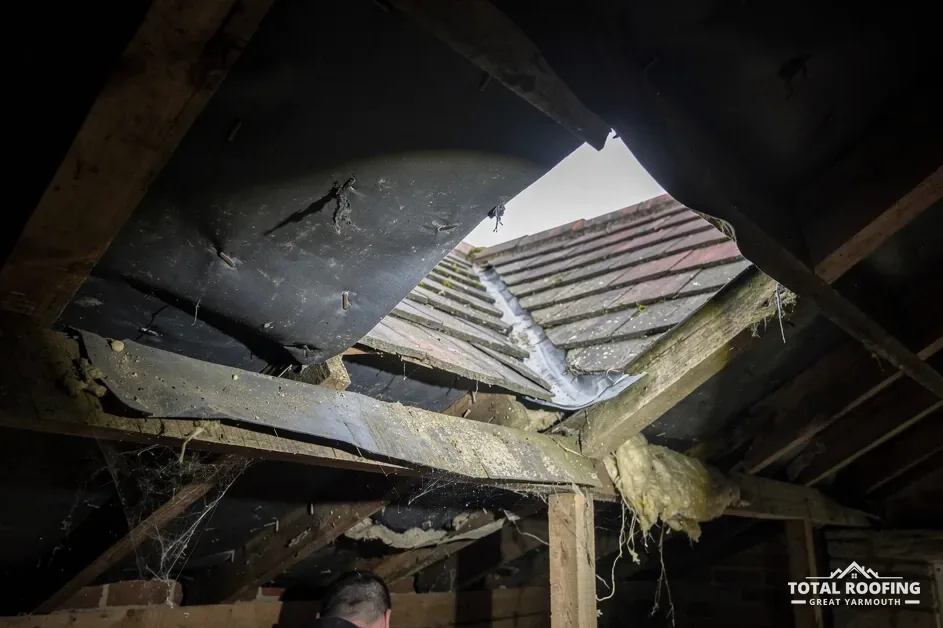
What wind does to a tiled roof
A tiled roof looks solid, but each tile is held on by a modest set of restraints. Gravity does part of the work, and the tile's nib hooks over a timber batten. On some roofs a nail or a clip adds a second fixing. When wind blows across a roof, air pressure drops over the top of the slope and builds up underneath wherever it can get in, so the covering is pulled up as well as pushed sideways. Anything that is held weakly gets lifted first.
That is why the damage after a blow can cluster at the edges. The eaves, the verge along a gable end and the ridge at the top are the places where wind meets the covering from the side or underneath, and they are where the fixings do the most work. Tiles in the middle of a slope are held by the tiles around them, and they have fewer ways to loosen.
Damage comes in grades. A tile may have slipped a few centimetres and be hanging by its nib. It may have cracked where a flying branch struck it. It may have left the roof completely and landed in the garden. Each of those needs a different response, and the smallest-looking one is not always the right one if the battens or underlay beneath have been exposed to rain.
Our guide to storm damage roof repairs sets out the wider repair work once a storm has passed. This page concentrates on tiles, how they come loose and what a lasting fix involves.
Why tiles lift: fixings, battens and old mortar
A tile that lifts in wind has been let down by whatever holds it. Nails can work loose or be too short for the batten, clips can be missing where they were never fitted, and the battens themselves can have softened with age and damp so that the nail has nothing firm to grip. On older roofs the ridge and verge were bedded in mortar, and mortar cracks and crumbles as the years pass, leaving the tiles it held resting on little more than their own weight.
The standard for tiled and slated roofs is BS 5534, and the edition in force is BS 5534:2014+A2:2018, which covers pitched roofs and vertical cladding. Marley, the tile manufacturer, says that installing to BS 5534 "isn't required by law", and that the 2015 amendments made it clear that mortar "could no longer be relied upon as the only means of securing the roof covering". So the standard is guidance, but it describes good practice for what holds a covering down.
BS 5534 sets minimum fixings, and Marley adds that the minimums in the standard are overtaken by a site-specific Fixing Specification, which weighs several factors, among them location: where the building stands and how exposed the site is. In plain terms, the fixings follow the site's exposure, so an open plot and a sheltered street do not get the same specification.
That calculation is the answer when someone asks how many nails or clips a roof needs. It is not a single number that applies to every house.
Myth
An old mortar-fixed roof is illegal, because the standard is the law.
Fact
Marley says following BS 5534 isn't required by law; it is a code of practice.
Ridge, hip and verge tiles
Three parts matter here. The ridge runs along the top where two slopes meet, a hip is the sloping line where slopes meet at an outward corner, and the verge finishes the roof where it ends at a gable. These parts take the full force of wind from both sides, and they are the places where mortar was long used to bed tiles in place.
Mortar-bedded ridges and verges fail by cracking, loosening and letting tiles slide or lift. Once one ridge tile moves, the ones either side lose their support, and the line can unzip along its length in one gust. A loose ridge is therefore worth repairing before the next windy night, not after it. Our guide to making a roof safe describes the temporary measures that hold a slope until the permanent work is done.
Dry-fixed systems are the modern alternative, and BS 8612:2018 is the specification for them, listed as current. Marley's wording on the point is direct: "In all cases, ridge or hip tiles should be mechanically fixed to resist the calculated wind uplift force."
A dry verge needs checking after wind too. The verge units, their end caps and the fixings at the gable sit in the exposed corner of the roof. If the end of a verge looks open or loose from the ground, photograph it and have it looked at.
Checking the damage from the ground and the loft
You can learn a lot without leaving the ground. Walk round the house in daylight and study each slope through binoculars, or use your phone's zoom. Work round every side, because wind that has damaged one slope may have loosened another that faces away from you, and write down which elevation each photograph shows. You are looking for gaps in the pattern of the tiles, tiles that sit at an angle, pieces of tile on the ground or in the gutter, a ridge line that no longer looks straight and anything hanging at a gable edge.
Inside, take a torch into the loft where the hatch can be reached safely, and look at the underside of the covering without stepping off the joists or boards. Daylight showing through the covering, damp patches on the underlay or rafters, a wet patch on the insulation and drips on the ceiling below all say that rain is getting in. A new stain on a bedroom ceiling after wind and rain is a reason to ring a roofer promptly, because the water may be running along timbers to reach it.
Do not climb onto a roof to check it, however sound the ladder feels. Tiles that have lifted may be unstable, wet slopes are slippery and a fall from a roof does serious harm. Our guide to making a roof safe explains what a roofer does at that point, and the checklist below suggests what to record from the ground.
What to photograph from the ground
- Each slope in full, taken from the path or lawn
- Gaps, slipped or cracked tiles, close up
- Tiles and debris where they landed
- The ridge and verges against the sky
- Any stain or drip inside, with the date
Repairing a few tiles or re-roofing a slope
A handful of lost or cracked tiles is a repair. The broken ones are removed, any damaged battens or underlay are put right and new tiles are fixed to the specification the roof needs. The skill is in matching the tile and checking what lies beneath, because a replacement tile laid over a rotten batten will not stay put.
Where the fixings across a whole slope have failed, or the old covering is tired and the next gust will lift more of it, a re-cover of that slope may be the sounder choice. Marley gives the expected life of roof tiles in these words: "Typically, roof tiles are expected to last for around 60 years", followed by "This is not a guarantee or warranty of its longevity." For clay tiles, the BRE determined a minimum life expectancy of 60 years, and HomeBuilding gives approximate lifespans of 60-80 years for clay and 40-50 years for plain concrete. The sources disagree on concrete, so both figures are named.
Re-roofing has its own Building Regulations test. According to the Planning Portal, no application is normally needed where "Less than 25 per cent of the total 'building envelope'" is affected and "Less than 50 per cent of the roof is affected". Swapping a few tiles sits comfortably inside that test, while a full re-roof does not, and the route is checked with building control before work starts. Approval is needed as well for a covering 15 per cent or more heavier than the covering it replaces, and the Portal advises consulting a structural engineer or surveyor before starting, which matters if a heavier tile is on the table.
Published prices for tile and ridge work
| Replace one to six broken tiles (Which?) | £75-£400 |
|---|---|
| Put in a new ridge tile (Which?) | £80-£300 |
| Average roof repair (MyJobQuote) | around £650 |
| Ridge tile replacement (MyJobQuote) | average between £225 and £550 |
Which? Trusted Traders figures come from a survey of 11 traders in November 2025 and exclude VAT. MyJobQuote repair page, last updated 06/10/26, and ridge page, last updated 01/10/26, state no VAT basis. Your written quote is one total price after a survey.
After the wind: cover, scaffold and the insurer
If a roof has been opened up by wind, the first aim is to stop rain getting in. A roofer can fit temporary cover over the gap until the right tiles are available and the weather allows the lasting repair. Matching the tile can take a little time, because tiles differ in profile, colour and age, and a near match left as a permanent fix shows from the street. Where the damage is high on a main roof, scaffolding may be needed to work safely. Scaffolding on the pavement or road needs a highway licence from the county council, and we arrange the licence with our scaffolder.
For insurance, shoot your photographs before anything is shifted, and keep any broken tiles. The Financial Ombudsman Service says: "We say that a storm usually involves violent winds, usually with rain, hail or snow." The same page adds that in a dispute "we'll usually look at expert reports and photos", which is why pictures count. The emergency roof repairs section has more on urgent work, and our guide to what an emergency roof repair costs sets out third-party price figures.
When the repair is done, ask for the written quote to name the covering, the fixings and the areas treated, so the description matches the work. Check the photographs you took of the ridge and verges against the finished roof from the ground, and keep the quote with the policy documents in case a later claim needs the history of the roof.
