
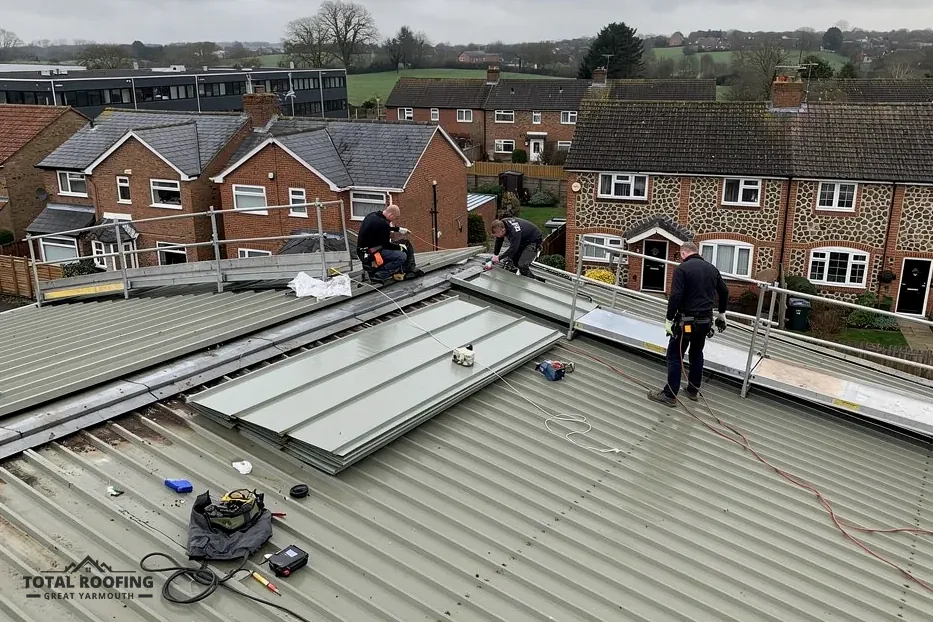
What counts as an emergency on a flat roof
A flat roof becomes an emergency when rain is already getting in, or when part of the covering is loose enough to be lifted or torn away. A brown stain that spreads on a ceiling, a drip into a room, a section of membrane flapping at an edge and a surface where rain has collected into a deep pool all qualify. A hairline crack found on a dry day, with nothing wet inside, is a repair to book rather than an emergency call. Ask yourself whether water is coming in now and whether the covering could be lifted or torn by the next gust. If the answer to both is no, a survey in the coming days will do.
Flat roofs show trouble differently from pitched ones. A pitched roof sheds water down a slope, so a leak can show close to the fault. A flat roof holds water on a deck that is only slightly tilted, and a gap can let water in at one spot while the damp shows at another, several feet away along a joist or the underside of the boards. That is why the spot on the ceiling is a clue to the leak, not the leak itself.
Inside, keep clear of a ceiling that is sagging or bulging with water, switch off lights and sockets below a wet patch if you can reach the consumer unit safely, and put out buckets and towels. Do not go up onto the roof to look. Our guide on what is a roofing emergency sets out the broader test, and the emergency roof repairs section covers the rest.
A photograph sent to us on WhatsApp is a good first step. We look at it, and it helps us judge how urgent the survey is.
Splits, lifted edges and ponding: three different faults
Splits are cracks in the covering. They open where the membrane has aged, where it has been stretched across a joint that moves, or where something has punctured it. Rain goes straight through a split into the layers below, so even a short one matters over a bedroom.
Lifted edges are a different failure. The covering is stuck or clipped down along its perimeter, and when that grip fails the edge peels back. Trims, drip edges and the line where the roof meets a wall are the places to look from an upstairs window. Wind can then get under the loosened material and lift more of it. A lifted edge is quick to worsen because each gust finds more to pull at, and it can take the trim and the first strip of the membrane with it.
Ponding is water that stays on the roof after the rain has stopped. Standing water is a sign that the roof's fall is not carrying water to the outlet, and it adds weight and stress to the same spot every time it rains. BS 6229:2025 sets a minimum finished fall of 1:80 for membrane flat roofs, and IKO reports that the roof should be designed to 1:40 in order to achieve 1:80. A roof that ponds may have lost its fall through sagging boards or a poor original build, which a patch will not cure. Our guide to flat roof repairs explained goes into each fault in turn.
How each fault shows up
- Split: a crack or open seam, damp patch below
- Lifted edge: curled or flapping covering at the perimeter
- Ponding: water standing after the rain stops
- Blister: a raised bubble in the surface
- Open joint at a wall or upstand where rain gets behind
What a temporary patch can and cannot do
A temporary patch is a holding action. It keeps rain out while the weather and the diary allow the proper repair. Depending on the covering and the fault, that might be a sheet of new membrane bonded over a split, a sealing strip along a lifted edge or a liquid coating brushed into a small defect. The aim is to stop the water entering, not to restore the roof.
A patch has limits. It does not change the fall, so a ponding roof still ponds. It does not add life to a covering that is worn out across its whole area, and it cannot make a perished membrane stick again. It also sits on top of the old surface, so any damp that has already got into the deck or the insulation stays where it is, and a patched roof can look sound while the layers beneath it are wet.
Weather limits what can be done on the day. Adhesives and sealants need a dry surface, and sheeting weighted down with bricks can blow off in the next gust and become a hazard in its own right. That is one reason a roofer sometimes patches in two stages, first to stop the water, then again once the roof is dry enough to take a lasting repair. Our guide to moving from a temporary to a permanent roof repair describes how the second stage is planned.
Patch or replace
Patch
- Stops water entering now
- Suits one small defect
- Roof still ponds if it did
Replace
- New covering over the area
- Fall and deck can be corrected
- Suits a worn-out surface
When a patch is the wrong answer
Repeated patching of the same roof is a signal. If a flat roof has been patched several times in a season, or the repair is already the size of a door, the covering has stopped doing its job. Each new patch adds a seam, and rain can run in along any seam.
Wet insulation or a soft deck is another reason to stop. A soft patch underfoot, a deck that dips between joists or insulation that is heavy with water all say the same thing: the problem is under the surface, and a new layer on top will trap it. If the boards beneath the covering have absorbed water, they no longer hold fixings or carry weight as intended, and the roof needs opening up rather than covering over. A roofer finds this by testing the area around the leak, which is part of the survey, and the test can show that the damp has spread well beyond the visible tear. The survey takes in the entire roof beyond the patch, and what comes back to you is a plain account of the findings, including any other faults seen.
Age matters too, though the figures differ between sources. HomeBuilding gives approximate lifespans of 10-15 years for felt, 25-30 years for EPDM and 25-30 years for GRP. Less gives torch-on felt as lasting 10 to 20 years depending on quality and installation, EPDM rubber membrane as typically lasting 30 to 50 years and GRP as lasting 25 to 40 years with minimal maintenance. A covering at the end of either range is a candidate for replacement rather than a fifth patch.
| Covering | HomeBuilding (approx) | Less |
|---|---|---|
| Felt | 10-15 years | 10 to 20 years |
| EPDM | 25-30 years | 30 to 50 years |
| GRP | 25-30 years | 25 to 40 years |
What the repair or replacement involves
Repair or replacement, the work follows the build-up of the roof. A damaged membrane is cut back to sound material, the deck beneath is checked for damp and softness, and the new covering is bonded or laid with its edges, upstands and outlets detailed so water leaves the roof rather than gathering. Our guide to flat roofing describes the systems, and the guides on EPDM, GRP and felt compare them.
A full replacement raises Building Regulations questions. Approved Document L lists "Replacing the waterproof membrane on a flat roof" as renovation, and where more than 50% of the roof's surface is renovated, the entire roof is to be improved where feasible. Where a full upgrade is not feasible, the roof is upgraded as far as a simple payback of 15 years allows. Insulation, ventilation and the fall are all part of that conversation, and we check the building control route with the council before work starts.
If the roof sits over a garage, an extension or a room that is part of the house, the same questions apply, because it is still part of the building's roof. Scaffolding on the pavement or road needs a highway licence from the county council, and we arrange the licence with our scaffolder. A roof that can be reached from a ladder at the back of the house needs none.
MyJobQuote's emergency roofer page, last updated 22/10/26, says: "Emergency roofer call-out costs typically range from £150 to £300, while extensive storm damage repairs can cost £1,200 or more." What we give you after the survey is a single written total, for a repair or a replacement alike.
Insurance, photographs and keeping the evidence
If wind tore the covering or a storm drove rain through it, your home insurance may respond. Photograph the damage before moving anything: the Financial Ombudsman Service says "we'll usually look at expert reports and photos" when a storm claim is disputed. Take pictures of the roof from the ground where you can see it, of the ceiling inside, of any water that has collected and of anything that has blown loose.
The Ombudsman describes it this way: "We say that a storm usually involves violent winds, usually with rain, hail or snow." It adds that "Rain, hail or snowfall by itself can constitute a storm." Whether a particular failure is a storm claim or a wear-and-tear matter is for the insurer to decide on the evidence, and the policy wording will say what is covered. Our guide to storm damage and home insurance explains how a claim runs.
Keep every quote, message and receipt, and ask for the quote to describe the work in plain words, including which layers are being replaced and which are being kept. A quote that says only "repair flat roof" leaves too much open. If a firm you have not called arrives unasked and calls your roof an emergency, take their name and ring a roofer of your own choosing before you sign anything or pay a deposit.
