
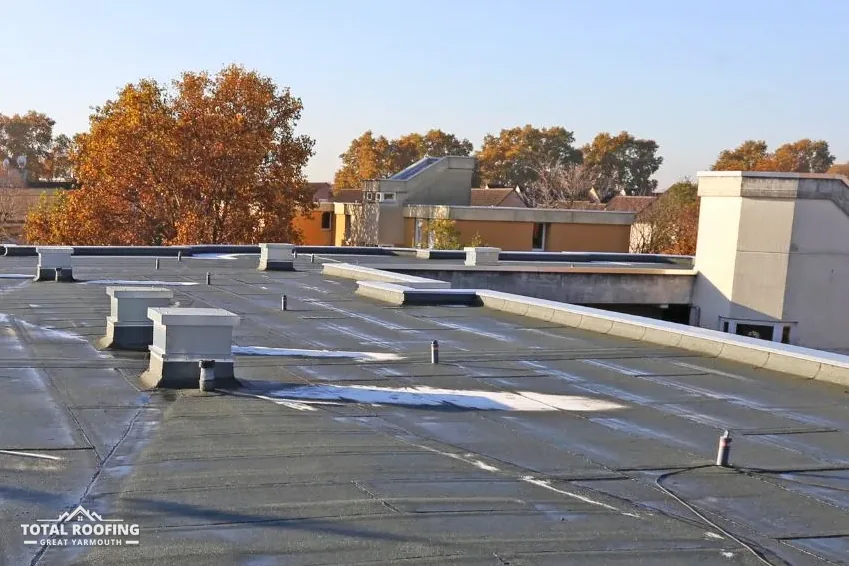
Reading the signs of a failing flat roof
A flat roof tells you something is wrong in a few ways, and not all of them are inside the house. Inside, look for a brown or yellow stain on a ceiling, paint that bubbles, plaster that feels damp and a musty smell in a room under the roof. Outside, look for water that stays on the surface a day or two after rain, a roof covering that has lifted or split, and a loose edge trim.
The stain on the ceiling and the hole in the roof may not be in the same place. Water can run along a joist or under a membrane for some distance before it shows. Chasing a drip into the nearest corner and sealing it is how one fault turns into a series of repeat leaks, which is the reason the survey covers the entire roof rather than only the patch you pointed to.
The state of the rest of the roof changes what a fault means. A single split in a roof with a sound deck is a small job. The same split in a roof that is soaked through, soft underfoot and full of ponds suggests the whole covering has run out of years. The three sections that follow take each common fault in turn, and the last one covers the choice between repair, overlay and replacement.
Signs to check from inside and out
- Brown stains or bubbling paint on a ceiling
- A damp, musty smell in rooms under the roof
- Water still standing on the roof two days after rain
- Raised bumps, splits or lifted seams in the covering
- Edge trims that have come loose or dropped
Splits and cracks in the covering
A split is a break through the waterproof layer, and a flat roof covering has several ways of getting one. Felt is made of bitumen and a fibre or polyester core, and it hardens and loses flexibility as it ages. The roof deck and the house move a little with temperature and weather, and a covering that has lost its flexibility cannot follow that movement, so it cracks, along a seam, at an upstand or across a ridge-like crease.
Single-ply rubber and fibreglass fail in their own ways. An EPDM sheet can lift at a seam if the adhesive has let go, or tear where something has dragged across it. Fibreglass is rigid once cured, and a crack can open at a joint between boards or at an upstand where the deck has shifted, because the laminate cannot stretch. Our guides to EPDM and GRP cover each material in more detail.
How a split is repaired depends on the covering and on what lies beneath. On felt, the damaged area is cut back, the layers are dried, and a new patch is bonded over a generous margin. On rubber, a patch is glued on with the maker's own adhesive and tape. On fibreglass, the crack is opened out, laminated with new matting and resin and topped with fresh gelcoat. In every case the repair only lasts if the deck under it is dry and sound, which is checked before anything is bonded down.
A split is also a clue. If the same covering has split in three places, the cause is probably the whole roof, not three separate accidents, and the survey will say so plainly rather than selling three patches.
Blisters and raised patches
A blister is a bubble under a felt covering where the layers have separated. It forms when a pocket of moisture or air is trapped between layers and is warmed by the sun, expanding and lifting the surface. Our dedicated page on flat roof blisters goes into detail. A small blister that has not broken is not leaking yet. It is a weak point, because the surface of the bubble is stretched thin, and a foot or a branch can open it.
The repair depends on whether the blister is dry or wet inside. A dry blister can be cut open in a cross, folded back, dried out and re-bonded, with a patch over the top. A wet one means moisture is trapped in the layers or the insulation, and the question becomes how far it has spread. If the wet area is small, it is cut out and replaced. If it is large, patching only seals the water in.
Sometimes the raised area is not a blister at all. A ridge under an EPDM sheet can be a wrinkle, a lifted seam or a gap in the adhesive. A bump in a fibreglass roof can be the deck underneath rising where boards have swollen. A raised patch is a prompt to look underneath, not a fault with one standard cure.
Do not cut into a blister yourself. A knife opens a path for rain and can find that the felt beneath is wet, which turns a small repair into a bigger one.
Ponding and the falls on a flat roof
Ponding means water left lying on the roof once the rain has stopped. A flat roof is built with a fall so water drains to an outlet or a gutter. According to NFRC, the 2025 edition of BS 6229 asks for a minimum 1:80 finished fall across general roof areas and internal gutters. IKO adds that reaching 1:80 means designing for 1:40. The standard applies to membranes that are continuously supported.
When a roof ponds, its fall is not doing the job. The deck may have sagged between joists, the fall may never have been enough, or an outlet may be blocked with leaves and moss. A pond of standing water is heavy, it sits against the membrane through frost and sun, and it speeds up wear at the lowest spot. Algae and silt show where water has stood. Our guide to ponding on a flat roof has the full treatment.
A blocked outlet is the simple cure and worth ruling out first. Beyond that, remedies range from adding a tapered insulation layer to lift the low area, to replacing a sagging deck section, to re-laying the roof to a proper fall. Which one fits depends on how far the ponding spreads and how soft the deck is, and only the survey, not a guess from the ground, settles it.
Myth
A flat roof is meant to hold a little water.
Fact
A flat roof is built with a fall so water drains away.
Leaks at edges, upstands and outlets
Many flat roof leaks start where the field of the roof ends, not in the middle. Three places need checking: the edge, where a trim or a drip should throw water clear; the raised junction with a wall, capped by a flashing; and the outlet or pipe that passes through the surface.
At the edge, a trim that has dropped or been knocked leaves a gap behind it, and water runs back under the covering. Where the covering meets a house wall, a flashing that has lifted or a sealant line that has cracked opens a slot straight down the brickwork. At an outlet, a collar that has pulled away from the pipe lets water in around it. Each of these is repaired with a small amount of material, as long as the covering around it is sound.
Hard leaks to trace are the ones that run along the deck. Water that enters at an upstand on one side of a roof can show up as a ceiling stain several metres away, so a repair at the stain does nothing. That is why surveying the whole roof, and tracing a leak back along its path, is the only way to put a repair in the right place. The guide to a leaking flat roof sets out how a leak is traced.
Patch, overlay or replace: choosing
The choice comes down to the age of the covering, how much of it has failed and what state the deck is in. A patch suits a young roof with one isolated fault. An overlay, a new covering over the old, suits a roof that is sound underneath but tired on top. A replacement suits a roof with wet insulation, a soft deck or damage across most of its area.
Lifespan figures help frame the decision, but they are only guides. HomeBuilding gives approximate lifespans of 10-15 years for felt, 25-30 years for EPDM and 25-30 years for GRP. Less says torch-on felt "lasts 10 to 20 years depending on quality and installation", EPDM rubber membrane "typically lasts 30 to 50 years" and GRP fibreglass "lasts 25 to 40 years with minimal maintenance". A roof near the end of those figures with several repairs behind it is a candidate for replacement.
Cost follows the choice. MyJobQuote says that in 2026 the average flat roof replacement costs between £1,500 and £6,000 (page dated 20/10/26), and a patch costs a fraction of that, but a run of patches can add up to more than a new roof. Each repair also depends on the one before it. Our flat roofing hub links to the guides on cost, replacement and each covering.
Patch or replace
Patch
- One isolated fault
- Deck dry and firm
- Covering still young
- Edges sound
Replace
- Faults across the roof
- Deck soft or wet
- Covering near its end
- Repeat repairs failing
What a survey of a flat roof looks at
A survey of a flat roof is a physical look at the whole roof, in dry weather where possible. The covering is checked for splits, lifted seams, blisters and worn patches. The edges and trims are checked for gaps. The upstands and flashings are checked wherever the roof meets a wall, and the outlets and any pipes are checked for collars and blockages.
The deck is tested by feel and by looking at the ceilings below. Soft or springy patches suggest rot. A ceiling stain suggests water has been in for some time. Where the covering allows it, a small test cut shows whether the layers beneath are wet. This is how the survey separates a roof that needs a patch from one that needs more.
You get the findings in plain words, extras spotted along the way included, and the written quote gives a single total price for the job. If you want us to look at a photo first, send it on WhatsApp. For a roof you cannot reach safely, the guide to walking on a flat roof explains why it is better to leave the climbing to the survey. A roof that looks solid can have a deck that gives way under someone's weight, and a fall from a low roof still injures.
