
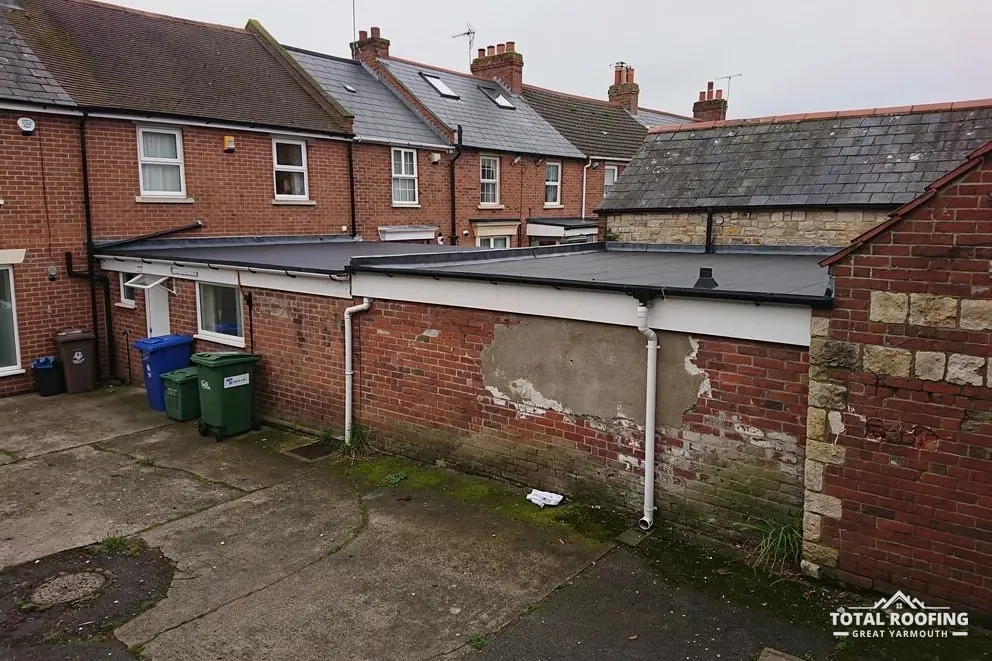
What a GRP roof is
GRP stands for glass-reinforced plastic, and the roofing version is commonly called fibreglass. It is not laid as a sheet. It is made on the roof: glass fibre matting is laid over the deck, resin is rolled through it, and the resin sets hard into a single rigid shell. A topcoat is then applied to give a finished surface and colour.
Because it is formed in place, a GRP roof follows the shape of the deck exactly. It goes round corners, up over upstands and across awkward outlines without the joins that a rolled covering needs. That makes it a useful choice for a roof of irregular shape, such as a bay, a porch with a curved front or a small roof with several steps.
The strength of the covering comes from the layers working together. The deck carries the load, the matting reinforces the resin and the resin holds it all in one waterproof shell. The sections below follow the build from the deck up, and our flat roof replacement guide covers the stages that come before the laminate goes down.
Fibreglass has been used on flat roofs for decades by trade custom, but its performance still depends on the install. Two GRP roofs with the same resin can behave very differently if one was laid on a stable deck in dry weather and the other was not. That is why this guide spends as much time on the deck and the conditions as on the material.
Laminating: how the shell is made
The deck has to be ready before any resin is mixed. It needs to be dry, clean and firmly fixed, with the boards laid and screwed so that nothing moves underfoot. Resin sets in a chemical reaction rather than by drying, and it sets against whatever it touches, so a damp or dusty board gives a poor bond.
A layer of resin goes down first, and a sheet of chopped strand matting is laid into it and rolled until the resin has soaked through and the air has been pushed out. The roofer works across the roof in sections, keeping the laminate wet at the edges so one section joins the next as a single piece. A catalyst is added to the resin to start the cure, and the quantity is adjusted to the day's temperature.
Once the laminate has cured, a topcoat goes on. This is a pigmented resin layer, often called gelcoat or topcoat, that seals the surface and sets its colour. It also protects the matting beneath from the weather and from foot traffic. A second coat can follow where the first has been sanded to key it.
Weather decides the day. Resin needs dry surfaces and a workable temperature to cure properly, so rain, damp or cold at the wrong moment leaves a shell with a poorer bond. A bad forecast is a reason to postpone, and a roofer who presses on regardless deserves a question.
Building a GRP roof
- Prepare a dry, flat, firmly fixed deck.
- Fit edge trims and drip details.
- Roll resin on, lay the matting and consolidate it.
- Let the laminate cure.
- Apply the topcoat.
- Check the surface, edges and outlets.
The deck, the trims and the edge
Edge trims for a GRP roof are installed before the resin goes on, and the laminate is run onto them so the covering and the trim become one. A drip trim carries water over the edge and into the gutter. Without it, water can run back under the edge of the shell and into the deck. Our page on flat roof edge trims covers the choices for the edge.
The deck matters more for GRP than for most coverings, because a rigid shell cannot stretch. If boards bow, swell or move at their joints, the laminate above them takes the movement and can crack. That is why the deck for a fibreglass roof is firmly fixed, boards are laid with the right gaps and the fall is formed in the structure or in the insulation, not by thickening the resin in places.
At a house wall, the laminate climbs the masonry as a raised edge and ends under a flashing or a sealed trim, so water cannot run down behind the edge. Pipes and roof lights have collars laminated to the shell. All of these details are made in the same resin as the main roof, which is why a good GRP roof is described as a single piece.
Cracking, and why joints are the weak point
A GRP shell is rigid. It does not stretch the way rubber does, so when the structure beneath moves, the laminate has to take that movement as stress. The stress shows up at points where the deck has a joint, where two boards meet, or where the roof meets a wall that moves differently from the deck.
Cracks that follow the lines of the boards are a sign that the deck has moved. Cracks around upstands suggest the wall and the deck are moving against each other. Cracks across a wide flat area can mean the laminate was too thin, was applied in cold or wet weather or was cured badly. A hairline crack still lets water through, so it is a fault, even when it is hard to see.
Colour change and a chalky topcoat are different. They are the surface weathering, and they do not by themselves mean the roof is leaking. A sound laminate under a tired topcoat can sometimes be refreshed with a new topcoat, whereas a cracked one needs the cracks opened and repaired first. The survey tells the two apart.
Movement is not always the deck's fault. A wall that settles, a timber that dries and shrinks or a beam that deflects can all open a crack. Pinning the cause down is part of the survey, because a crack repaired without finding the cause can open again.
Myth
A hairline crack in fibreglass is only cosmetic.
Fact
Any crack through the laminate can let water into the deck.
How long GRP lasts: what two sources say
Two published sources give figures for GRP, and they differ. HomeBuilding gives an approximate lifespan of 25-30 years. Less says "GRP fibreglass lasts 25 to 40 years with minimal maintenance". Neither figure is a forecast for one roof, since how a GRP roof ages turns on the deck, the laminate and the care given afterwards.
What the figures leave out is the work that sits behind them. A GRP roof laid on a flat, dry, firmly fixed deck, with trims and upstands done properly, starts with fewer weak points than one laid in a hurry. A roof checked for cracks, with outlets cleared and any debris swept off, has a better chance of reaching the upper figure. Moss and standing water shorten the life of any covering.
For comparison, the same sources give 25-30 years from HomeBuilding and 30 to 50 years from Less for EPDM, and 10-15 years from HomeBuilding and 10 to 20 years from Less for torch-on felt. The pages on EPDM rubber roofing and torch-on felt roofing go through those two in turn.
Looking after the roof is simple and cheap. Keep the surface clear of leaves and silt, make sure outlets run freely, and look at the edges and upstands after bad weather. A small crack found early is a minor repair, and one left alone for a winter is a bigger one.
Published GRP lifespans
| HomeBuilding, approximate lifespan | 25-30 years |
|---|---|
| Less, GRP fibreglass | 25 to 40 years |
HomeBuilding last updated 30 September 2025. Less page updated 9 November 2026, which adds "with minimal maintenance". Both describe the material, not a specific roof.
Repairing a GRP roof
A GRP repair depends on what has failed. A small crack is ground out along its length, the area is cleaned and dried, new matting and resin are laminated into the groove and the repair is finished with topcoat to match. A larger split or a damaged area is cut out and re-laminated, with the new laminate overlapping the old for a good bond.
Water that has entered through a crack may have reached the deck beneath, and a repair over a wet deck traps the moisture. So the survey checks the deck, and if boards have gone soft the repair is bigger than the crack suggested. Our guide to flat roof repairs sets out how patching, overlay and replacement compare.
A new topcoat is a different job. It refreshes a weathered surface where the laminate under it is sound, restoring colour and protection. It does not close cracks, and painting over a crack hides it without curing it. When cracking is widespread, the question becomes whether the deck is moving, and if it is, a new GRP layer over the same deck can crack in the same places.
Where the topcoat alone has failed, a recoat is the answer. Where the laminate is cracked across a large area, repair becomes patchwork and replacing the shell is the honest option. The survey sets out which applies.
GRP against EPDM and felt, and what it costs
GRP is rigid and jointless. EPDM is flexible and laid as a sheet. Felt is layered. A GRP roof suits a roof of irregular shape and a deck that is firm and stays still. A roof on a structure that moves, or with a deck that has been unstable, might suit a flexible covering better. The right call is made at the survey, once the deck and the structure have been seen.
Prices for GRP are not in the third-party sources we draw on, so a figure for your roof can only come from the survey. What drives it is the area, the shape, the deck repairs, the trims, the access and whether scaffold is needed. Scaffold over the footway needs a licence from the highway authority, and we arrange the licence with our scaffolder. After the survey, the written quote sets one total for the whole roof. Deck work, trims and any insulation sit alongside the covering in the total.
Our flat roofing hub has the guides to every flat roof covering, and our flat roof cost guide sets out the published cost figures that are available.
The deck decides a lot of this choice. A firm deck suits a rigid shell, and one with a history of movement or damp suits a flexible covering better. The survey looks at the boards, the joists and the ceiling below before any covering is recommended.
Rigid shell or flexible sheet
GRP
- Rigid laminated shell
- Forms round any shape
- Needs a firm deck
- Cracks if the deck moves
EPDM
- Flexible rubber sheet
- Cut and bonded to size
- Tolerates movement
- Seams and corners to detail
