
The short answer
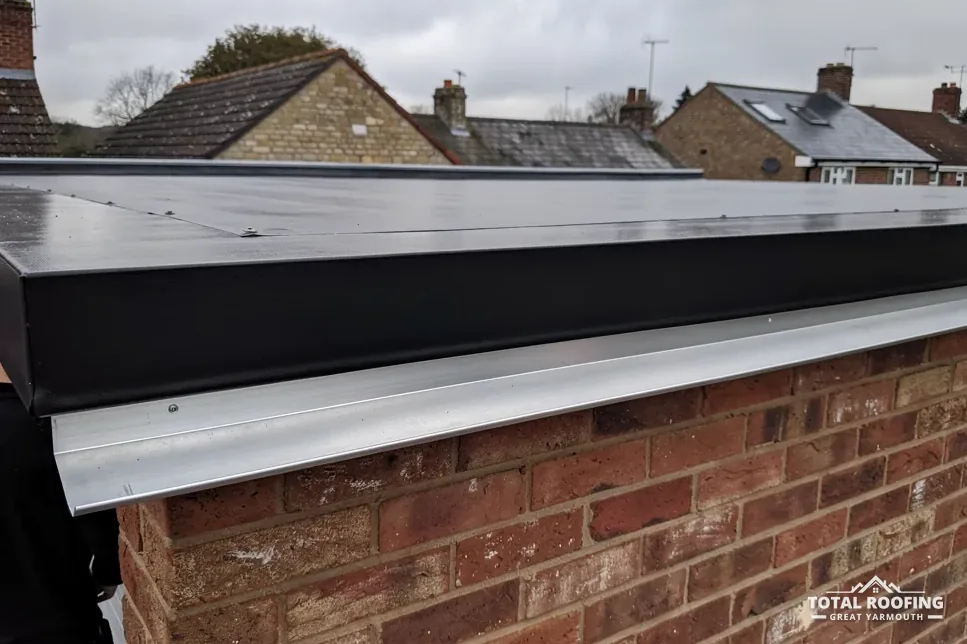
An edge trim finishes the covering at the perimeter, holds it down and throws water clear of the wall. When a trim works loose, wind can get under the covering and lift it from the edge inwards. A survey checks every trim, its fixings and the covering tucked beneath, and replaces any that have moved.
What the trims on a flat roof do
The covering on a flat roof is a sheet or a set of layers laid across a deck. Its edges are the points where it is most open to the weather, so they are finished with a trim, a shaped strip of metal or plastic fixed along the perimeter.
A drip trim sits at the low edge where water leaves the roof. It holds the covering firmly, and its lip stands clear of the fascia so that rainwater drops into the gutter and does not run back along the underside of the board. An upstand finish, sometimes with a flashing, caps the covering where it turns up a wall or a parapet, so that rain is kept from running in behind it. A verge or side trim does the same job along a gable edge.
These parts are small beside the covering itself, but the covering depends on them. A flat roof that is watertight in the middle can still leak at an edge whose trim has shifted.
Why edges lift in wind
Wind blowing across a flat roof pulls at the surface, and the pull is greatest where it first meets an edge. If a trim is loose, or the covering beneath has lost its bond, air can get under the edge and lift it. Once a corner is up, the gap lets more air in and the lifting works inward across the roof.
How hard the edges are worked depends on the site: an open plot, a gap between buildings and a sheltered corner all behave differently. That is judged on the roof itself, so the survey looks at the edge details whatever the surroundings, and a roof on open ground gets the closest look at its perimeter.
The work is set against BS 6229:2025, which covers flat roofs finished with continuously supported flexible waterproof coverings. Lead is outside its scope. Beyond that, the detail of each trim and its fixings is set by the roof and by the covering used on it, so two roofs on the same street can need different edge finishes.
What a roofer checks along the edge
The survey works along every edge of the roof, one side at a time. A list of what gets looked at:
- Whether each trim is straight, tight to the deck and free of gaps where two lengths meet.
- Whether its fixings are present, firm and not rusted or pulled through the strip.
- Whether the covering tucked under or over the trim is bonded, or has curled or cracked.
- Whether a lifted edge shows daylight, staining or a stripe of dirt that marks where water has been running.
- Whether upstands against walls and any flashing above them are tight and sealed.
- Whether the fascia and the gutter beneath have moved, since a sagging gutter pulls the drip edge out of line.
A trim with a small fault can sometimes be refixed and resealed. One that is bent, corroded or short of fixings is replaced, and the covering beneath is checked before the new trim goes on. A lifted edge on an old covering may be a sign that a larger repair is due, and the page on flat roof repairs explains how repairs are weighed against replacement.
Edge trims and the covering you have
The way the covering meets the trim depends on the material. A rubber EPDM sheet is taken over the edge and secured by the trim and by adhesive, and our page on EPDM rubber roofing describes how that sheet is laid. A GRP roof is moulded over a prepared edge and finished with its own trim, as the page on GRP fibreglass roofing explains.
If you can see a trim hanging down, a covering curling at the edge or a strip lying in the garden, take a picture from the ground and message it on WhatsApp to 07880 284133, or ring 01493 277103. Keep clear of the edge while it is loose and do not lean a ladder against a trim that may give way.
The survey covers the full roof, so other faults seen on the way round are reported too, and the work is priced as a single written sum once the survey is finished. The wider flat roofing section sets out the options if the whole covering is due for renewal.
