
The short answer
Moisture or air trapped under the covering causes a flat roof blister. Warmth makes the pocket expand and push the layers apart. A small, unbroken, dry blister can be cut open and patched, but a split blister, or a scatter of them across the roof, points to wet felt or deck below and needs a survey to judge.
How a blister forms in felt
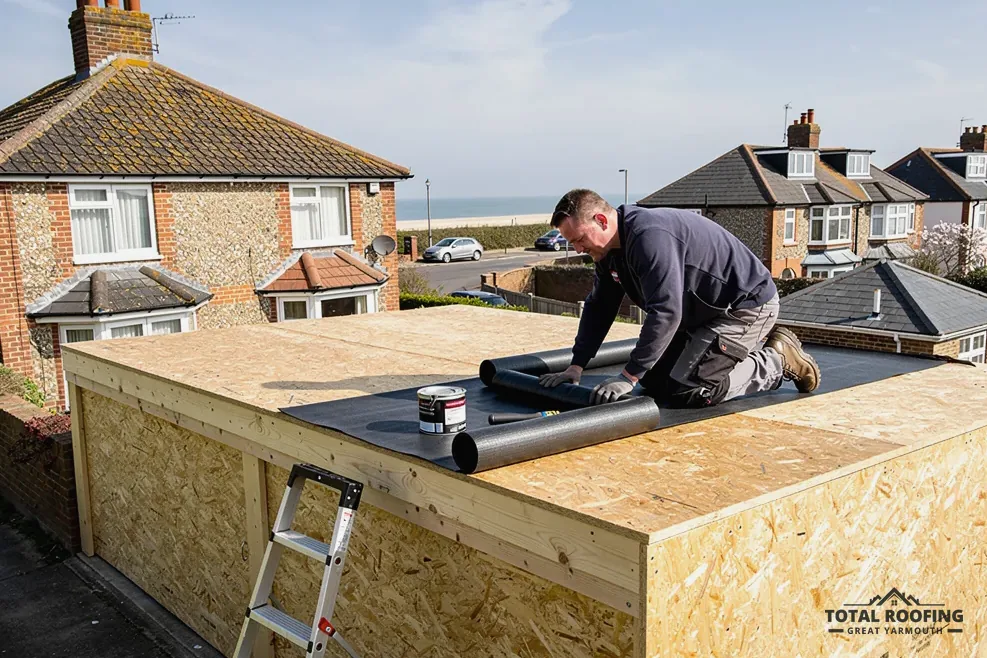
Built-up and torch-on felt are laid in layers, each bonded to the one beneath and the first layer to the deck. Where a patch of damp boarding, a pocket of air or a little rainwater from an old split is left between those layers, the bond is weaker. When the sun warms the surface, the water vapour or air in the pocket expands, and the felt above rises into a dome.
Cooling lets the dome settle, but the bond has gone, so the same spot lifts again on the next warm spell. Each cycle stretches the felt a little more, and a blister that has been flexed this way can crack along its crown. Rain then runs into the crack and the pocket below grows.
Blisters are a fault of the covering and the layers beneath it, not of the weather alone. That is why the cause is looked for under the dome as well as on it, and why painting over one does nothing for the pocket beneath.
What a survey looks at around a blister
The roofer wants to know whether the blister is a single local fault or a sign of wider moisture in the roof. A press with a gloved hand and a look at the felt around the dome tell a good deal before anything is cut. These are the checks:
- Whether the dome is intact, or has cracked or split on its crown.
- Whether the felt around it is soft, spongy or discoloured, which can point to wet insulation or boarding.
- The laps, edges and upstands nearby, where rainwater may have first got in.
- The outlets and any area where water stands, since a wet surface pushes more moisture towards the layers.
- The ceiling below, for staining or a sag.
We survey the full roof rather than just the spot you phoned about, and anything else seen up there is named in plain words, such as a second blister on a far corner or laps that have started to lift. A single dome and a roof covered in them are different problems, and the survey tells you which one you have.
Cut and patch, or something bigger
Where one blister is small, unbroken and the boarding below is dry, the repair in the trade is to open the dome, let the pocket dry, bond the layers back down and put a patch of covering over the cut. Painting or sealing over a blister without opening it traps the moisture and does not cure it.
Where the pocket is wet, the felt around it is soft or blisters appear across the roof, the damp is wider than one patch can reach. The wet layers or boards may need to come off, and that moves the job towards flat roof repairs of a larger kind, or a full re-cover.
Age matters here too. HomeBuilding gives felt an approximate lifespan of 10-15 years, while Less says torch-on felt lasts 10 to 20 years "depending on quality and installation". The two ranges overlap only at the lower end. A felt roof that has reached the far end of either range and carries several blisters is one to weigh for replacement, and the page on torch-on felt roofing explains how that covering is built up.
Getting a blistered roof looked at
Photos help us see the pattern of blisters before anyone climbs up. Take them standing on the ground, or at an upstairs window where the roof is in view without any leaning out, and send them on WhatsApp to 07880 284133. You can also ring 01493 277103. Do not go onto the roof to press or cut a blister yourself, since the felt around it may be softer than it looks and the deck beneath may be wet.
A photo shows where the domes sit and whether any have split, but it cannot show the state of the layers under the felt. Once the survey is done you receive a single price, written down, for the work the roof needs. The wider flat roofing section sets out the coverings, what each involves and how a repair differs from a replacement.
If the ceiling below has a stain, a bulge or a drip, say so when you get in touch, and put a bucket under any drip meanwhile. Water that has reached the room is a sign the felt has already been breached somewhere, and that detail points the survey towards the likely path of the leak.
