
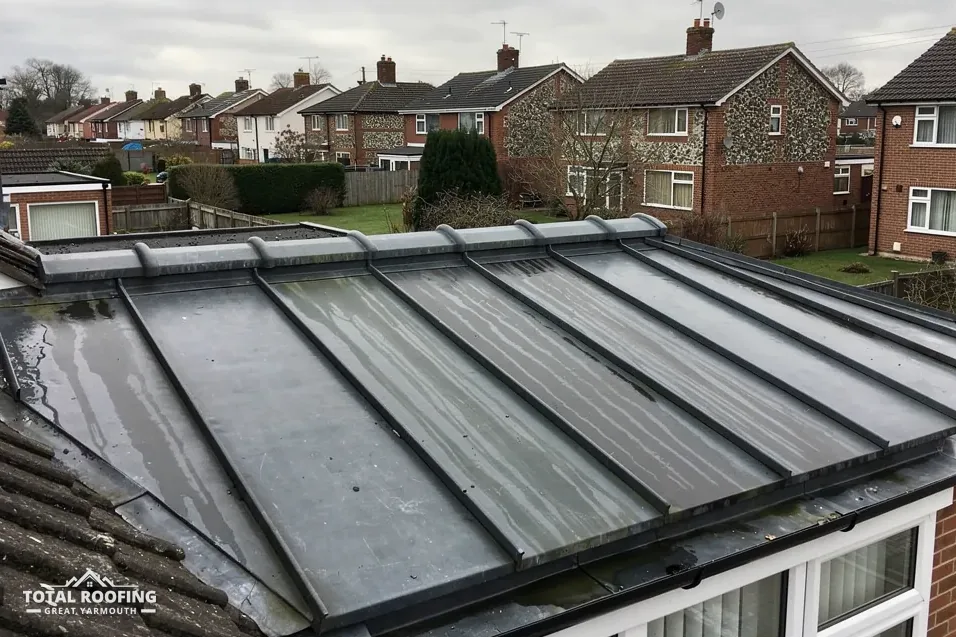
What a zinc roof is
A zinc roof is a roof covering made from sheets of rolled zinc alloy, cut to length and shaped on site. The sheets are laid in strips from the eaves to the ridge, each strip joined to the next, so the whole roof is a set of long panels and not a pattern of small tiles. The metal is thin, light and stiff, and it can be folded into sharp seams that a softer metal such as lead cannot hold.
It is sold as a sheet and also as pre-formed panels and trims. The maker's details control how the roof is built beneath the zinc: a solid or boarded deck, a separating layer under the metal and a gap for air where the design calls for one. The covering is only the top layer of a build-up, and a poor build-up beneath a good sheet is a failure waiting to show. The load a zinc build-up puts on the structure comes from the system's own data, and the timbers are checked against it as they would be for any covering.
Zinc is a metal that forms its own surface. Fresh sheet is bright, and it dulls over time as a protective layer forms on the face. That layer is part of why the metal lasts, and scratches in it repair themselves slowly. A roof whose colour shifts in its first years is behaving as the metal does, and a zinc roof does not need painting.
Lead and zinc sit in the same trade, which is why this guide belongs with the lead guides, but they are laid differently. Lead is dressed round shapes while it is soft. Zinc is folded and seamed, and the skill is in the layout of the seams. For the lead side of the comparison, see our lead flashing alternatives guide.
How long zinc lasts, and who says so
The lifespan figure comes from the maker. VMZinc says "When correctly designed and installed a zinc roof can last in excess of 100 years." The words that matter are the first and the last: correctly designed and installed, and can last. It is a statement about a roof built to the maker's details, and it is the maker's claim, not an independent test. Read the sentence in full before you repeat it to anyone else.
That figure sits beside the ones published for other coverings. MyJobQuote says correctly installed lead flashing can last for over 80 years, and HomeBuilding gives a lead flat roof 60-100 years while Less says lead lasts 50 to 100. The sources use different units, covering different parts of a roof, so they cannot be set in a table as if they measured the same thing.
What can be said is that zinc and lead are both long-lived metals when they are put on properly, and both fail early when they are not. A zinc roof that leaks after a few years has been let down by the seams, the fixings or the build-up beneath, not by the zinc. When you read a quote, ask what the roof is designed to and who answers for the details.
Costs depend on the area, the number of seams, the shape of the roof and the access, and they are set by the survey as one written total, so a zinc roof cannot be priced from a photo alone.
Myth
A zinc roof lasts a century whatever the build quality.
Fact
VMZinc: "can last in excess of 100 years" when correctly designed and installed.
Standing seam: how the sheets are joined
Standing seam is the best-known way to lay zinc. The sheet is cut to a strip that runs with the fall of the roof. Its long edges are turned up, and the edge of the next strip is turned up beside it. The two upturns are folded together into a raised seam that stands proud of the surface, and water runs along the flat between seams and off the eaves.
The sheets are not nailed through the face. They are held by clips fixed to the deck and folded into the seam, so the strip can slide a little as the temperature changes while the seam stays closed. That is the central idea of the system, and it is the same idea as the rolls and drips of a lead flat roof: let the metal move at its joints instead of nailing it through the face.
Seam layout controls how the roof looks as well as how it works. The lines run straight up the slope, evenly spaced, and a roof with curves or changes of pitch needs the seams planned from the start. A roof that has been set out badly shows it in uneven lines that no later repair can hide. Any of this can be shown in a sketch from the firm doing the work.
Cross joints, where one strip meets the next along the slope, are formed with a fold or a step, and they are another place where care counts. The deck beneath has to be flat and fixed firmly, because a seam laid over a dipping board puts a strain on the fold.
How a standing seam roof goes on
- Check the deck is flat, dry and fixed
- Lay the separating layer over the deck
- Fix clips along the line of each seam
- Lay each strip and turn up its edges
- Fold the seam over the clips
- Form the ridge, eaves and wall details
Where zinc suits a roof
Zinc suits shapes that tiles cannot follow. A curved roof, a barrel-vault extension, a shallow pitch or a tall dormer face can be covered in one run of seamed metal. Whatever the shape, the structure beneath is designed for the weight of the build-up that the specification names.
It also suits modern extensions on older houses, where a contrast in material is chosen deliberately. A zinc box added to the back of a house is a design decision, and the planning side of it is a question for the council. In the Broads, a conservation area or a National Landscape the rules are tighter, and the planning permission guide for roof work sets out the position.
On dormers and bays, zinc can cover cheeks and tops where lead would otherwise be used. The lead dormers guide describes those parts, and zinc follows the same parts with a different method. Its stiffness makes it better for flat, even faces than for the tight angles of a canted bay, where lead can be dressed.
A listed building raises a further question. A change of covering that alters the building's character needs listed building consent, and the council decides. Zinc on a building that carried lead or slate is a change of material, so the council is asked before any metal is ordered.
Limits, and what to ask about
Zinc has limits. It is a hard metal, so it cannot be dressed into a shape the way lead can, and tight three-dimensional corners are made from folded and soldered pieces rather than pushed into place. A roof full of small awkward details may be better in lead, with zinc on the broad faces.
Noise is another point. Metal roofs ring in rain unless there is something under them to absorb it, and a zinc roof over a bedroom needs its build-up considered for that reason. The build-up also controls condensation, so the layers below the zinc are as important as the metal on top.
Contact with other metals is a point the maker's details deal with, and a detail that puts zinc in contact with the wrong material or a wet timber is a detail to question. Ask the firm quoting which build-up they are following, and ask for the maker's name.
Last, ask about repair. A damaged seam on a zinc roof is repaired by opening the seam, replacing the strip or a section of it, and folding it closed again. It is not a patch of sealant. The same applies to any metal roof. A seam that has been opened and closed properly is as sound as the day it was made. Mixed roofs are common enough to plan for. A roof can carry zinc over the broad slopes and lead at the awkward junctions, because each metal does what it does well, and a good survey says where the line between them falls.
What to ask before choosing zinc
- Which maker's details is the roof built to?
- What build-up lies under the zinc?
- How are seams, clips and cross joints set out?
- What happens at walls, dormers and rooflights?
- Does the building need consent for a new covering?
- How is a damaged seam repaired later?
Zinc, lead and the written quote
Choosing between zinc and lead is a choice of detail. Lead is soft and takes every shape, and zinc is crisp and clean on straight runs. A roof can carry both, with zinc on the main faces and lead at the awkward junctions, and a survey says where each belongs.
The deck beneath a new metal covering carries the weight of the job, so the boards, the joists and the rest of the roof structure are looked at before any metal is priced, and the whole roof is surveyed with them, so you hear plainly about anything else on it. A new zinc covering laid on a tired deck takes its faults with it.
One written total comes after the survey, and scaffold sits within it. Any scaffold on the pavement is licensed, and we arrange the licence with our scaffolder. Put the same questions to every firm: which metal, which build-up and which seam system, so the figures describe the same roof.
Our lead roofing and leadwork page gathers the lead guides, and a WhatsApp photo of your roof is a fair way to start. If the roof has leaked before, mention where. A stain under a seam, a damp patch at a wall or a run of drips below a gutter all point to a place to check, and a note of when the water came in helps tie it to the weather. The survey then follows the water to its cause.
