
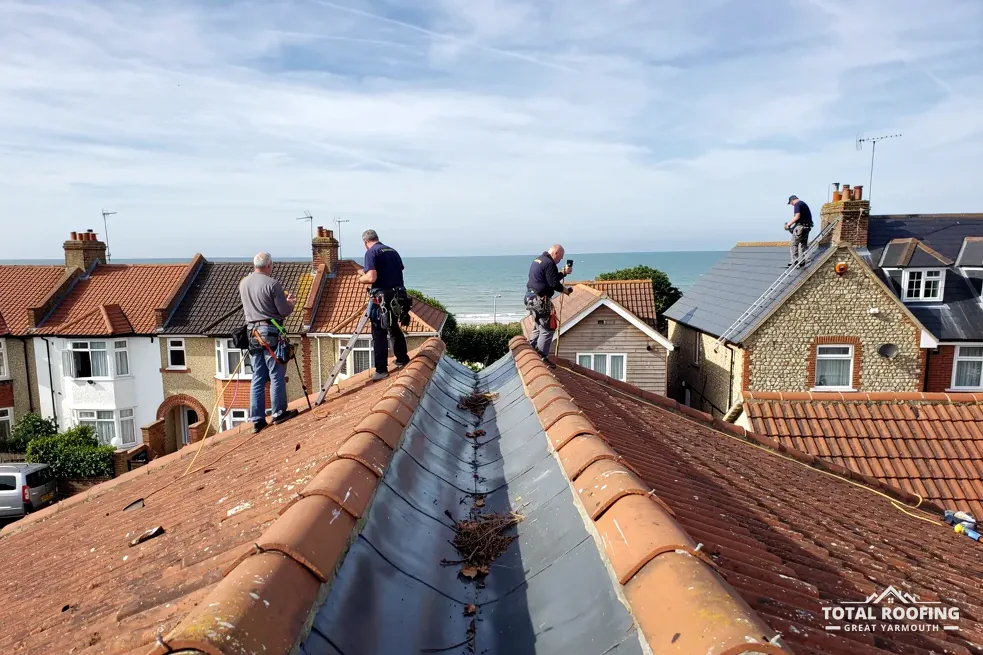
What a valley does and why it works hard
Where two roof slopes meet at an inward corner and run down towards each other, the line between them is a valley. Rain from both slopes collects in the fold and runs along it to the gutter at the foot. The valley is therefore a channel on a roof, and it carries the run-off from two planes of roof, not one.
Under the covering, a valley is built on a timber base called a valley board, which gives the lead a flat, continuous surface to lie on. The lead is laid in the board's length as a lining, with the edges of the tiles or slates on each side stopping short of the centre line so that a width of lead stays visible. That visible strip is the part that takes the flow.
Lead suits the job because it can be shaped by hand to the angle of the fold and stays watertight when its joints are formed properly. The code of the sheet is chosen for the position and set out in the specification, as our guide to lead codes explained describes. A valley is one of the most heavily worked places on a roof, so the lining matters more here than on a short flashing. Debris and moss gather in the channel as well, and a blocked valley pushes water sideways under the edge of the tiles, so the cleanliness of the channel is part of how well the lining works.
How a lead valley fails
Valley linings fail in a few recognisable ways, and each has its own cause. Knowing the cause matters, because patching a split without understanding why it formed lets the next one form beside it.
| Fault | Cause | What shows |
|---|---|---|
| Splits | Metal fatigue from movement | Cracks across the lead |
| Short laps | Joints too small for the pitch | Water tracking under a joint |
| Holes | Foot traffic or dropped tools | Pinhole or torn patches |
| Blockage | Debris trapped in the channel | Water backing up the slope |
| Theft | Lead removed for its scrap value | Bare boards in the fold |
Several of these show only inside the roof, which is why a valley fault can stay hidden for a long while. Rain that tracks under a lap does not drip at once: it soaks the board, runs along a rafter and shows on a ceiling some distance away from the real fault. Heavy staining and soft board are more serious than a single drip, because they show water has been getting in for some time. A stain on a ceiling below the valley line, damp on a rafter in the loft or a patch of rot in the valley board can be the first evidence, because the lead surface itself may look intact from the ground.
Where valley trouble shows
- Ceiling stain beneath the valley line
- Damp rafters or boards in the loft
- Moss or debris packed in the channel
- Tiles lifted along the valley edge
- Bare boards where lead has gone
Splits, movement and undersized laps
Lead moves. It grows in warm weather and shrinks in cold, and over many cycles a sheet that is not free to slide will fatigue and crack. A valley lining laid as one long sheet with nothing to let it move can split across its width. Longer valleys are built in lengths, with joints between them that let each length slide a little, so the movement is taken up at the joints and not by the sheet.
That is where laps come in. A lap is where one length of lead runs over the next, and the joint is only as watertight as that overlap is deep. The depth that is needed rises as the roof gets flatter, because water runs more slowly and can be pushed further under an edge. An undersized lap, one that was formed too short or has been pulled out by movement, lets water travel under the joint onto the board below.
Both faults begin in the specification and the fixing, not in the lead itself. A thick sheet with short laps leaks and a correct lap in thin sheet can split. The sound answer sets the code, the length of each piece, the lap and the fixing together, and a valley lined that way is far less likely to split at a fold or leak at a joint. Our guide to types of lead flashing shows how the other pieces on a roof are put together to deal with movement.
Myth
A split valley only needs a patch of fresh lead dropped over the crack.
Fact
A patch on fatigued lead can split again beside it; the cause has to be found first.
Patch, repair or replace the whole valley
Where the lead is sound and a single hole or short split is the only fault, a patch can be a proportionate repair. A properly made patch is formed and fixed so that water runs over its joints, not into them. It is not a layer of sealant spread over a crack, which holds until the lead moves again.
Where the lead is fatigued along its length, has several splits or has joints that are too short for the pitch, a patch is a short-term answer to a long-term problem. Full replacement renews the board if it is damp or soft, lays a new lead lining with correct laps and refixes the tiles at each edge. A valley that has needed several repairs is a candidate for this.
MyJobQuote's lead figures apply to chimney leadwork alone, so they say nothing about a valley. A valley is priced after a survey, because its length, the code of lead, the state of the board and the way the roof is reached all change the work. The survey takes in the whole roof, and not just the valley you rang about, and says plainly what else turned up. Our guide to what lead flashing costs shows the figures that do exist and what each covers.
Lead or GRP in a valley
GRP, glass-reinforced plastic, is the other lining a valley can have. A resin is laid over glass-fibre matting on the valley board and sets into a single sheet with no seams. Because there are no laps, there is nothing for water to track under, and there is no sheet to fatigue in the way lead can.
The comparison is not one-sided. GRP is a rigid shell, and if the board beneath it moves, the shell can crack where the movement concentrates. It is also not formed by hand into the fold in the way lead is, and it needs a dry surface and suitable conditions when it is laid. Lead is repairable in place, and a small split can be patched. A cracked GRP shell needs the area ground back and recovered.
A lead valley and a GRP valley can both last when they are built on a sound board. Neither lining wins on every roof. The choice depends on the length and shape of the valley, the state of the board, the covering on each side and what the owner wants to see: lead has a visible metal strip, while GRP is painted or finished to colour. We look at the roof, give a view and put one written total price on the option chosen.
Lead and GRP side by side
- Lead: formed by hand, joints are laps
- Lead: a split can be patched in place
- GRP: one resin sheet without seams, no laps
- GRP: cracks if the board beneath moves
- Both: laid on a sound valley board
Access, scaffold and theft
A valley low on a roof may be reached with a ladder laid on the slope. On a tall house, or where the valley sits deep between two high slopes, a scaffold is needed to work safely. Erecting it is a large part of the effort, which is one reason valley jobs differ so much. Scaffolding on the pavement or road needs a highway licence from the county council, and we arrange the licence with our scaffolder.
A valley can share a scaffold with other work. A ridge, a chimney or a bargeboard on the same side of the house can all be reached from one scaffold, so a valley job is a good moment to raise anything else that needs height. Where a valley job needs scaffold, our written quote carries it within one total.
Lead has a scrap value, and that is why it is taken from roofs. A valley that has been stripped leaves bare boards in the fold, and rain then soaks the structure beneath. If lead has gone, let your insurer know and photograph the damage before anything is shifted. A replacement valley is then a matter of restoring the lining on a sound board, and the survey says whether the board itself needs work. The new lining goes on a sound surface, never on a board that has taken water, because rot beneath the lead would undo the repair from below.
What a replacement involves and how long lead lasts
On a full replacement the tiles or slates along both sides of the valley are lifted and set aside, the old lead and board are checked, any soft board is renewed and the new lead is laid with its laps and fixings as the specification sets out. The covering is then refixed to the standard that applies to the roof. The tiles at each edge are cut to the valley line where they need it, and the lead is left standing clear of them so water has a clear run down the channel. Tile fixings are set by a site-specific fixing specification under BS 5534, which allows for how exposed the roof is.
Tile and slate along the valley edge are also looked at during a replacement, because a cracked or slipped piece there lets water onto the lead from the side instead of down the channel. MyJobQuote says lead flashing that is correctly installed can last for over 80 years. That is the cost guide's wording for flashing, offered as a general statement, and it is not a promise for a valley. It does indicate why a well-made lead valley can be a sound long-term choice where the board is good and the joints are formed to suit the pitch. The hub for lead roofing and leadwork brings the guides on each detail together.
