
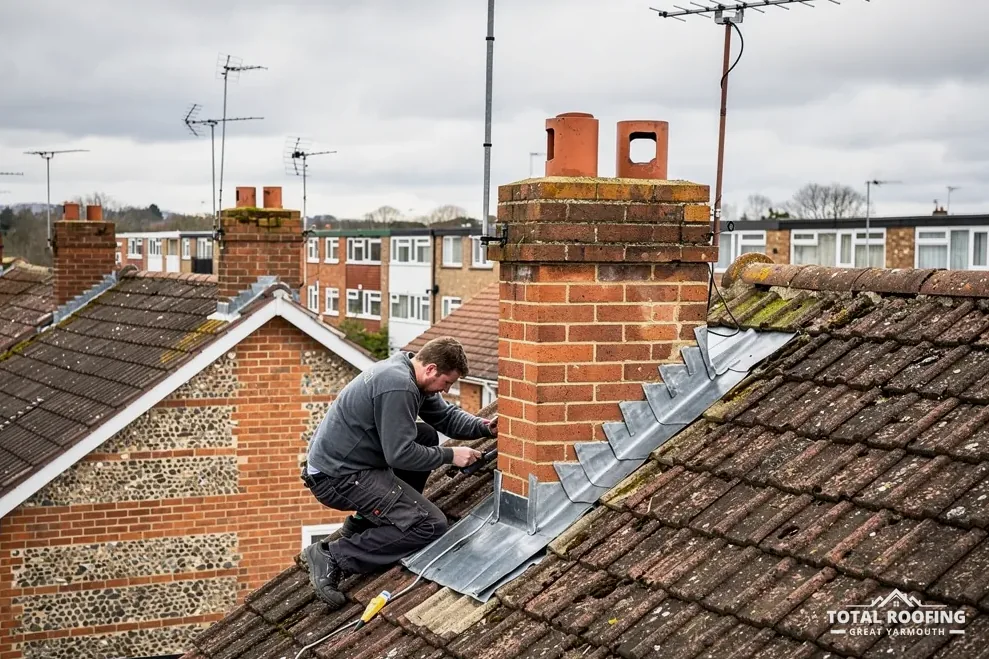
What decides the price of lead flashing
Lead flashing is a strip of lead sheet sealing the joint at which a roof meets something taller, a chimney stack, a gable wall or the side of a dormer. Because every joint is different, a flashing price is set by the job in front of the roofer, not by a standard rate. Five things set the figure: how much lead the detail needs, which code of lead is specified, how awkward the junction is to form, how the work is reached, and what has to be taken apart first to get at it.
The quantity of lead is the simplest of the five. A short flashing at the foot of a small chimney uses far less sheet than a long run beside a gable wall, and the cut and dressed pieces are measured to each junction. The code, meaning the thickness and weight of the sheet, changes the material cost as well. Our guide to lead codes explained shows the range, and the lead roofing and leadwork hub places flashing among the other lead details on a roof.
Form and access come next. A step-by-step run of stepped pieces up a gable takes more cutting and fitting than a single apron on a flat face. A chimney in the middle of a ridge is harder to reach than one at the eaves. Where the roof is high, the scaffold stands for the whole job, and in practice that can be a large part of what the household pays. A flashing that is a short walk from the ground costs differently from the same flashing on the third storey, even though the lead itself is identical.
The dated figures that exist for lead work
Third-party cost guides give a few figures for lead, and each applies to one kind of job. They are the only numbers worth quoting, because a figure borrowed from one detail and applied to another gives a false picture. The first source is MyJobQuote, whose lead page was last updated on 22 September 2026. It writes: "A chimney lead flashing patch repair typically costs around £200, while a full replacement averages around £570." The same page puts a full leadwork replacement at "between £350 and £920", with the spread depending largely on scaffolding.
Those are chimney figures only. They describe chimney leadwork only, and they are not a price for valleys, bay windows, flat roofs or leadwork in general. MyJobQuote does not state whether its figures include VAT, so that question stays open for any figure you compare them with.
The second source is Checkatrade, whose roof repair guide has a price table last updated in June 2026. It gives lead flashing repairs at £50 to £70 per metre, and says all its costs are exclusive of VAT. That is a rate per metre of flashing, not a total for a house, and it should not be multiplied up into a job price without a measured length.
Lead flashing: sourced figures
| Chimney lead patch repair (chimney only) | around £200, chimney leadwork only |
|---|---|
| Chimney lead full replacement, average (chimney only) | around £570, chimney leadwork only |
| Chimney full leadwork replacement (chimney only) | £350 to £920, chimney leadwork only |
| Lead flashing repairs, per metre | £50 to £70 per metre |
MyJobQuote chimney leadwork page, last updated 22 September 2026, no VAT basis stated; Checkatrade roof repair guide, price table last updated June 2026, exclusive of VAT. The written quote after a survey is one total price.
Why scaffold drives so much of the cost
MyJobQuote links its chimney leadwork range to scaffolding more than to anything else. That one qualifier explains the width of the chimney range from £350 to £920. A chimney reached from a low roof with a roof ladder is a short job. The same flashing on a tall house with a steep roof needs a scaffold to work safely, and putting up and taking down a scaffold costs more than many repairs.
Scaffolding over a footway or a carriageway is licensed by the county council under the Highways Act, and we arrange the licence with our scaffolder. Where a job calls for scaffold, it is built into the single total on our written quote, which is why you get one figure instead of a scaffold number to set beside someone else's.
A flashing repair is worth planning alongside other work at height. A chimney, a ridge or a valley that all need attention can share one scaffold, where separate visits would each need their own. A chimney, a ridge or a valley that all need attention can share one scaffold, where three separate visits would each need their own. If other work is waiting on the same elevation, say so when you ask for a survey.
Repairing a patch or renewing the flashing
A flashing that has lifted at one end, or cracked along a single fold, can sometimes be repaired with a patch. A flashing that has split in several places, been torn by movement or is simply too thin for its position is a candidate for renewal. The MyJobQuote gap between its patch figure of around £200 and its full-replacement average of around £570 shows how large the step can be for a chimney.
A patch holds only where the lead beside it is sound. Lead that has thinned, work-hardened or been overstretched over years cannot always be patched back to a lasting repair, and a patch on tired lead can fail beside the repair instead. That judgement is made on the roof, from the condition of the surrounding sheet, not from the ground.
We survey the whole roof, not only the flashing you rang about, and say plainly what else turned up. If the lead is sound and a patch will hold, that is what the written quote covers. If the lead needs renewing, the quote says so and gives one total price for the work. Our guide to types of lead flashing explains the different pieces involved in a renewal.
What changes the price of a flashing job
- Length of flashing to be formed
- Code of lead specified
- How many junctions or steps
- Height of the roof and access
- Work needed to open up the joint
How long lead lasts and what that does to value
Lead is more expensive to buy and fit than some other flashing materials, and its life is part of the case for it. MyJobQuote says lead flashing installed correctly can last for over 80 years. That is a source's wording about correctly installed work, not a promise for any individual flashing, and it depends on the detail being formed and fixed properly in the first place.
A flashing that lasts that long is paid for once rather than several times. A cheaper material that needs replacing within a shorter span can cost more over the life of the roof, though sources do not give a figure that lets us put numbers on that comparison, so it stays a point of judgement and not a calculation. Our guide to lead valley replacement shows where the same reasoning applies to a valley.
What shortens the life of a flashing is the detail rather than the metal. A lap that is too short lets rain run behind it, a fixing that pinches the sheet tears it as it moves with the temperature, and a joint filled with sealant instead of formed properly fails when the sealant does. Those are faults in the installation, and a faulty detail is one reason lead is renewed before its time.
Reading a quote for lead work
If you have a quote from another firm, ask what it covers before comparing totals. A quote for a chimney flashing should say which flashing pieces are being replaced, what code of lead is specified and whether the price covers the scaffold. Two totals that look apart may describe different jobs, one renewing every piece around a chimney and the other only the apron at the front.
Ask also how the lead is to be fixed and the work is being fixed and finished, because two quotes can name the same sheet and still describe different details. Lead is dressed into the wall or chased into a mortar joint and sealed in the way the specification sets out, and a quote that names only the sheet and says nothing about the fixing leaves a question unanswered. The same goes for the finish at the top edge, where the lead meets the wall.
Our written quote is one total price after a survey. Length, code and access can only be judged on site. If you would like us to see the flashing first, send a photo by WhatsApp: it can show whether a patch looks possible or a renewal looks likelier.
Party walls, chimneys and other points that touch the cost
Two legal points can sit beside a flashing job. A flashing cut into a wall that you share with next door is work to a party structure under the Party Wall etc. Act 1996, and the building owner, not the roofer, must give the next-door owner notice, at least two months before the date on which the proposed work will begin. A notice is a step for the owner to take, and a party wall surveyor, not building control, answers questions about it.
Removing a chimney breast is a different matter. Removing a chimney breast always needs Building Regulations approval, since it forms part of the structure, and a party wall notice as well where the breast stands on a party wall. If a chimney is to come down, its lead goes with it, so the flashing figures above stop applying and the job is priced afterwards as a whole.
None of this changes the quote itself. What it does change is the order of events, since a notice period can sit in front of a start date, and a neighbour who dissents starts the party wall surveyor process, which is not a veto. If you are unsure whether your wall is a party wall, a photo on WhatsApp showing the flashing and the wall helps us see the position.
