
The short answer
You can legally do it on your own home, but it is hard to do well and risky at height. Lead has to be cut, dressed and fixed to suit the roof, the wall may need chasing, and a shared wall brings in the Party Wall etc. Act 1996.
The work behind a strip of lead
From the ground a flashing looks like a single sheet laid along a wall. Fitting one is a series of separate jobs. The old lead has to be taken off without disturbing the tiles beside it. A line has to be marked and a groove cut in the wall for the top edge. The new lead has to be cut to length, dressed over the covering, wedged and pointed, and its lower edge held down.
Every one of those steps can go wrong in its own way. A sheet cut too long splits as it expands. A groove cut into the wrong part of the brickwork breaks a brick. A lower edge left unclipped lifts in the first strong gust. Our page on how lead is chased into a wall shows what the groove involves.
Leadworx, a lead flashing maker, says lead sheet comes in codes from 3 to 8 under BS EN 12588, and that code 4 has become the standard choice for general flashing work. Picking the code that suits each detail falls to whoever writes the specification, and a wrong pick can surface years later.
Height, access and scaffold
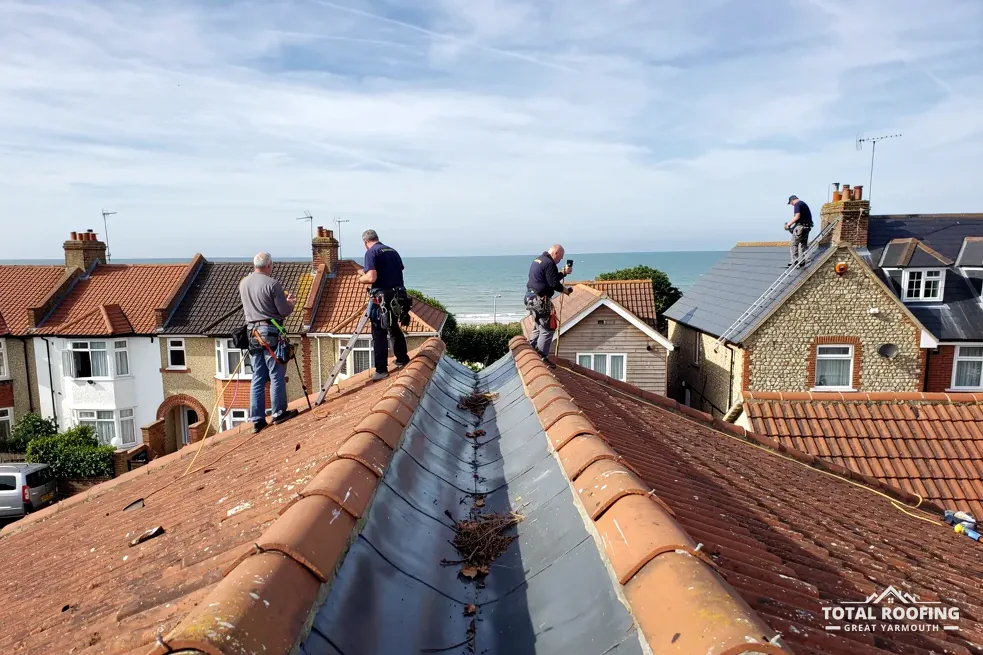
A lead flashing is fitted at the line where a slope runs into a wall or a stack, so the work is done beside an edge, on a slope, well above the ground, with one hand needed to hold the sheet. Falls from ladders and roofs are a serious risk in any roofing job, and a ladder leaning on a gutter or a wet slope adds to that risk. Lead itself is slippery on a wet day, and wind catches a sheet in the hands.
Work on a two-storey house calls for scaffold. Putting scaffold on the pavement or road takes a highway licence from the county council, and we arrange the licence with our scaffolder. A homeowner who hires a scaffold directly has to deal with that licence as well, which is an extra step.
- Work on a ladder against the roof edge is the weak point of a do-it-yourself job.
- A wet or frosty slope makes any footing unreliable.
- Wind makes a loose sheet of lead hard to hold still.
- Moving old lead and new rolls up and down adds weight to every trip.
Handling lead, old roofs and shared walls
Lead is a toxic metal. A cut edge and the dust from old lead should be handled with care, and hands washed before eating, drinking or smoking. Old lead on a roof is also heavy, and it has to go somewhere once it is stripped.
Dust and debris from chasing a wall, or from the roof next to it, deserve attention as well. HSE's advice on age is blunt: "If the building was built or refurbished before 2000, assume that there is asbestos in it". A flashing beside old cement sheets, a soffit or a chimney stack is a reason to find out what a material is before it is cut or scraped.
If the flashing sits on a wall shared with a neighbour, cutting into it can be party structure work. The Party Wall etc. Act 1996 section 2(2)(j) lets a building owner "cut into the wall of an adjoining owner's building in order to insert a flashing or other weather-proofing". The notice has to reach the neighbour "at least two months before the date on which the proposed work will begin", and the neighbour is free to dissent. A homeowner doing the job alone would be the one serving it.
When to call a roofer
A small, low flashing that a person can reach from a stable base, with no chasing and no shared wall, is the kind a confident handyman might consider. The moment the work involves a chimney, a ladder against the eaves, a party wall or old materials that may contain asbestos, the sensible step is to have it surveyed.
The survey looks at the flashing and also at the pointing, the tiles around the lead and the timbers beneath, because a leak at a junction can come from any of them. We tell you what we found, and quote one written total. For a sense of scale, Checkatrade's June 2026 table gives lead flashing repairs at £50 to £70 per metre, exclusive of VAT, a rate per metre that is not a job total.
Before you do anything, message a photo to WhatsApp on 07880 284133, and read our guide to the signs lead flashing has failed. The lead roofing and leadwork hub lists the rest of the topics.
