
The short answer
A damp patch on a ceiling near a chimney or party wall, a split or lifted edge in the lead, a gap at the brickwork and a flashing that has slid down its slope all point to failure. Any one of them is reason enough for a closer look.
What shows indoors
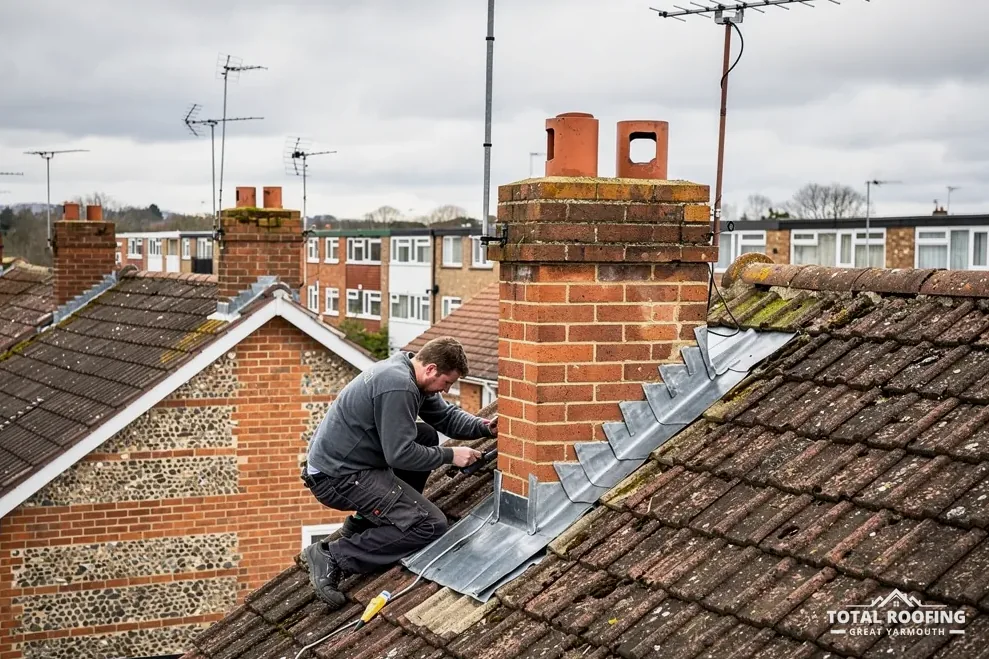
Householders meet a failed flashing first as damp, not as a fault in the metal. A flashing is the lead that seals the line where roof covering butts up to a wall, a chimney or a dormer cheek, so water that gets past it turns up at the matching spot inside the house.
Watch for a brown or yellowish stain on the ceiling or wall close to a chimney breast, a party wall or the edge of a dormer. Paint blistering along a wall beside the roof line is another clue, as is a damp smell in a bedroom below a junction. In the loft, check the timbers next to the stack for dark, wet patches, and the roof covering's underside around it for staining.
A stain is a clue to the area, not the exact spot. Rain can track along a rafter or a pipe and drip a metre from where it entered, so a ceiling mark names the junction to inspect and nothing more. A stain that spreads after rain and dries in dry weather makes a roof junction a strong suspect. Photograph the stain with a coin or a tape beside it and date the picture, so you can show later whether it has grown.
What shows on the roof
The lead itself gives plainer signs. These count as failure, whether seen from a ladder at the eaves by someone competent to be there, through binoculars from the ground, or in a photo sent to us.
- A split or hairline crack running along a fold, or at the point where the lead is fixed.
- A corner or edge standing proud of the tiles, open to the wind.
- A gap between the top edge of the lead and the wall, where the pointing has crumbled or the sealant has pulled away.
- Lead that has slid down the slope, leaving bare brickwork showing at the top of the joint.
- A tile or slate resting on the lead and pushing it out of shape, or lead that has been trodden flat.
- Sealant smeared thickly over a joint, which suggests an earlier attempt to hide a gap.
None of these is a matter of age or colour. A flashing that has turned dull grey is only showing patina, the natural surface layer that protects lead, and our answer on how long lead flashing lasts explains why grey is no cause for worry. Look at the lower edge as well: lead should lie over the covering, and a gap between the two is a place for wind-driven rain to enter.
Signs that look like lead trouble but are not
A leak beside a chimney is not always the lead. Several other faults make the same stain, and sorting them out before any repair saves paying for the wrong job.
A slipped or cracked tile near the stack lets water in at the same spot. A blocked or overflowing gutter can soak a wall until damp shows inside. Crumbling mortar in the chimney stack itself can let rain into the brickwork above the lead, and condensation on a cold chimney breast can leave a patch that has never seen a drop of rain.
The way to tell them apart is to inspect everything around the junction at once: the lead, the pointing, the tiles beside it, the gutter below and the stack above. A repair to the lead alone can leave the stain exactly where it was. For the named pieces of a chimney's leadwork and what each does, see our guide to types of lead flashing.
What to do when you spot one
Do not go up onto the roof to look. Work at height injures householders, and lead is easily bent or cracked by a boot. Stay on the ground with binoculars, photograph the stain indoors and, if you can, the junction from across the road or the pavement.
Photograph the damage before anything is moved if it follows a storm. The Financial Ombudsman Service says: "we'll usually look at expert reports and photos", and that "Rain, hail or snowfall by itself can constitute a storm". Tell your insurer before repairs are made, and keep the photos with the claim.
After that, either ask for a survey or send a photo of the junction to our WhatsApp number. The flashing, the covering and the stack are all examined, and you get one written total. The repair or replace lead flashing page sets out how that choice is made once the fault is known, and the lead roofing and leadwork hub lists the lead jobs we cover.
