
The short answer
Yes, we work on large industrial roofs within 30 road miles of Great Yarmouth, which takes in the industrial estates around the town. What shapes the job is access, whether the sheets are fragile or asbestos cement, and construction duties under CDM 2015. A survey comes before any price.
Reaching a large industrial roof
A unit on an industrial estate can have a roof the size of several houses, standing high above a yard that is busy with delivery traffic. Getting a roof team and materials to it takes planning before the first sheet is touched. The questions are practical: where vehicles can stand, which route avoids loading bays, whether a mobile platform or scaffold is needed, and how to keep the public and staff out of the fall zone.
Where a scaffold or platform has to stand on a footway or on the road, a licence is needed under Highways Act s169 from the county council, and we arrange the licence with our scaffolder. Estate roads that are private are a matter for the estate's owner or manager, who sets what is allowed on them.
Neighbouring tenants matter on a terrace of units. A repair on one bay can need the neighbour's yard or access across it, and where it involves a shared wall or gutter the party wall rules and the leases come into it.
Fragile sheets and asbestos cement
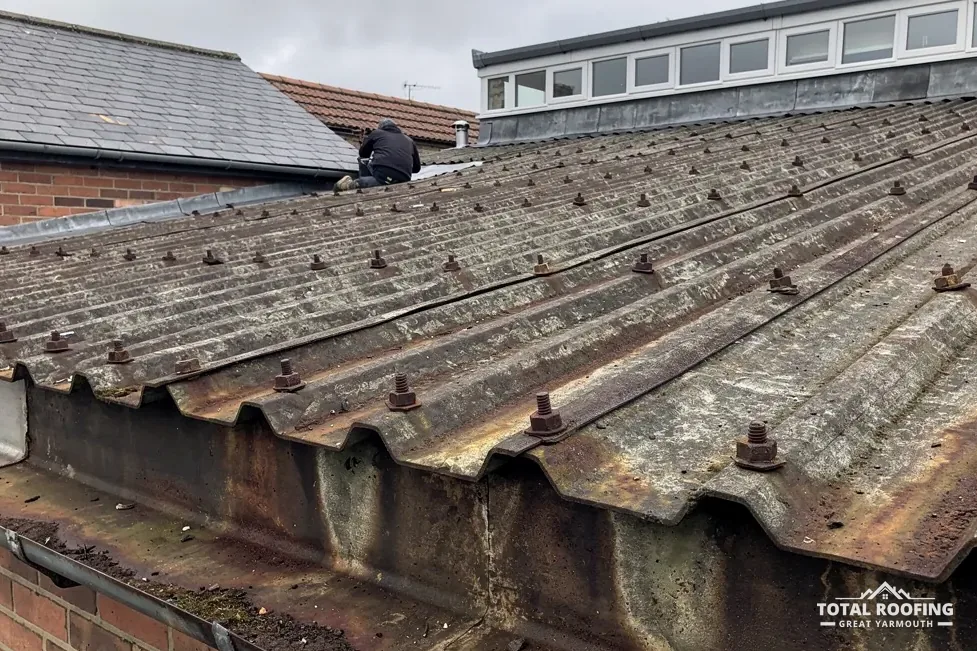
An industrial roof can be profiled steel, fibre cement or a mix, with rooflights set into it, and a rooflight is a weak point in any of them. An aged plastic or glass-reinforced panel can look solid and still give way, so the roof is handled as fragile until shown otherwise. Our fragile roof safety page explains the access methods.
Asbestos needs a separate decision. HSE's guidance reads: "If the building was built or refurbished before 2000, assume that there is asbestos in it." Fibre cement sheeting on such a roof is treated as asbestos cement until a laboratory test of a sample says otherwise, and repairs that would break the sheets are planned accordingly, and HSE guidance A14 says "AC roofs are always fragile". A cracked AC sheet is not patched by whoever happens to be on site.
HSE also says to "Use a lockable skip for asbestos", so waste from a roof like this is handled separately from ordinary skip loads.
Who carries the duties under CDM 2015
Roof work on a business premises is construction work, and CDM 2015 applies to it. That brings duties about planning, about who controls the site and about keeping people safe, and they start before anyone goes up a ladder. HSE's domestic client is a person whose home is being worked on, with the work "not done as part of any business". A unit on an estate falls outside that, so the owner or occupier is a commercial client with duties of their own.
The regulations are plain on the plan. With one contractor, that contractor draws up a construction phase plan; with several, the principal contractor does. Every project has one. Our CDM on commercial roof work page sets out who carries which duty.
That means agreeing early who controls the roof, who controls the yard beneath it and who tells staff and neighbours which areas are closed. On a busy site, some of the risk sits at ground level, in the yard, not up on the sheets.
What we survey and how the price follows
A survey of a big industrial roof covers a defined set of parts.
- Sheets and laps, and whether any are cracked or lifted.
- Fixings, washers and the purlins they hold to.
- Rooflights and the seals around them.
- Gutters, outlets and downpipes.
- Flashings, ridges and edges.
- Cut edges on steel, where rust can start; see our page on cut-edge corrosion.
Our survey at Total Roofing Great Yarmouth takes in the full roof and not just the leak that started the enquiry. Everything it shows, including anything else we notice, is reported to you plainly. One written total price follows, covering how the roof is reached too. An industrial roof has no standard rate here: area, access and the state of the sheets change the work, so each is priced after its own survey.
Describe the unit, the roof type if you know it and where the leak shows, and send a photograph by WhatsApp if you can; stand on the ground to take it, and keep off the roof. The wider range of work for business buildings is under commercial roofing.
