
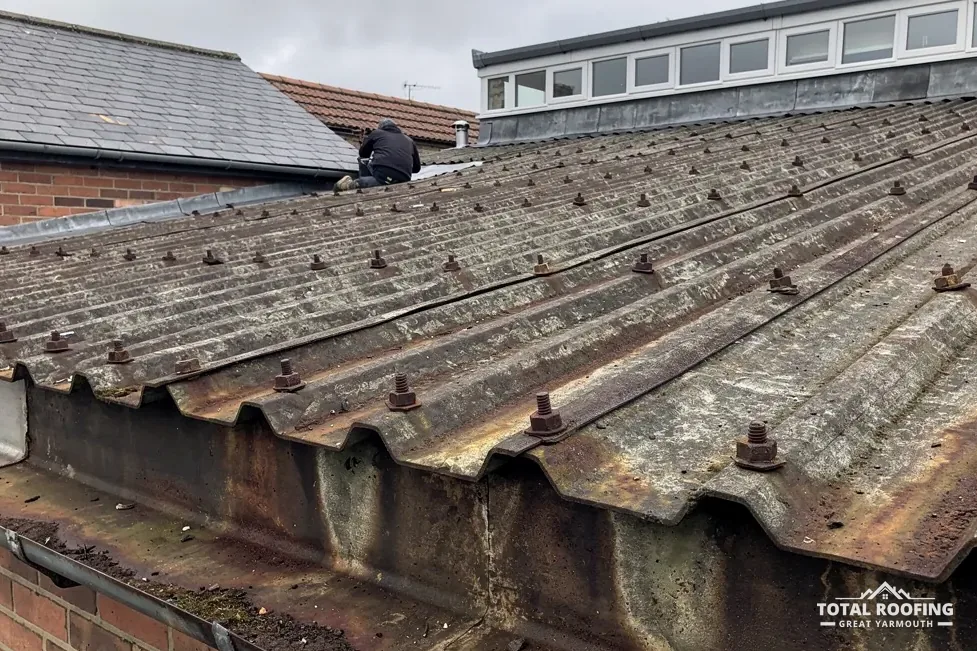
What a commercial roof survey is
A survey is a planned examination of a roof by someone who is looking for faults, not for work. It records the roof's present condition: what the covering is, how it is fixed, where it has worn, where it has failed and what is likely to fail next. The roof of a shop, an office, a guest house, a workshop or a warehouse can be surveyed this way, and the same method applies whether the covering is metal sheet, membrane, felt, tile or slate.
A commercial roof survey can be wanted for several different reasons. A leak has appeared and the owner wants the cause traced. A building is about to be bought, sold or let and somebody needs to know what the roof will cost. A planned maintenance schedule is being set up, as in our guide to planned maintenance for commercial roofs. A lease is ending and the question is who owes what. Each reason shapes what the survey stresses, but the roof itself is examined in the same way.
The survey comes before the price. We survey the roof before quoting, and the quote we then give is a single written total, so the work described is the work the survey found. You can send us a photo on WhatsApp first and we will look at it, but a photo taken from the ground cannot stand in for the survey on the roof.
One thing a survey is not is a sales visit. It is worth asking anyone who offers one what you will receive at the end, in what form and when, and whether they are quoting for the repairs as well. Those answers show you what you are buying.
Before the roof: access, fragile areas and asbestos
The first part of a survey is not on the roof at all. It is a conversation about the building and a walk round it. What is the covering? How old is the roof? Is there a history of leaks, and where did they appear inside? What is underneath: stock, plant, bedrooms, offices? Were there repairs, and who did them? A roof's history explains faults that the surface cannot.
Access comes next. HSE guidance A14 says "AC roofs are always fragile", where AC means asbestos cement, and HSE says to assume asbestos is present: "If the building was built or refurbished before 2000, assume that there is asbestos in it". An older roof of sheets, a roof with plastic rooflights or any roof that nobody has walked on recently has to be treated as one that cannot take a person's weight until shown otherwise. That affects where the surveyor stands and how they move, and our guide to fragile roof safety sets out the principles.
Asbestos is a second, separate matter. A survey that looks at a roof is not an asbestos survey, and a roof survey does not identify what a sheet is made of. If the roof or the soffits could contain it, the building owner should know before anyone drills, lifts or breaks a sheet. MyJobQuote gives an average of around £325 for an asbestos survey in 2026, a national figure from its page on removing asbestos from a roof, last updated 09/09/26.
The safe approach on any older commercial roof is to settle what can and cannot be walked on, and what the sheets are, before the survey goes onto the surface. Where the answer is not clear, a survey can be done from edge protection, a platform or from below, and some detail is then seen from a distance.
What is looked at on the roof
Once it is safe to do so, the roof is examined section by section. The covering is checked first: laps, seams, fixings, splits, blisters, slipped or missing pieces and the state of the surface. Then every junction, because that is where one part meets another and depends on a seal: ridges, verges, eaves, upstands, abutments, flashings and edge trims.
Penetrations and fixtures are the third group. Pipes, flues, vents, plant bases, hatches, aerials, solar mounts and rooflights are each a hole or a load on the roof. Each has a seal or a kerb, and each has a history of being disturbed by whoever services it. A survey notes what is fixed through the covering and whether the seal is sound.
Drainage is the fourth group. Outlets, gutters, downpipes, overflows and any place where water lies. A flat roof that holds water after rain tells the surveyor something about its falls, and a gutter that does not drain tells them something about its fall. Brett Martin says a gutter should fall towards the outlet at "1mm for every 600mm", and a gutter that has lost that fall holds water along its length.
Last comes the building below. Staining, damp patches, daylight and changes to ceilings and walls show where water has been in, and they are matched to the roof above. A stain is not always below the opening, so this step can change where the surveyor looks next. Our guide to CDM on commercial roof work covers the safety plan that sits around any work that follows.
Roof survey checklist
- Covering, laps, seams, fixings and surface wear
- Ridges, verges, eaves, upstands and flashings
- Pipes, flues, plant bases, hatches and rooflights
- Outlets, gutters, downpipes and standing water
- Ceilings, walls and insulation below the roof
- Access, edge protection and fragile areas
Findings and prioritised repairs
A survey is useful when its findings are ranked. A long list of defects, all marked as urgent, does not help an owner who has to decide what to spend this month. The finding that matters is what is failing now, what is wearing and will need attention, and what is cosmetic and can wait. Within each group the findings should say where they are on the roof, what the defect is and what putting it right involves.
Ranking depends on consequences, not on size. A small split over a stockroom is higher on the list than a large area of weathering over an empty yard, because of what the water reaches. A blocked outlet that causes ponding is higher than faded sheeting. The order is the surveyor's judgement, and the building's use and the owner's plans shape it. A roof due for replacement in a short time should not receive spending that a longer-lived roof would justify.
The same findings feed the quote. Because we survey first, the written price is one total for the work that the survey found. Scaffolding on the pavement or road needs a highway licence from the county council, and we arrange the licence with our scaffolder. If the survey finds something outside the job you rang about, you are told, so that you can decide.
It helps to ask the surveyor, before the visit, how the findings will be set out. A numbered list that matches areas of the roof, with the repair beside each, is easier to follow than a general paragraph, and easier to hand to a landlord, a tenant or a solicitor.
From findings to a repair plan
- List each defect with its place on the roof
- Sort them into failing now, wearing and can wait
- Match each to the repair that puts it right
- Agree what is done now and what is watched
- Add what is watched to the maintenance log
What a survey cannot promise
A survey is a look at what can be reached and seen on the day. It cannot see through a covering. It cannot see inside a sandwich panel, under a membrane that is bonded down or behind insulation that is fixed over a deck. It cannot tell how a roof will behave in a storm that has not happened. Where something is hidden, an honest survey says that it is hidden.
It also cannot promise a remaining life. Published lifespans exist, but they are guides, not forecasts. HomeBuilding, for instance, gives approximate figures for flat roof coverings such as EPDM at 25 to 30 years, GRP at 25 to 30 and felt at 10 to 15, while the Less website gives different ranges of 30 to 50, 25 to 40 and 10 to 20 years. Two sources disagree, and neither is a promise about your roof. The condition in front of the surveyor tells more than a table.
A survey cannot say that a leak will stop. It can say what the likely cause is and what repair is proposed, and it can say when the answer is not certain. If the water is entering at an unseen point, the first repair may be a test of the diagnosis, and the survey should be clear about that.
Finally, a survey cannot replace advice from other professionals. Whether a roof needs a structural engineer's check, an asbestos specialist, a fire risk view or building control approval is a question the survey can raise but not settle. Building Regulations may apply to a re-covering of a commercial building, and the route is checked with the council's building control team before work starts.
Myth
A roof survey can tell you exactly how many years the roof has left.
Fact
It records condition on the day. Published lifespans are guides, and sources give different ranges.
Choosing when to survey, and what it costs
The sensible time to survey a roof is before it becomes urgent, which means before the sale, before the lease ends, before the budget is set and before the wet season turns a small fault into a large one.
Commercial roof survey costs are set by the roof, not by a rate card. The size and shape of the building, the height, the number of levels and the way of reaching them, the covering and whether any part has to be reached by platform all change the time and the equipment. Once the survey is done, the price of the work is given as a single written total.
When you commission any survey, ask four things. What will you be given at the end? Who carries it out? What will they do if they find a fragile area or suspected asbestos? And are they quoting for the repairs, because if so, the survey and the sale are tied together? A survey from someone with nothing to sell is cleaner in one way and more distant from the repair in another. Both are reasonable, as long as you know which you are buying.
When you have the findings, you can use them: to repair, to plan, to talk to a landlord or tenant, to compare quotes or to put a repair on the maintenance programme. Our commercial roofing hub lists the guides that follow from different findings.
