
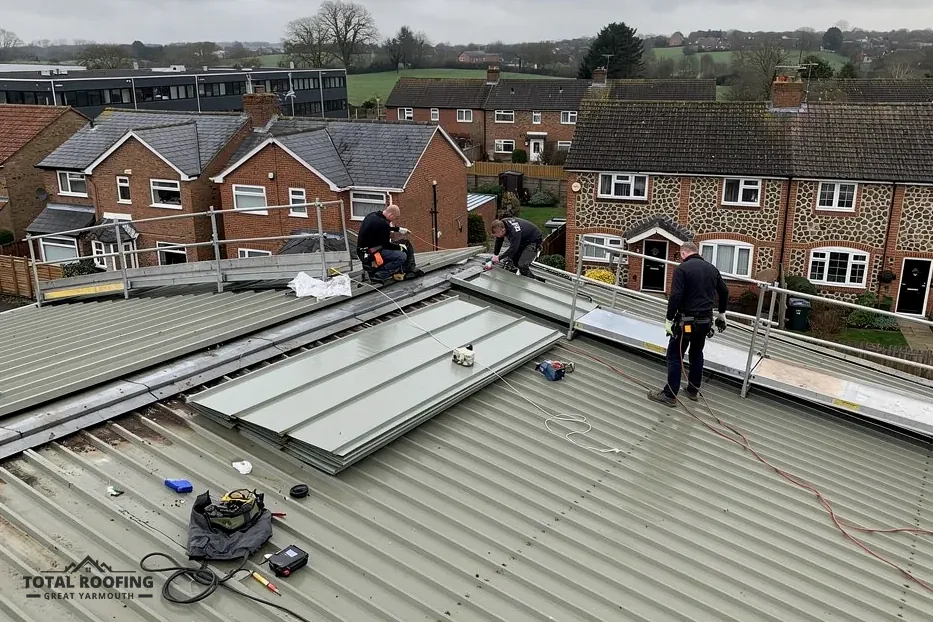
What a commercial flat roof is made of
A flat roof is not flat. It is a low-slope roof with just enough fall to move water towards an outlet or a gutter, built from layers. At the bottom is the deck, which may be timber, concrete or profiled metal. Above or below it sits insulation, with a barrier against moisture from inside the building, and on top is the waterproof layer that does the work of keeping rain out. A surface finish may sit above that, such as chippings, paving or a coating, to protect the layer beneath.
The waterproof layer is what the four systems in this guide differ on. Single-ply is a factory-made sheet of synthetic material laid out in strips and joined. Built-up felt is several layers of bitumen-based sheet laid one over another. A liquid-applied coating is a resin or similar product spread over the surface and left to cure into a continuous skin. Mastic asphalt is a hot-applied mixture poured and spread in place.
Each system has its own strengths, its own weak points and its own rules for details. What follows is a guide to how each works, so that the survey findings and the quote make sense. It is not a recommendation for any one of them, because the right choice depends on the roof. Our commercial roofing hub has the other guides in the group.
Whichever is used, the details decide whether the roof stays dry. The upstands where the roof meets a wall, the edges, the outlets, the rooflights and anything that passes through the roof are the places a survey looks at hardest.
Single-ply membranes
A single-ply system uses one layer of flexible sheet, supplied in rolls, to waterproof the roof. The sheets are laid across the deck and joined, either by heat welding, by adhesive or by mechanical fixing through the sheet into the deck. The material is a synthetic polymer, and the different polymers have different properties, so the maker's data sheet matters for each one.
The joint between sheets is the critical point. A welded seam, made properly, forms one continuous skin. A glued or taped seam relies on the adhesive. Around the roof, the sheet turns up the walls and is finished with a trim at the top, and every penetration is sealed with a preformed piece or a patch of the same material.
Single-ply can be laid loose and held down with ballast, fixed mechanically or bonded to the deck. Each method loads the building differently and suits a different structure. A roof that has lost its ballast, or that has fixings that have lifted, needs attention before water gets under the sheet.
EPDM, a rubber membrane, is one of the single-ply materials with published lifespans. HomeBuilding gives 25 to 30 years for EPDM, while the Less website says it "typically lasts 30 to 50 years". The two sources differ, and a published range is a guide and not a promise about any roof.
Built-up felt
Built-up felt, called felt for short, is made of layers of bitumen-based sheet. A base layer is fixed or bonded to the deck, one or more layers are laid over it and a cap sheet goes on top, with a mineral surface to protect the bitumen where the product has one. The layers are bonded together by heat, by torch or by cold adhesive, and the system is a mass of laps that must all be closed.
The multiple layers give some redundancy. A defect in one sheet may be covered by the next, and a repair can be patched into the layers. The weak points are the laps, the upstands and any place where the felt has to turn a corner, because bitumen sheet resists movement and sharp bends.
Felt surfaces age through sun, frost and foot traffic. The mineral finish wears away, the bitumen dries and the sheet can split along a line of movement. A roof that is walked on by service engineers will wear along the walkways, and a protective path of tiles or boards is the way to limit that.
HomeBuilding gives felt a lifespan of 10 to 15 years, and the Less website gives 10 to 20 years "depending on quality and installation". Again two sources give different ranges. A survey of a felt roof records the state of the surface, the laps, the upstands and any blistering.
Liquid-applied coatings and mastic asphalt
A liquid-applied system is a resin that is rolled or sprayed onto the roof, sometimes over a reinforcing fleece, and cures to a continuous skin. The attraction is that it has no joints in the field of the roof, and it can follow awkward shapes around plant and penetrations. It is also used to restore an existing roof by coating over it, provided the roof beneath is sound enough to take the coating. Our guide to commercial roof maintenance covers why a coated roof still needs to be looked at.
The skin depends on the preparation. The surface has to be clean, dry and compatible with the product, and the coating has to be laid at the thickness the maker specifies. A coating laid too thin, or over a wet or dirty surface, loses adhesion and lifts. Where there is water trapped beneath an old roof, a coating can seal it in.
Mastic asphalt is a different material, a mixture of bitumen and fine aggregate heated in a cauldron and spread by hand in layers. It forms a dense, joint-free surface, and it is used on roofs that carry traffic, such as walkways and roof terraces, as well as ordinary roofs. The skill is in the spreading, and the weakness is at the junctions, where the asphalt turns up a wall and a separate flashing or chase has to keep the edge sealed.
Both are applied in place, so the quality of the finished roof depends on the conditions on the day and on the person applying it. Neither is a product that arrives complete. For that reason a survey of a coated or asphalt roof looks at the surface for cracks, crazing, blisters and splits, and at every upstand, instead of assuming that a continuous skin has no weak points.
Continuous or sheet
Liquid or asphalt
- Applied in place
- No joints in the field
- Weak at upstands
- Quality depends on laying
Sheet systems
- Made in a factory
- Joined in strips
- Weak at laps
- Quality depends on seams
Falls, ponding and BS 6229:2025
Water has to leave a flat roof, so the roof has a fall: a slope, however slight, that carries water to an outlet or a gutter. BS 6229:2025 is the current code of practice for flat roofs with continuously supported flexible waterproof coverings. BSI withdrew the 2018 edition on 16 December 2025. The code covers membranes and does not cover lead sheet.
NFRC, the roofing trade body, reports that BS 6229:2025 sets "a minimum 1:80 finished fall for general roof areas and internal gutters". IKO, a membrane maker, reports that the code of practice calls for the roof to be designed to a 1:40 fall in order to achieve 1:80. A roof that is designed to a lesser fall, or that settles, will hold water.
Standing water is called ponding. A pond adds weight, speeds the wear of the surface, collects silt and debris and, in winter, freezes. It is the first thing a survey looks for after rain. A pond may mean the deck has sagged, the fall was never enough, an outlet is blocked or an upstand is leaning. Each cause has a different repair.
Brett Martin gives a gutter fall of "1mm for every 600mm" towards the outlet. The guttering follows the same logic as the roof: water must have somewhere to go, and the path must stay open. Outlets, overflows and gutters therefore belong to the same inspection as the membrane.
How long each system lasts
Published lifespans are the starting point for a budget, and they are not forecasts. HomeBuilding, last updated 30 September 2025, gives EPDM 25 to 30 years, GRP 25 to 30 and felt 10 to 15. The Less website, updated 9 November 2026, says EPDM "typically lasts 30 to 50 years", GRP "lasts 25 to 40 years with minimal maintenance" and torch-on felt lasts "10 to 20 years depending on quality and installation".
For single-ply polymers other than EPDM, for liquid-applied coatings and for mastic asphalt, the lifespan depends on the product, so ask its maker for the figure and the conditions attached to it. The condition of the roof at the time of the survey is the evidence that counts.
| Covering | HomeBuilding | Less |
|---|---|---|
| EPDM | 25 to 30 years | 30 to 50 years |
| GRP | 25 to 30 years | 25 to 40 years |
| Felt | 10 to 15 years | 10 to 20 years |
Lifespan also depends on what stands on the roof. Plant that is serviced regularly, aerials, walkways and rooflights each add wear. A roof that carries a lot of equipment may need a protected route, and a roof nobody visits wears in a different way. The survey notes what is on the roof and how people reach it, because a walkway worn through to the layer beneath is a leak waiting for the next heavy rain.
Choosing a system, and what sets the cost
Several things guide the choice. The deck and the structure set how much weight the roof can carry and which fixing methods are possible. The condition of the existing roof decides whether it can be recovered or has to be stripped. The shape of the roof, with its upstands, penetrations and levels, decides how much detail work there is. Use decides how much foot traffic the surface gets. And the building's own plans decide how long the new roof has to last.
Regulations sit alongside. Recovering or replacing a covering on a commercial building can bring Building Regulations into play, including the energy rules for non-domestic buildings, which are in a different approved document from the one that covers dwellings. We check the route with the council's building control team before work starts. Scaffolding on the pavement or road needs a highway licence from the county council, and we arrange the licence with our scaffolder.
Cost depends on the area, the system, the access, the state of the deck and insulation and how many details there are. A commercial flat roof is priced following a survey, since the numbers that would let a price be worked out in advance are the ones the survey finds. You then receive one written total price. Our guides to commercial roof surveys and to industrial roof cladding cover related questions.
