
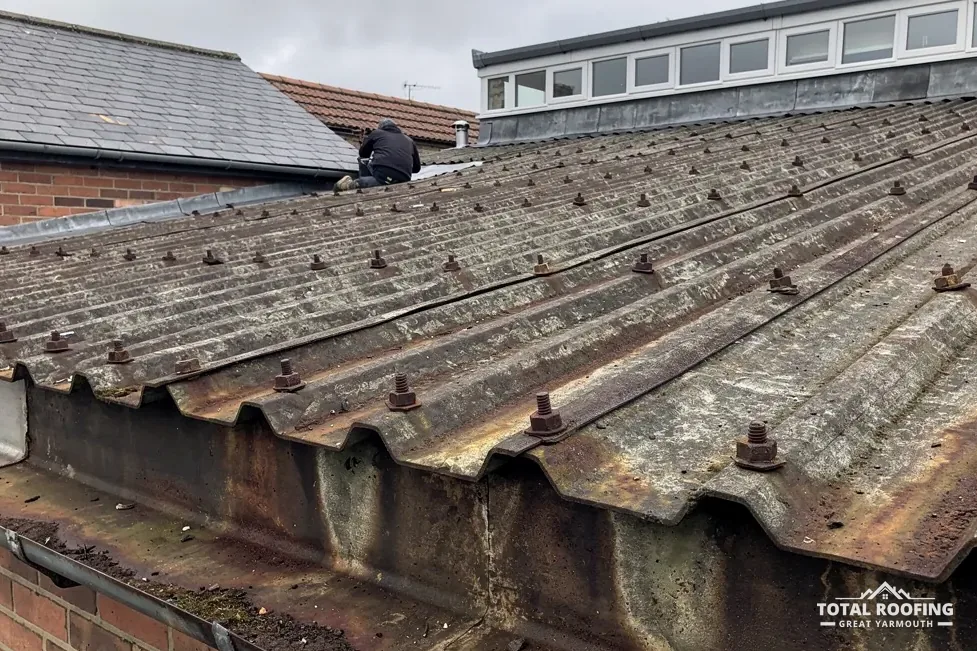
What makes a roof fragile
A roof is fragile when a person who steps, kneels or falls onto it could break through. That has nothing to do with whether the roof keeps the rain out. A sheeted warehouse roof can be watertight and still give way under one pair of boots, and a leaking roof can be perfectly sound underfoot. The two questions have to be asked separately.
The risk lies in how little the surface tells you. Profiled sheets look the same wherever you stand on them, but the strength underneath changes from one sheet to the next. A sheet that is well fixed to a purlin, the horizontal rail the sheets sit on, behaves very differently from one at its unsupported middle. Corrosion eats the fixing points, and a sheet can look intact from the ground while little still holds it down. Moss, paint and dust hide the signs further.
Surveyors and roofers therefore treat an unknown roof as fragile until it is proven otherwise, and they plan access on that basis. The sections below take the main sources of fragility in turn: asbestos cement sheets, roof lights, old metal and fibre-cement cladding, and the edges where a roof ends. Each needs its own precautions, and the precautions are cheaper to plan before a ladder goes up than to arrange after someone has been hurt.
None of this is limited to big sheds. A small flat-roofed extension behind a shop, a lean-to over a yard and a canopy above a loading door can each be fragile, and each has the same drop beneath it. The height does not need to be dramatic for a fall to cause serious injury.
Myth
If a roof carried someone last month, it will carry them today.
Fact
Strength cannot be judged by looking; age, corrosion and hidden fixings change it without any visible sign.
Asbestos cement roofs are always fragile
HSE's guidance on working safely on roofs (publication A14) puts it plainly: "AC roofs are always fragile". AC means asbestos cement, the corrugated or flat sheeting fitted to industrial units, agricultural buildings, garages and plant rooms for much of the twentieth century. Age and weather make the material brittle, so a sheet that looks solid can shatter under a footstep.
That brings a second hazard on top of the fall. HSE says: "If the building was built or refurbished before 2000, assume that there is asbestos in it." On a commercial roof of that age, the working assumption is asbestos until a survey says otherwise, which means nobody walks on it and nobody breaks it up, however quick the repair looks.
HSE separates the work into categories. Careful removal of cement sheeting in one piece counts as non-licensed work in HSE's list, weathered sheets included. Sheeting that fire or flood has wrecked falls into a different class, notifiable non-licensed work, called NNLW. Asbestos insulating board is different again: most work on it is licensed, and HSE lists soffit panels under the eaves among the places it turns up.
Waste has its own rules. HSE's skip guidance says to use a lockable skip for asbestos, and adds that throwing sheeting over a standard skip is not good enough. The household consignment-note exemption in the government's hazardous waste guidance is for waste "other than asbestos waste". For a Norfolk address, Norfolk County Council does not accept any asbestos at its recycling centres, so removal and disposal go through a specialist route. A leaking asbestos cement roof therefore raises two questions in order: how anyone reaches it without falling, and what happens to the sheets if they are disturbed. Our over-cladding guide covers the option of covering the old sheets rather than removing them.
Roof lights: the weak patches in a sound roof
Roof lights are panels of translucent plastic or glass set into the roof to let daylight into a unit. They are the point on a commercial roof where a fall-through can catch someone who knew the roof was sound everywhere else. A sheeted roof may carry a person along its fixed lines, while the roof light beside it cannot take weight at all.
Age makes them worse. Plastic panels weather, yellow and grow brittle in sunlight, and a panel that was fixed securely when the building was new may now be held only by its own bolts. They also get covered. Moss, bird droppings, dirt and the odd coat of roof paint can leave a panel the same colour as the sheet around it, so it is not obvious where the weak ground begins. Anyone walking a roof for the first time may not know a light is there until the surface disappears.
There are three sensible responses, and the choice depends on what the roof is for. A panel can be fitted with a guard or screen that stops a body going through it. The area around it can be marked and fenced so nobody walks near it. Or the panel can be replaced with one that is rated to bear weight. A roof that is walked on regularly for plant maintenance or solar panel servicing points towards the third.
When a roof is surveyed, roof lights are a standing item. The survey looks at how each panel is fixed, whether the surround is corroded, whether anything has been laid over it and where it sits against the likely routes across the roof.
What a roof light check looks at
- Cracks, crazing or yellowing in the panel
- Corrosion round the fixings and the surrounding sheet
- Moss, dirt or paint hiding the panel's edge
- Whether a guard or screen is fitted underneath
- How near the panel is to the walkway or plant
- Whether panels differ in age along the same run
Edge protection and getting onto the roof
A fall from a roof edge is the other main hazard. On a flat commercial roof with a low parapet, a person can walk backwards into the drop without noticing, and on a pitched sheeted roof the eaves and gable ends have no wall at all. Working-at-height rules put the emphasis on preventing a fall in the first place, with edge protection and platforms, rather than relying on harnesses to catch someone after the fact.
Edge protection means guard rails and toe boards fixed along the roof edge, either on a scaffold or on a temporary system clamped to the structure. Where the building has a pavement or road beside it, the scaffold can stand on that highway, and that brings a licence into the plan. A scaffold on that highway brings in a licence: we arrange the licence with our scaffolder, and for a Great Yarmouth building it is Norfolk County Council that issues it. Norfolk wants a fresh application for each scaffold, which puts the licence into the programme from day one.
Access up to the roof gets skipped when a job is called small. A ladder that reaches the eaves lands a person at the edge of the roof, where the drop is. A scaffold stair tower or a mobile access platform gives a protected way up and a protected way down, and it keeps ladders for the short, controlled moves they suit.
Order of safe access on a roof
- Survey from the ground or a platform before anyone walks the roof.
- Mark every roof light and sheet of unknown strength.
- Fit edge protection along every open side.
- Set up a protected way up, not a loose ladder at the eaves.
- Lay boards or staging along each working route.
- Keep tools and materials off fragile areas.
Crawl boards, staging and nets
Where a roof has to be crossed and cannot be proven strong, the load is spread. A crawl board is a long, stiff board with cross battens, laid on the roof so the weight of a person is shared over several supports. Staging does the same job on a larger scale, as a walkway or working platform. Neither makes a fragile roof safe to fall onto. They make it possible to cross while the other protection stays in place.
Nets and soft-landing systems sit below the roof surface and are rigged to catch a person who goes through. They are used when the work cannot avoid crossing a fragile area, and they are set up before the work starts, never after the first incident. A roof light guard is the same idea in miniature, stopping the fall at the panel itself.
| Control | What it does | Where it is used |
|---|---|---|
| Edge protection | Stops a person reaching the roof edge | Eaves, gables, parapets |
| Crawl board | Spreads one person's weight over several supports | Short crossings of sheeted roofs |
| Staging | Forms a walkway or working deck | Longer routes and repair areas |
| Roof light guard | Stops a fall through a panel | Every light on the route |
| Safety net | Catches a person who falls through | Under fragile areas the work must cross |
No single item in the table is enough on its own. A crawl board on a roof with no edge protection leaves the eaves open, and edge protection on a roof with an unguarded light leaves a hole in the middle. The survey decides which combination suits the roof, and the written quote carries that planning inside its one total price.
Who is responsible when the roof belongs to a business
The person who owns or manages the building has a hand in roof safety even when a contractor does the work. Under CDM 2015, the regulations that govern construction work in Great Britain, a commercial client has to make suitable arrangements for the project and pass on what is known about the building. For a roof, that includes any known asbestos, any fragile areas and anything that has been fitted to the surface since the building was put up. Our CDM guide sets out how those duties work on a commercial job.
Other people also use the roof without anyone planning it. Maintenance engineers go up to service air handling units, aerial fitters go up to fix an antenna, and cleaners go up to clear gutters. Each of them meets the same fragile surfaces, sometimes without being told where they are. A simple rule helps: nobody goes on the roof without being told what is up there, and a roof with fragile areas has warning signs at the access point.
A roof survey is the tool that turns an unknown roof into a known one. It records which sheets are fixed well, which roof lights are weak and where the safe routes run, and it gives the next person up there something to rely on. Read our commercial roof surveys guide for what the survey covers. A photo of the roof sent to our WhatsApp number, 07880 284133, gets looked at before any visit is arranged.
