
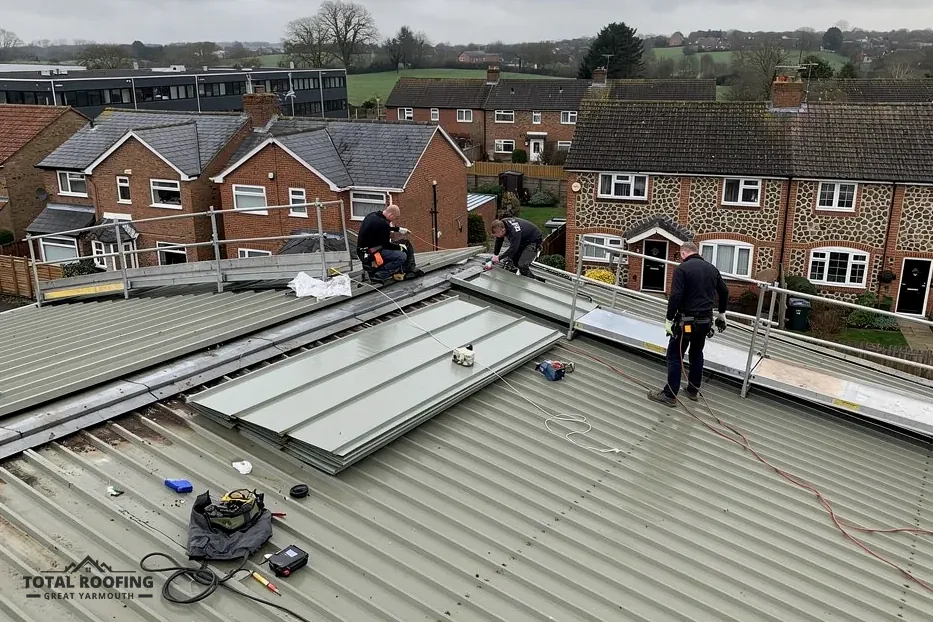
What a planned maintenance schedule is for
A planned maintenance schedule is a list of roof checks and small jobs that are done on a set programme, before a leak forces the issue. It exists because a commercial roof is out of sight, out of reach and out of mind. The people who work beneath it may never see the covering, the outlets or the flashings, and a fault can run for a long time before it shows as a stain on a ceiling tile or a dripping light fitting.
The aim is simple. Small things get found while they are small: a lifted lap, a blocked outlet, a cracked sealant joint, a displaced sheet. Each one costs little to put right when it is found early. Each one can cost a great deal when it is found after a season of water has soaked into insulation, a ceiling and the stock beneath it.
A schedule is not a promise about how long the roof will last, and nobody can promise that. It puts order into what is checked, who checks it and what is written down, so that decisions about repair or replacement rest on a history and not on a guess. The sections below follow the order of a visit: the covering, the drainage, the cleaning, the access and the record. Our guide to commercial roof surveys covers the wider condition survey that sometimes comes before a schedule is set.
A schedule belongs to the building owner or the manager responsible for the property, and the frequency is theirs to set, based on the covering, the age of the roof, what is underneath it and what the manufacturer's literature says. A figure picked from a website is no substitute for that. Before quoting, we survey the roof and look at all of it, not just the leak you rang about. You are then told plainly what the survey found, and the rest of the roof is mentioned as well.
What an inspection looks at
An inspection starts from the ground and works up. Staining on ceilings and walls inside, daylight where there should be none, damp patches on the insulation and any change since the last visit all point to where to look outside. Then the roof itself is checked from a safe position, section by section, covering first.
On a pitched roof of sheets or tiles the list is the covering, the ridge and hips, the verges, the eaves, the flashings and every penetration. On a flat roof it is the membrane and its laps, the upstands and the edge trims, plus anything that stands on the roof such as plant, flues and rooflights. Each of these is a joint or a junction, and a joint is where two parts depend on a seal or a fixing, so it is where the inspector spends the longest.
The visit is as much about what is on the roof as about the roof. Debris, moss, a bird's nest, a forgotten hatch left open, a service engineer's dropped fixings or a new aerial bracket screwed through the covering can each change how water behaves on the surface. A roof that was sound last time can be damaged by the people who maintain the equipment on it.
None of this needs special language. It needs somebody to look carefully at every part of the roof, one after another, and to say what they see, in words the owner can follow. If a part cannot be reached safely, that is worth stating too, so that it is added to the next visit with the right access arranged.
What a visit covers
- Covering, laps, seams and fixings
- Ridge, hips, verges and eaves
- Flashings, upstands and edge trims
- Rooflights, hatches and plant bases
- Gutters, outlets and downpipes
- Signs of leaks on the ceilings below
Gutters, outlets and drainage
Drainage is the part of a roof that collects what falls on it, because it is where leaves, silt, moss and debris collect. A blocked outlet on a flat roof lets water stand on the membrane, and a blocked gutter on a pitched roof lets water spill over the eaves or back up under the covering. Either way, the water ends up where it was not meant to go.
Brett Martin, a guttering maker, says a gutter should be installed falling downward towards the outlet, "1mm for every 600mm". A gutter that has dropped, sagged at a bracket or lost its fall holds water along its length. Standing water in a gutter is an early sign worth noting, because it can freeze, stain and corrode the gutter itself long before it overflows.
A shop, office or guest house has more gutter, more outlets and harder access than a house, so clearing it is priced after the roof itself has been surveyed. Length of run, height, the number of outlets and whether a scaffold or a platform is needed all change the work.
On a flat roof, the outlets, any overflow pipes and the area around them get the closest look. A scupper or an overflow that is blocked defeats the purpose of having one, and the first time anybody notices is the first time it rains hard. Our guide to commercial flat roofing systems explains how the falls on these roofs are designed to move water towards them.
Cleaning and moss: what to avoid
Moss and algae hold moisture against a covering and can lift the edge of a sheet or tile. Removing them is part of caring for a roof, but the method is a separate choice from the decision to clean. Marley, a roof tile maker, says "the use of high powered jet washes is not recommended as it can damage the surface of the slate or tile, thus reducing its expected life considerably". That is the manufacturer's position for slate and tile; for sheets and membranes, ask the maker of the covering what cleaning it allows.
The area of a shop, an office or a warehouse roof is a measured quantity, and the cost of cleaning it depends on that area, on the covering and on how hard the roof is to reach. A per square metre figure from a website cannot be multiplied into a total by guessing the size, so cleaning is priced after a survey.
Cleaning gives a clear view of the roof. Once the moss is off, a cracked tile, a split lap or an open joint is visible in a way it was not before. That is another reason to treat cleaning and inspection as parts of the same visit, not as separate jobs booked on different days with different people.
Access, fragile roofs and who is responsible
Every maintenance visit needs somebody on or near the roof, and that makes access a safety matter before it is anything else. HSE says: "If the building was built or refurbished before 2000, assume that there is asbestos in it", and HSE's guidance A14 says "AC roofs are always fragile", meaning asbestos cement sheets cannot take a person's weight. Rooflights and old sheeting need the same care. Our guide to fragile roof safety covers what that means on site.
CDM 2015 is the regulation that sets out who is responsible for health and safety on construction work. HSE describes a domestic client as an individual who has construction work carried out on their home "that is not done as part of any business". A shop, office or guest house roof is a business roof, so a homeowner's rule that passes client duties to the contractor does not describe it. Under CDM every project has a construction phase plan, made by the contractor or the principal contractor. A building owner with a commercial roof should take CDM advice before the work, and the schedule should say who holds each duty.
The Health and Safety Executive's asbestos guidance matters for maintenance too. A roof visit that disturbs an asbestos cement sheet by drilling, breaking or walking on it starts a different kind of job. The building owner's duty is to know where asbestos is before work begins, and a maintenance schedule should record what is known.
Anyone arranging visits should also confirm in advance what each visitor will do, so nobody is surprised on the day. A routine look from a ladder or a platform is one thing. Walking across a roof, lifting sheets or cleaning near rooflights is another, and the plan has to match, including who supplies the ladders, platforms or edge protection and who watches the people working near the edge.
Records, budgeting and different kinds of building
Keep your own record. Write down the date of each visit, who attended, what was found and what was done, and keep the list with the building's other maintenance paperwork. Keep it up to date. It shows whether a problem is new or old, whether a repair held, and what the next owner or tenant needs to know.
Budgeting follows the same logic. A planned schedule moves spending from emergency calls to planned visits, so roof spending can be planned ahead of time rather than in a rush. A commercial roofing figure comes from the survey and the written quote, which is one total price. No table on a website can do that job.
A shop, an office and a guest house each need a slightly different plan. A shop with a flat roof over the stockroom needs the outlets and the membrane watched, because stock is at risk. An office with plant on the roof needs the plant bases and the penetrations looked at, because engineers walk there. A guest house has bedrooms under the roof, so a slow leak becomes a guest complaint before it becomes a repair. Our guide to commercial roofing introduces these building types, and the roof is surveyed before any schedule is priced.
Setting up a schedule
- Survey the roof and note its covering, age and condition
- Mark the access routes and any fragile areas
- Agree what each visit looks at and who attends
- Keep a dated log of findings and repairs
- Review the plan against what the log shows
