
The short answer
Lead welding, also called lead burning, joins two pieces of lead by melting their edges with a gas flame so they run together as one piece of metal. On roofs it makes seams and patches in lead sheet. It involves a naked flame close to timber, so fire risk is part of the job.
What lead welding is
In lead welding, a worker heats the edges of two pieces of lead with a fine, hot gas flame until the surface melts and the pools flow together. Lead is added from a thin strip of the same metal as the joint cools, and it sets as one piece with no separate solder. Within the trade it is also called lead burning, and the term welded joint refers to the same thing. The finished seam is dressed smooth, so rain runs across it without catching.
This is a description of the technique, not a claim about any particular job. Welded work varies with the sheet, the position and the weather, so the details below describe the method in general.
Lead melts at a lower temperature than most metals used on roofs, which is why it can be worked this way and why the heat has to be controlled. Too much heat burns a hole through sheet that is only a couple of millimetres thick, and too little leaves a seam that has not fused and will open in service.
Where it is used on a roof
Welded joints are used where lead has to be made continuous, and where a lapped or rolled joint will not do the work. The cases below are the ones where a welded seam is considered. Each of these is a place where the lead has to stay watertight across a joint.
- Patches over splits and holes in lead sheet, which the page on patching lead on a roof compares with tape and sealant.
- Seams in lead-lined gutters and box gutters, where water collects and must not find a joint.
- Corners and junctions on lead flat roofs, upstands and parapet linings.
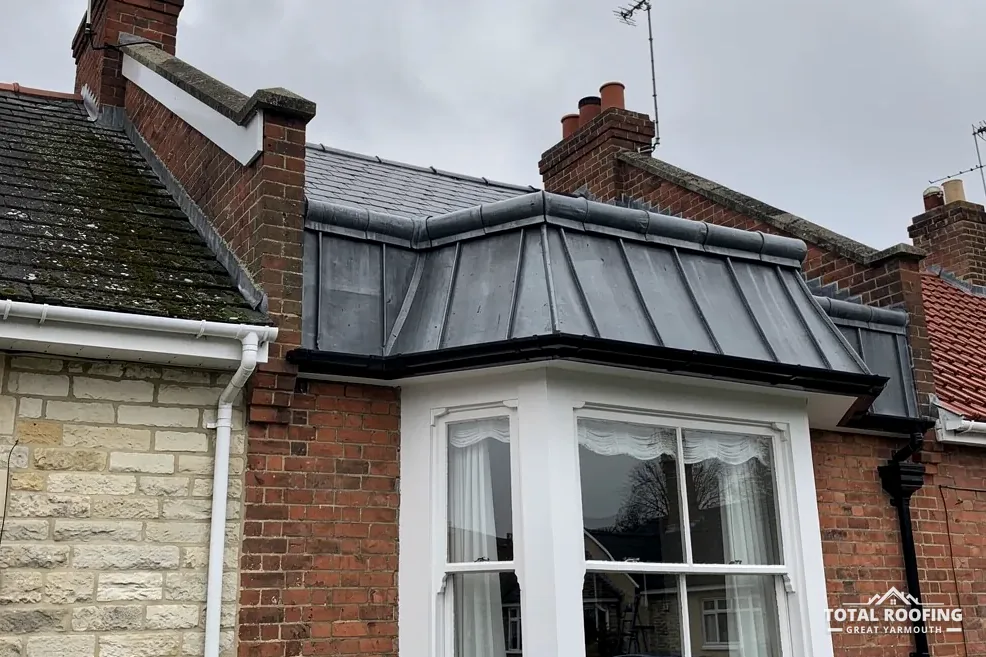
- Joints in lead work on dormers and bay window roofs, where shapes meet at awkward angles.
On a flat lead roof, sheets are jointed with rolls and drips, which are raised timber details and steps that let each sheet move. Welding is not a substitute for those, and a roof designed to be free to move should not be welded across its movement joints. Our guide to lead flat roofs covers how the sheets are laid.
Hot works and the fire risk
A gas flame on a roof is hot work. Lead melts at about 327 degrees Celsius, the flame itself is far hotter, and roofs hold timber battens, boards, felt, loft insulation and dry debris within a few centimetres of where the lead is being worked. Heat can also travel through the lead to ignite material on the other side. Because lead conducts heat, a flame on one face can warm the timber under the other.
The safe-working points run like this: the flame is kept away from combustible material, the area is checked before and after the work, a fire extinguisher is to hand, and loft spaces under the work are inspected once the flame is out, since a smouldering fire can start some time after the heat was applied.
Welding is only one of the ways to deal with a fault in lead, and for many repairs it is not needed. A lead patch may be dressed and clipped into place, and sealing a joint without heat is possible in some details. The survey decides which method suits, and which one carries the least fire risk for that roof.
Questions to ask before welding is proposed
If a quote includes lead welding, ask what is being welded and why. A welded patch over one split is a repair to the metal. A welded seam in a gutter lining is part of how that detail is made. A welded joint across a movement joint on a flat roof is a fault waiting to happen.
Ask also how the fire risk is being managed, because it is part of the work, not an extra. The roof, the loft below it and the neighbouring roofs on a terrace all matter when a flame is in use. On a terrace, a flame on one roof can reach the roof void of the next house along, so the neighbours' roofs are part of the risk, not an afterthought.
The roof is surveyed first, with the lead looked at in the hand, and you get a plain statement of what was found. We give one written total price for the job chosen. For the repair choices around welding, see repair or replace lead flashing, and the lead roofing and leadwork hub lists the other lead jobs.
