
The short answer
A lifted flashing means wind has got under a loose edge and bent the lead back, because the lower edge was not held down or its fixing had failed. Photograph it from the ground, do not climb up, and have the roof surveyed, since the lead and the joint it covers both need checking.
How wind lifts a flashing
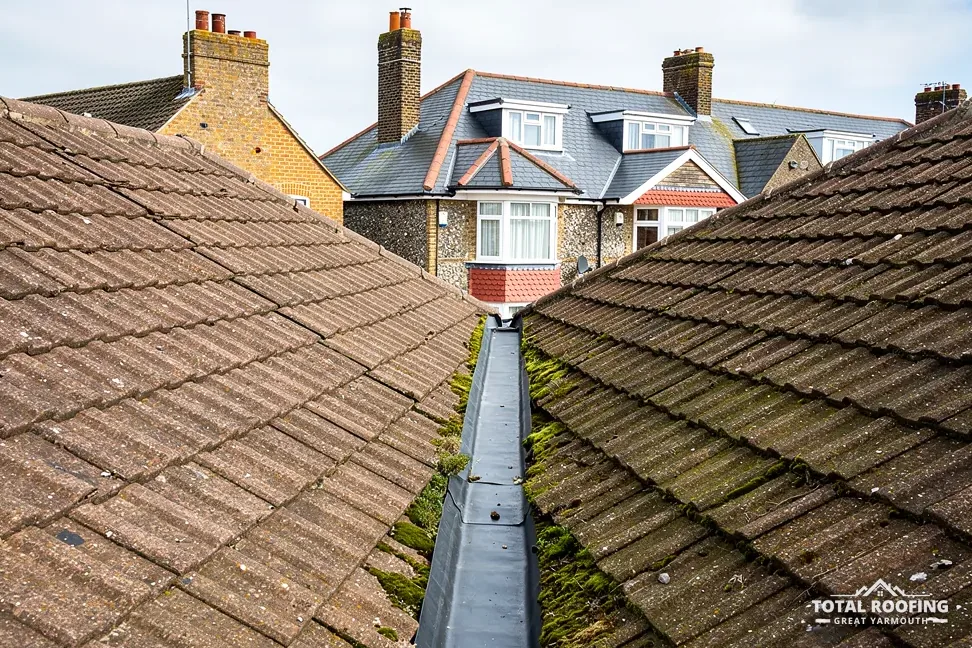
Lead is heavy, but it is also thin and flexible, and a loose edge behaves like the edge of a sail. Wind crossing a roof is forced up over the ridge and over the wall beside it, and it pulls at anything that stands proud. If the lower edge of a flashing is free, air gets under it, lifts it a little, and rolls it back on the next gust.
Once the lead is bent back, the joint it covered stands open. Rain runs in behind it, down the wall and onto the tiles or the timbers, and a stain on a ceiling can be the first thing a household notices. The bent lead can also tear along its fold, so a flashing that could have been dressed back down becomes one that needs replacing.
What keeps a flashing down is its fixing. The upper edge is held in the wall, and the lower edge is held by clips or by the shape of the dressing over the covering. Our page on lead flashing clips explains how the lower edge is gripped, and a flashing that has lifted has lost its hold at one point before the rest follows.
Exposure and fixing
Marley, a tile maker, explains that a fixing specification written for the particular site overrides the minimums in BS 5534, and that the exposure of the roof is one of the things it weighs. BS 5534 is the code of practice for tiles and slates, not for lead, but the thinking carries over: a roof standing high or open to the weather asks more of its fixings than a sheltered one.
Marley also says that a ridge or hip tile must be held by mechanical fixings that resist the uplift calculated for the roof. For a coastal roof, exposure is the point of difference, and the fixings are set for that roof's own site. We name no wind speed here, since a figure of that kind belongs to the site and the specification and not to the town.
- An upper edge pointed into the wall, with the wedges in place
- A lower edge held by clips so it cannot lift
- Lead of a code suited to the exposure and the length of the run
- Tiles beside the lead that are secure and not slipped
What to do after a gale
Stay off the roof. A ladder in a gusty spell is a risk, and loose lead can swing and strike. Photograph what you can see from the pavement, and any stained ceiling inside, before anything is shifted or binned. The Financial Ombudsman Service says "we'll usually look at expert reports and photos", so pictures taken early carry weight.
In the Ombudsman's own words, "Rain, hail or snowfall by itself can constitute a storm", and "a storm usually involves violent winds, usually with rain, hail or snow". Tell your insurer about the damage. Whether a claim is accepted is for your policy and insurer to settle, and the Ombudsman is where a dispute goes.
For a rough idea of scale, MyJobQuote, 22 October 2026: emergency roofer call-out costs typically range from £150 to £300, while extensive storm damage repairs can cost £1,200 or more. A figure for your own roof comes with the survey. If you message a photo to WhatsApp on 07880 284133, we can look at it and see which part of the roof is involved.
Repairing a lifted flashing
A flashing that has been peeled back but not torn can sometimes be dressed down again, with fresh fixings and new pointing along the top. Torn or stretched lead cannot be pulled flat, so the damaged section is cut out and a new piece fitted in its place. Checkatrade's June 2026 table puts lead flashing repairs at £50 to £70 per metre, exclusive of VAT, which is a rate for a length and not the price of a job.
The survey looks beyond the lead at what the wind may have done beside it: tiles slipped at the edge, a pot loosened on a chimney, damp carried into the timbers. Whatever it shows is put to you in ordinary words, followed by one written total price. The lead patch repair page covers the smaller jobs, and the lead roofing and leadwork hub covers the rest of the topics.
Because the same gust that lifted one flashing can have loosened others, the rest of the lead on the roof deserves attention, on the chimney, along the wall and over any bay. A lift in one place points to a weak fixing, and that weakness may not be limited to that spot.
