
The short answer
Brett Martin, a guttering maker, advises "1mm for every 600mm" towards the outlet. On a six metre run that is 10 mm from one end to the other, a slope you can hardly see. Too little and water pools; too much looks wrong and sends water past the outlet.
The published figure
Brett Martin, which makes guttering, advises in its installation guidance that a gutter should fall towards its outlet, at "1mm for every 600mm". That ratio is the same as one part in six hundred, and it is the figure to hold on to for an ordinary pitched-roof gutter.
The slope is tiny. Over a gutter of 3 metres, which is 3,000 mm, the drop is 5 mm, about the thickness of a pencil. Over 6 metres it is 10 mm, and over 12 metres it is 20 mm if the whole run falls one way to a single outlet. Where the outlet sits in the middle of a long run, each half falls towards it separately, and the high points are at the two ends.
A fall that small cannot be judged by looking up from the garden, and an old gutter can seem level while carrying an unseen reverse slope. It is one reason a gutter that looks fine can still hold water, and a gutter that looks tilted can drain well.
What goes wrong without it
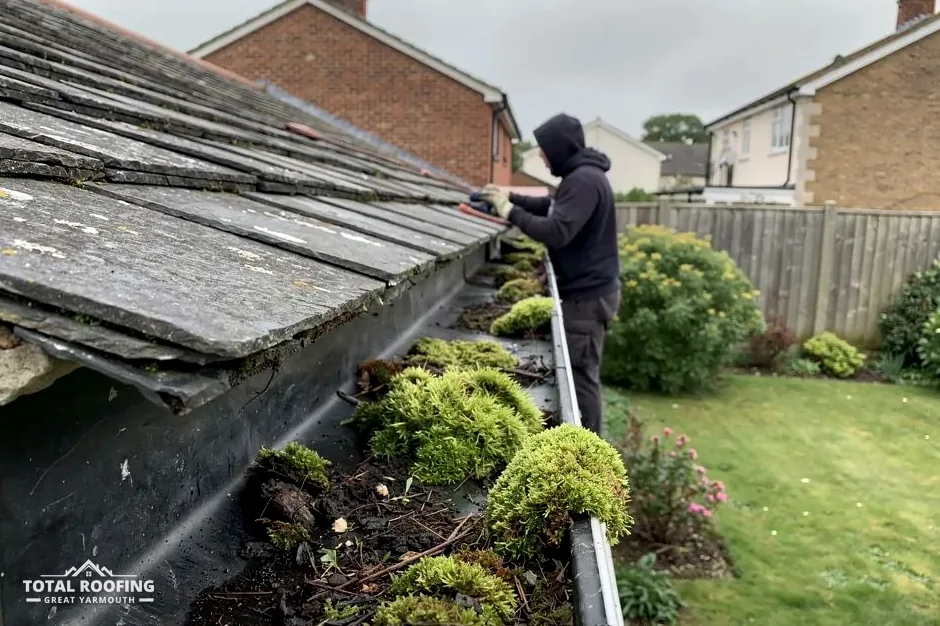
A gutter set level passes water on slowly, and one set the wrong way round passes none along. Water stays in the channel after the rain stops, and the standing water causes trouble in four ways:
- It carries silt and leaf matter that settles instead of washing away, so the channel blocks sooner.
- It adds weight to a plastic run, which sags further at the low point and deepens the pool.
- It tips over the lip at the lowest spot, wetting the wall and the fascia below.
- It sits against the joints, where seals wear out faster in a pool than in a flowing channel.
Too much fall causes a different fault. A steep slope carries water fast to the outlet, where a heavy downpour can overshoot it, and it makes the gutter look crooked against the line of the roof and the fascia. The ratio above is a gentle slope for a reason, and a long run can also be set to fall both ways from a central outlet to keep the drop in check.
Checking the fall on your own house
You can see how a gutter behaves without any tools. After a spell of rain, look for water still lying in the channel hours later, or for a damp or stained fascia directly under one stretch. Run a hose slowly into the high end and watch which way the water goes, and whether it reaches the outlet without pooling on the way.
A spirit level laid in the channel is less reliable than it sounds, because the profile curves and the level sits on the high edges. Measuring the drop between the two ends along a line is better, set against the ratio above.
A run that has lost its fall may have sagged between brackets or been pulled down by a soft board, and our pages on sagging gutters and gutter overflowing follow those causes. A hose test is safe from ground level on a low run, but working at a roof edge needs a proper platform.
Flat roof gutters follow a different rule
A gutter built into a flat roof, an internal gutter, is a different case. NFRC, reporting on the revised BS 6229:2025, says the code sets "a minimum 1:80 finished fall for general roof areas and internal gutters". The code covers flat roofs with continuously supported flexible waterproof coverings, and IKO reports that to reach a finished fall of 1:80 the roof should be designed for 1:40. Those figures apply to membranes on flat roofs and not to the clipped-on gutters of a pitched roof.
For a pitched roof the survey looks at the gutter, the brackets and the board together, because a gutter with a lost fall can be a gutter whose fixings have moved. We tell you plainly what the survey shows, including any other fault noticed on the roof, and the price for putting it right is one written total. A photograph taken along the run, sent on WhatsApp, can show a dip or a pooled stretch beforehand.
The guttering, soffits and fascias hub covers the other faults that affect the roofline.
