
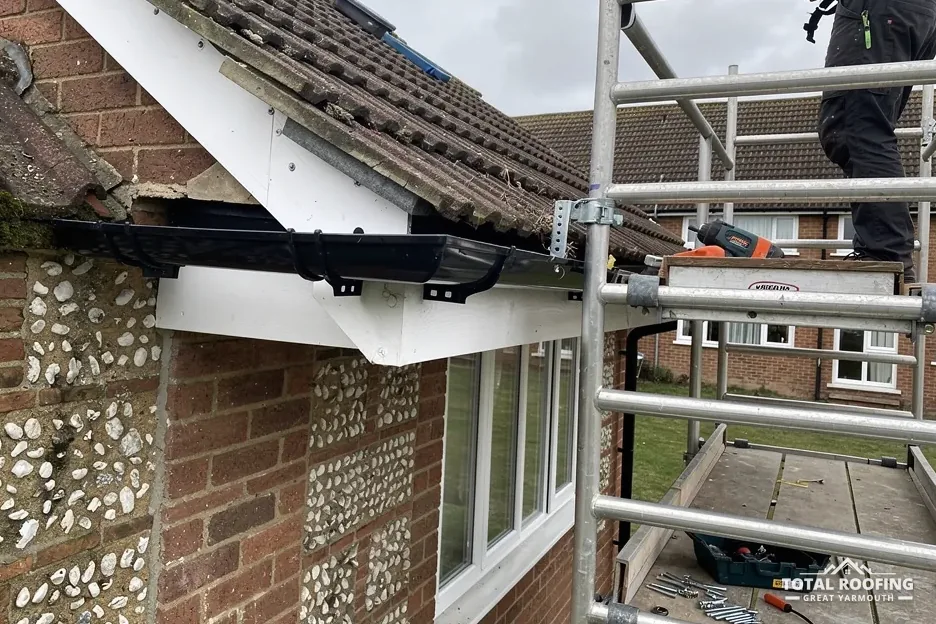
What a blocked gutter does to the house
A gutter has one job: take the water that runs off the roof slope and deliver it to a downpipe. Everything that stops it doing that job moves the water somewhere else. A full gutter spills over the front edge and runs down the face of the wall. A gutter that is only part full still holds a pool of dirty water that never drains, and that pool sits against the fascia board all day.
The gutter is also meant to fall gently towards its outlet. The fall towards the outlet is slight, a matter of millimetres along each metre, so a handful of wet leaves, a clump of moss or a bridge of silt is enough to hold water back where it should be moving on. Once water stands in the run, the debris in it gets heavier, and a gutter run that was straight before starts to sag between its brackets.
The damage shows up away from the gutter itself. Rain running down a wall can leave green staining, a damp patch inside, or a wet band along the bottom of the brickwork. A fascia board that is soaked from above and behind can soften and rot. None of this needs a storm. An ordinary wet week with a blocked outlet is enough, which is why a gutter that looks fine from the garden can still be the reason for a damp wall.
Clearing is not the same as repairing. A clear-out removes what is in the gutter. It does not cure a joint that leaks, a bracket that has pulled away or a length that has dropped below its neighbour. The point of the visit is to find out which of those it is, so that the written quote covers what the gutter needs and nothing it does not.
What actually blocks a gutter
Moss is one source. It grows on roof slopes and the loose bits wash down into the gutter, where they mat together with grit shed by the covering itself. Leaves and seed pods from nearby trees do the same, and a house with no trees nearby can still collect windblown debris and silt. A gutter is an open channel, so anything that lands in it stays there until it is lifted out or washed on.
Bird nests are another cause. A gutter end, a stop end or the corner behind a downpipe hopper makes a sheltered ledge, and a nest built there can fill the run. A nest is not only an obstruction. The law treats a nest in use or being built differently from loose rubbish, and the section on nests below explains how.
Old roof granules and sand also end up in the channel. A tile or slate covering sheds fine grit as it weathers, and that grit gathers at the low end of a gutter run, around the outlet, where it forms a bed of sludge. Plants can root in that sludge, which is why a gutter sometimes carries small weeds or even a seedling tree.
Whatever the cause, the sludge sits where the water is supposed to leave the gutter. That is why a gutter can look mostly clear along its length and still overflow: the blockage is at the outlet, not in the middle of the run.
What collects in a gutter
- Moss and algae washed off the roof slope
- Leaves, twigs and seed pods from trees
- Grit shed by tiles or slates as they weather
- Silt and sludge settling at the outlet
- A bird's nest built in a corner or behind a hopper
Signs you can see from the ground
You do not need a ladder to see whether a gutter is struggling. Watch the house during a heavy shower, or just after one, and look along the eaves. Water pouring over the front lip, or falling in a curtain from one point, tells you where the run is blocked or where a joint has opened. A dry day shows other clues: the line of staining on a wall below the gutter, a darker or greener strip where the same patch of wall gets wet every time it rains, and stripes of mud on a path below a corner.
Look at the gutter line as a whole. A run that dips in the middle is carrying weight it should not, or has lost a bracket. Plants growing from the gutter are visible from the garden and show that sludge has been in place long enough to take root. Water that dribbles down the face of the downpipe rather than inside it, or a downpipe that stays wet at the top while the bottom is dry, points to a blockage inside the pipe itself.
Inside the house, a stain on a ceiling near an outside wall, or a damp patch high on a wall beside a window, can be traced back to a gutter above it. It is easy to blame the roof covering for a leak that is really an overflowing gutter, so it is worth checking the gutter before assuming a tile has slipped.
Check from the garden
- Water spilling over the front lip in rain
- A dip or sag in the gutter line
- Green staining on the wall below
- Weeds growing from the gutter
- A downpipe that is wet at the top only
How a clear-out is done
The gutter has to be reached safely first. For a low eaves line that may be a ladder that is footed properly and set on firm, level ground, with the person on it keeping their weight over the rungs rather than leaning out sideways. A higher or awkward eaves line needs a tower or scaffold, and where scaffolding stands on the pavement or road it needs a highway licence from the county council; we arrange the licence with our scaffolder. Any scaffold the job calls for forms part of the written quote.
With the gutter reached, the loose debris comes out by hand, working along the run towards the outlet and putting what is lifted into a bag rather than dropping it to the ground. Silt and sludge are scraped from the channel. Moss is lifted rather than washed on, since moss rinsed into a downpipe can lodge in a bend. The outlet is cleared last, because everything that was moved along the run ends up there.
Water then does the checking. Flowing a hose along the gutter shows whether it runs freely to the outlet, whether it pools anywhere, and whether the joints hold or weep. A joint that drips under a gentle flow will not cope with a downpour. The downpipe is checked at the same time, and a pipe that does not pass a clear flow is rodded or flushed from the top.
Moss on the roof is a separate job from the gutter, and the FAQ below gives Marley's advice on washing a slate or tile covering.
Order of a gutter clear-out
- Reach the gutter safely from a ladder, tower or scaffold
- Lift loose debris into a bag, working towards the outlet
- Scrape silt and sludge from the channel
- Clear the outlet and the top of the downpipe
- Run water along the gutter to check fall and joints
Nests in the gutter: check before you start
Section 1 of the Wildlife and Countryside Act 1981 makes it an offence to act intentionally against a bird's nest: whoever "takes, damages or destroys the nest of any wild bird while that nest is in use or being built". An old nest that is finished with is a different matter from one with eggs or young in it. Scooping a live nest out with the leaves is the kind of act the section describes.
So the first thing to do on any gutter visit is look for a nest. If a bird is flying in and out, or you can hear chicks, leave that section alone. The gutter can be cleared elsewhere along the run and that section left for later. No nesting dates are set out in the Act's wording, so the test is what you can see and hear on the day.
A blocked section with a live nest in it can cause the gutter to overflow in the meantime. In that case check that the rest of the run still drains, and deal with the nest section once the birds have gone. If you are not sure whether a nest is active, ask before disturbing it. A survey is also the moment a nest gets noticed, so look before anyone lifts a handful of debris.
What a gutter clear-out costs, and when cleaning is not enough
The published figure for this job comes from Which?, whose survey of 11 traders in November 2025 puts clearing every gutter, front and back, of a property at £75 to £350. Those prices cover labour and materials but leave out VAT. Which? gives a band, not a figure for any one house. After the survey, the quote arrives as one written total.
What pushes a clear-out towards the top of a band is access. A single-storey run reached from a ladder is one job. A three-storey front that needs a tower is another, and any scaffold the job needs is part of the written quote. Setting up safe access and checking the run afterwards are part of the job as well as the clearing itself.
Cleaning is not always enough. If the water test shows a joint that weeps, brackets that have lost their grip, or a run that no longer falls to the outlet, clearing the sludge will not cure it. At that point a repair or a replacement is a better route, and our gutter replacement cost guide sets out the published figures.
Also look at the board the gutter hangs from. If the fascia is soft, the brackets have nothing sound to hold, and new guttering fixed to a rotten board will not stay up. Our guide to fascias and soffits explains what to check there. The wider picture for the whole roofline is on the guttering, soffits and fascias page.
Published figures for gutter work
| Which?: clear out all gutters, front and back | £75 to £350 for all gutters |
|---|---|
| Checkatrade: roof cleaning | £8.50 to £14 per m² |
Which? Trusted Traders, survey of 11 traders, November 2025, excluding VAT. Checkatrade roof cleaning guide, April 2026, no VAT basis stated, per square metre only. The written quote after a survey is one total price.
