
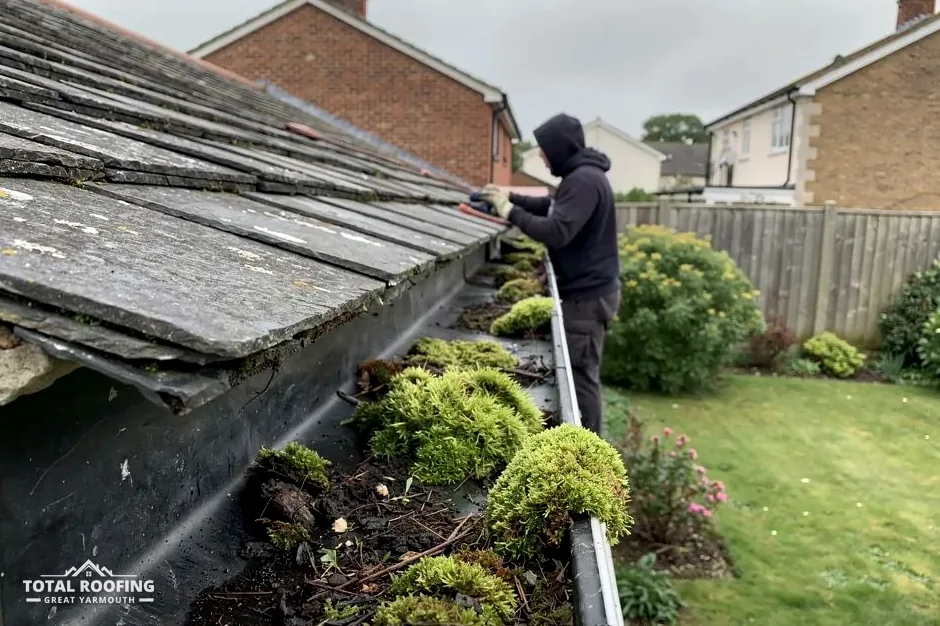
Two jobs that look the same from the road
Capping, sometimes called cap-over, means fitting plastic covers over fascia and soffit boards that stay in place. The old timber is cleaned up, any loose paint is scraped back, and a new plastic skin is fixed over the face and the underside. Replacement is the other route: the old boards come off, the rafter ends behind them are exposed, and new boards, timber or plastic, are fixed in their place.
From the road the finished result can be identical. Both leave a clean white plastic edge along the roof, and a person standing on the pavement cannot tell which was done. The difference is hidden. After capping, the old board is still there, behind the new skin. After replacement, it is not.
That hidden difference is why the question matters. A capped board that was sound will stay sound for as long as it is kept dry. A capped board that was already rotten carries on rotting out of sight, and the plastic that covers it gives no warning. If you are not sure what the parts at the eaves are called, our guide to what fascias and soffits are names each one.
The two jobs also differ in what they ask of the roof. Capping leaves the rafter ends untouched and in place. Replacement exposes them, and an exposed rafter end can be probed, treated or cut back. A survey weighs those points for each roof, and it is the only way to know which job a particular house needs.
What the published price covers
MyJobQuote says "The average cost of capping fascias and soffits is around £800", in a cost guide last updated 17/09/26. That is a national average, it covers capping only, and it states no VAT basis. It is not a price for replacing boards.
Replacing the fascias and soffits is priced after a survey, as a written total for your house, because what the boards are like underneath sets the work. The extra work that sets it apart from capping is real: the old boards have to come off, the rafter ends are checked, new boards are cut and fixed, and the gutter has to be taken down and put back or renewed.
Read the capping figure with care. A job at the average does not make capping the better choice, because a lower figure for a job that covers rot only postpones the larger one. If the boards behind are failing, the figure for capping is a price for hiding them. The sensible comparison is between two firms' written quotes for the same job on the same house, each saying what is being done to which boards.
Gutters belong in the same conversation, because they are fixed to the fascia. The gutter has to come off for either job, which is why the gutter replacement cost guide gives the MyJobQuote and Which? figures for that work.
Sourced price for capping
| Capping fascias and soffits, MyJobQuote | average around £800 |
|---|---|
| Full replacement of boards | priced after a survey |
MyJobQuote cost guide last updated 17/09/26, no VAT basis stated. It covers capping only. Replacement is priced after a survey.
Rot trapped behind the caps
Timber rots when it stays wet. At the eaves it gets wet from the front, when a gutter overflows or a joint drips, and from above, when water runs under the covering and down the rafter ends. Capping does not stop either source. If the leak is still there, the water still reaches the timber. The cap only stops the water from leaving again.
Plastic caps are close-fitting. They shed rain from their own face, but they also trap the moisture that does get in at the joints, the fixings and the back edge. Behind the cap the old board can stay damp for a long time with no air to dry it. Rot spreads along the board and into the rafter ends, and the first outward sign may be a gutter that sags because the fixings have nothing left to bite into.
So a survey before capping asks a plain question: is the timber sound? A screwdriver pushed into the board tells a lot. Firm wood resists, and rotten wood gives way. The rafter ends and the back of the soffit are checked as well. Where the timber is soft, capping would be fitted over a fault and the money spent would not remove it.
The decision is not capping against replacement as a matter of taste. It follows the timber. Sound boards can take caps. Soft boards, and any board that has had water behind it for a long time, are replaced, and the rafter ends are cut back or repaired as part of the same job.
What sits behind the cap
Sound board
- Firm to a probe
- Dry at the back
- Fixings grip
Rotten board
- Soft to a probe
- Damp, stained
- Fixings pull out
Ventilation and the soffit
A soffit can be an air path as well as a cover. In a cold roof, air enters through the eaves and leaves at the ridge or high level, and that movement keeps the roof void dry. Marley's figures for a cold roof with an HR (high resistance) underlay are "25mm along the length of the eaves for pitches of 15° or less; 10mm along the length of the eaves for pitches of more than 15°."
Both capping and replacement can change that opening. A solid cap fixed over an old vented soffit can close the vents. A new solid board can do the same where the old one had slots or a vent strip. Vented soffit boards and vent strips exist for exactly this reason, and either job should keep the opening, not lose it.
An HR underlay does not pass vapour, so the roof depends on the eaves opening to carry moisture out. Moisture that cannot leave the roof void settles on the timber and the underside of the underlay. That is a different fault from rot at the fascia, and it shows up inside the roof, not at the eaves.
Warm roofs are built differently. Where the insulation sits above the structure, the build-up of the roof decides what the eaves need. Our page on soffit ventilation covers the question in more detail, and the survey checks the roof you have before any board is covered or renewed.
Soffits that may be asbestos
Capping a soffit means fixing to it, by nailing or screwing through the new board into the old one, or into the rafters behind. If the old soffit is asbestos insulating board, that fixing is work on the board.
HSE lists "AIB white soffit panels to underside of roof eaves" and "Damaged AIB soffit" as places the material is found. Its rule, "If the building was built or refurbished before 2000, assume that there is asbestos in it", applies to the house as a whole, so an older house has to treat a flat white soffit board as possibly asbestos until a specialist's sample says otherwise.
HSE's guidance puts most work on asbestos insulating board in the licensed category, with some short-duration work on the notifiable non-licensed list. Neither category is something to try without knowing which applies. A board that might be AIB is left untouched while the test result is outstanding, and the sample is the next step.
With a soffit on a building built or refurbished before 2000, a capping quote and a replacement quote carry a question neither can answer until the test is back. Waste from a board that proves to be asbestos has its own rules: "Use a lockable skip for asbestos", says HSE, and the household consignment-note exemption is for domestic hazardous waste "other than asbestos waste".
What a survey looks at before either job
A survey for a roofline job does not stop at the face of the boards. It starts with the roof above them, because the covering, the felt or underlay and the first row of tiles decide whether water is reaching the eaves from above. A board can only stay dry if the water above it has somewhere to go, so a slipped tile or a torn underlay at the edge counts as part of the same problem.
Next come the gutters and the downpipes. A gutter that leaks at a joint, overflows at a corner or drains slowly feeds water to the fascia at one point. Finding that point explains why one stretch of board is rotten and the rest is sound, and it tells you whether the gutter is the cause or the victim.
Then the boards themselves: probed at the screw lines and at the joints, looked at underneath the soffit and checked at the corners, where two boards meet and water collects. The rafter ends are looked at wherever they can be seen. If the survey finds something you did not ring about, such as a cracked tile or a loose bargeboard, what the survey found is explained to you in plain words, including anything else the roof showed.
The written quote follows the survey and gives one total price. It says which job the roof needs: capping where the timber is sound, replacement where it is not. A second firm's quote can be set beside it, as long as both name the same boards, the same gutters and the same work.
Checks made before choosing
- Roof covering and underlay at the eaves
- Gutter joints, corners and the downpipe
- Probe test of fascia boards at the fixings
- Soffit boards, vents and any staining
- Rafter ends where they can be reached
- Possible asbestos in older soffit boards
Choosing between capping and replacement
Put the points together and the choice follows the condition of the roofline. Capping can suit a house whose boards and rafter ends are sound, whose gutters are not leaking onto them and whose soffit has been checked for asbestos and for ventilation. Replacement suits a house with soft or stained boards, rot at the rafter ends or fixings that no longer hold.
| Question | Capping | Replacement |
|---|---|---|
| What happens to the old board? | It stays, covered | It comes off |
| Can the rafter ends be inspected? | Only the exposed parts | Yes, once boards are off |
| Sourced price | Around £800 average, MyJobQuote | Priced after a survey |
| Rot behind the board | Stays hidden | Found and dealt with |
Access is part of either job. Scaffolding on the pavement or road needs a highway licence from the county council, and we arrange the licence with our scaffolder. Birds can nest in eaves, and under the Wildlife and Countryside Act 1981 it is an offence to intentionally take, damage or destroy a wild bird's nest while it is in use or being built, so the eaves are looked at before any board is lifted.
A picture of the roofline, sent by WhatsApp, gives us the front of the boards, the paint and the line of the gutter, which is a start. It cannot show the back of the board. For that the survey is made at the eaves, and the written quote that follows gives one total price for the job the roof needs.
