
What the published figures say
Prices for gutter replacement are third-party figures, dated, and each one measures something slightly different. MyJobQuote says "The average gutter replacement cost in the UK is around £1,000 to £1,600", in a cost guide last updated 20/10/26. That is a national average for a replacement, and the guide states no VAT basis, so it should not be read as including or excluding VAT.
A second MyJobQuote guide, last updated 17/09/26, gives around £800 as the average for capping fascias and soffits. That covers fascia and soffit capping, which is a different job from replacing gutters, and it is shown here because a gutter replacement can be priced alongside the roofline boards that carry it.
The Which? Trusted Traders survey of 11 traders, gathered in November 2025, prices a gutter job of another kind. It gives £75-£350 to "Clear out all gutters at front and back of property". That is cleaning, not replacement. Prices in that survey cover labour and materials and leave out VAT. It marks the low end of the range of gutter work, and it is not a replacement price.
Each figure belongs to its own job, so none of them is added to another. A house that needs new gutters and new fascias is described by a written quote after a survey, which gives one total price for the work on that house.
Gutter and roofline figures, with sources
| Average gutter replacement, MyJobQuote | average around £1,000 to £1,600 |
|---|---|
| Capping fascias and soffits, MyJobQuote | around £800 |
| Clearing all gutters, Which? | £75-£350 for all gutters |
MyJobQuote cost guides last updated 20/10/26 and 17/09/26, no VAT basis stated. Which? Trusted Traders, survey of 11 traders, November 2025, excluding VAT.
What moves the price from house to house
A gutter is priced by its run and its fittings, so the size and shape of the house is the first thing that changes the figure. A bungalow with a single long eave and two downpipes is a smaller job than a two-storey house with a rear extension and a bay, even if the floor areas look similar. Every corner, stop end, outlet and joint is a part that has to be bought and fitted, and each one adds time.
Height is next. Gutters at first-floor level cannot be reached from the ground, and the way they are reached sets part of the cost. A ladder works on a low eave. A tower or full scaffold is needed where the eave is high, the ground is uneven or a pavement runs below. Scaffold is part of the written quote.
Material matters too. A plastic gutter, an aluminium gutter and a cast iron gutter are different products with different fittings and different fixings, and our pages on uPVC against aluminium guttering and cast iron guttering set out the differences. The gutter brackets also have to be fixed to something sound, which brings the fascia into the price.
Finally, what is already there changes the work. Old gutters that are bolted through, painted in, jointed with putty or hung from rotten boards come down more slowly than a clean uPVC run. The survey looks at that before a price is set.
Repair, re-hang or replace
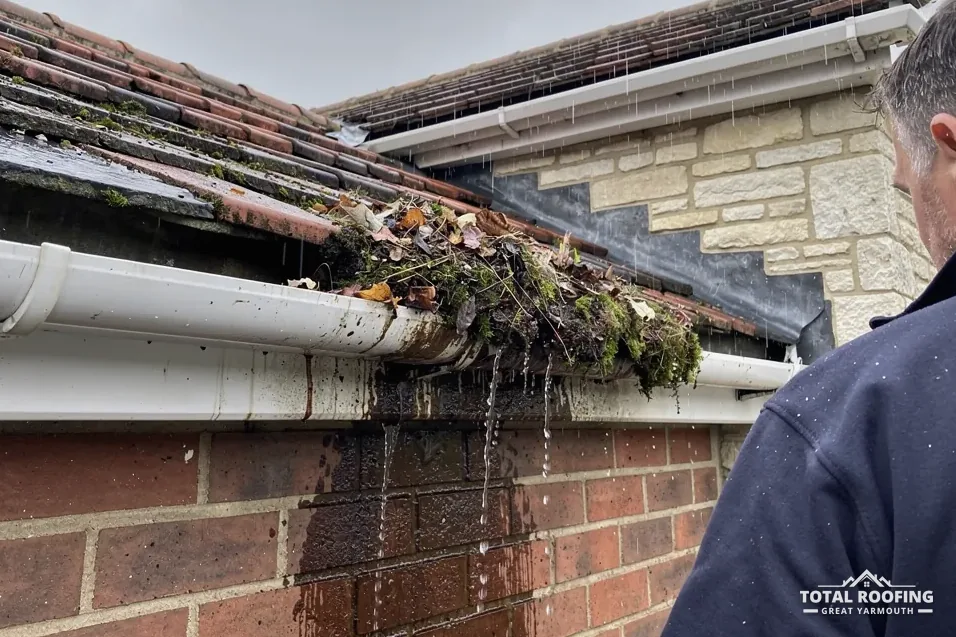
Not every gutter problem needs new gutters, and the first job of a survey is to sort the fault into one of three kinds. A leak at a joint is a repair: the run is sound and one connection has failed. A sag between brackets is a re-hang: the gutter is fine but its supports have moved, or there are too few of them. A gutter that is cracked along its length, warped, brittle or rusted through is a replacement, because patching a failing run only moves the leak to the next weak point.
The age of the gutter does not settle the question. A plastic gutter of many years' standing can still be sound, and a recent one hung on poor brackets can be failing. The fall decides much of it: a run that holds water along its length has lost its slope, and water standing in a gutter is a sign the brackets have dropped or the fascia has moved. Our post on replacing 20-year-old gutters works through that decision in more detail.
The price follows the kind of fault. A repair or a re-hang touches part of a run, and a replacement takes down the whole of it. The MyJobQuote average is for replacement. A small repair does not sit inside that range, and this guide does not set a figure for one, so what your fault needs is settled by the survey, and the written quote follows it.
Three kinds of gutter fault
- Leaking at a joint: repair the joint
- Sagging between brackets: re-hang and add supports
- Cracked, warped or rusted through: replace the run
Materials, listed homes and conservation areas
Three materials are on offer for a house: plastic, aluminium and cast iron. Plastic gutters are light and are cut and clipped together. Aluminium is a metal gutter that can be formed to length on site, which means a long run can be made with no joints, and it comes in a range of colours. Cast iron is heavy and jointed in sections, and it is painted, which gives it a maintenance routine that a plastic gutter does not have. The differences between plastic and aluminium are set out on the uPVC against aluminium guttering page.
The material also changes the price, which is one reason the MyJobQuote range is as wide as it is. A national average sits in the middle of everything from a short plastic run to a full set of metal gutters, and neither end of that spread tells you where your house sits.
Where the house is listed, the Planning Portal's route is listed building consent for work that would affect "its character as a building of special architectural or historic interest". A change of gutter material can do that. In a conservation area or where an Article 4 direction may apply, ask the council whether a change needs permission before the material is chosen. We check the route with the council before work starts, and the Broads Authority is the planning authority for properties inside its executive area.
The fascia behind the gutter
Gutters hang from the fascia, or sit on brackets fixed to the rafter ends. A new gutter on a rotten fascia is a poor job, because the screws pull out of soft timber and the gutter sags within a short time. Where the fascia is soft, replacing the gutter on its own would mean doing the work twice.
That is why a gutter quote can lead to a question about the boards behind. The fascia, soffit and bargeboard are described in our guide on what fascias and soffits are, and the choice between covering old boards and replacing them is set out in the guide to fascia capping or full replacement.
One retailer of uPVC roofline products says its fascia boards "can typically maintain reliable performance for between 20 and 40 years" when installed correctly. That is a retailer's statement about boards, not a figure for gutters, and it does not apply to timber. It is useful only as a sense of scale: a plastic roofline can outlast the gutters hung from it, so the two do not always need replacing together.
A written quote that names both the gutters and the boards lets you compare it with another firm's quote for the same work. If a quote prices gutters only, ask whether the fascia has been checked.
Gutter falls, outlets and downpipes
A gutter is not level. A gutter maker, Brett Martin, gives the slope as "1mm for every 600mm", running down towards the outlet. The fall is a gentle one, and the brackets set it. If the old brackets were spaced unevenly, or the fascia has dropped, a new gutter clipped to them inherits the dip.
Outlet position affects the whole run. A gutter drains towards the downpipe, so a long run with a single outlet at one end is slower to clear than the same run with an outlet in the middle. Where a downpipe has been boxed in, painted shut or blocked at the shoe, that part of the system is checked as well.
If the old gutters might be asbestos cement, the cost changes shape. Rainwater goods made of asbestos cement fall under HSE's non-licensed list when they are removed carefully and not broken up. HSE's rule on dates is "If the building was built or refurbished before 2000, assume that there is asbestos in it." A heavy grey gutter on a house of that age is not just a gutter. It is treated as asbestos until a test shows otherwise, and a test is the first step.
Scaffold, access and the written total
Access is a part of a gutter job that is easy to miss in the price. Scaffolding on the pavement or road needs a highway licence from the county council, and we arrange the licence with our scaffolder. Norfolk County Council and Suffolk County Council each set their own fees and notice periods, and the right authority depends on which side of the county line the house stands.
That sits inside the written quote, which gives one total price after the survey. The quote covers the work on your house, in words you can read, and it does not depend on anything MyJobQuote, Which? or any other source says. It names the gutters, the downpipes, what is taken away and the state of the boards behind them. Those figures are useful for judging whether a total is in the right region. They cannot set a price for your gutters.
When you compare two quotes for gutters, check that each names the same things: the length of run, the material, the number of downpipes, what happens to the old gutters and whether the fascia has been looked at. Two totals can differ because one covers a larger job. A quote that does not say what it covers is hard to hold anyone to.
Reading a gutter quote
- Check it names the address and every side of the house
- Check the material and the number of downpipes
- Check what happens to the old gutters
- Check the fascia is mentioned, even if only to rule it out
- Check the total is one figure, in writing
