
The short answer
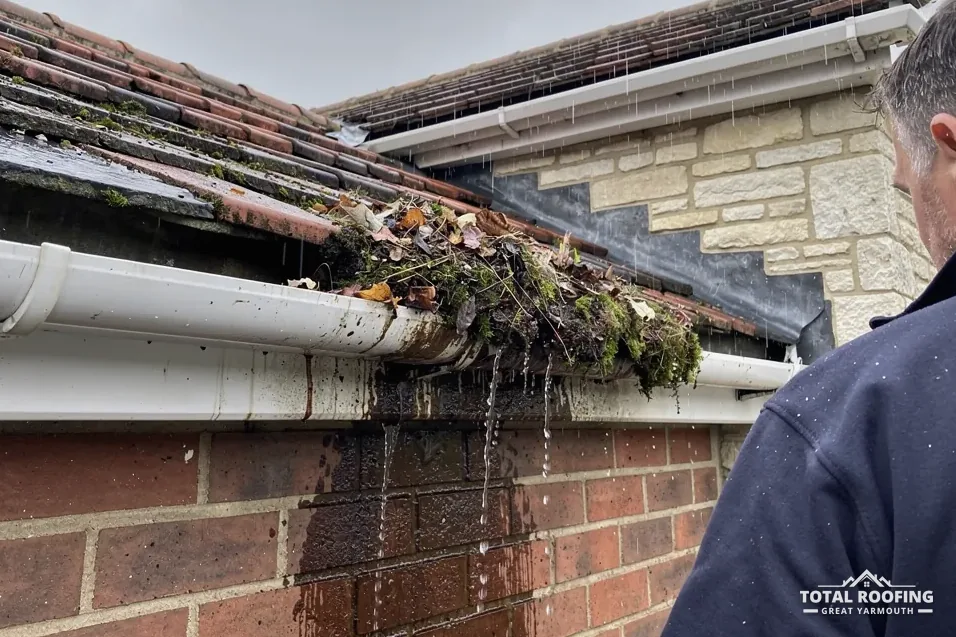
Gutters sag because the brackets are too far apart or have loosened, because the fascia board behind them has gone soft, or because debris, standing water or ice is weighing the channel down. A sag also ruins the fall, so the gutter holds water and gets heavier.
Brackets: too few, or loose
A gutter is a long, light channel that depends on its brackets for its line. Between two brackets it is carried by nothing except its own stiffness, so a run fixed with brackets set too far apart bows in the gap, and a bracket that has bent or come away lets its neighbourhood drop. The bow shows up as a dip in the front edge when you look along the run from one end.
Bracket spacing is set by the maker of each gutter system and differs between profiles and materials, so the right distance is on that system's own fixing sheet. A run that sagged from new was probably hung with too few supports, while one that sagged later has probably lost one or more, and the survey can tell the two apart by looking at the holes.
A loose bracket is not always the bracket's fault. The screw may be turning in timber that has gone soft, which brings in the board behind it. Re-fixing into rotten wood only buys a short reprieve, and the screw works loose again.
The fascia board behind the gutter
Brackets for most guttering screw into the fascia, the board that runs along the foot of the roof, or into the rafter ends behind it. If that timber has rotted, the fixings have nothing to grip. The gutter then sags in patches, wherever the wood is weakest, rather than evenly along the run.
A simple check from the ground is to look for flaking paint, dark staining or a board that has bowed or split along its lower edge. Water that has overflowed or leaked from a gutter soaks the board it hangs on, so a long-running overflow and a rotten fascia can belong to the same story.
If the board is the cause, the repair belongs to the board. Our page on rotten fascia board sets out when a section can be replaced and when the full run should come off. Fascias are the boards at the foot of the roof and soffits the panels under the overhang, and both are part of what holds the gutter.
Weight, water and ice in the channel
A gutter built to carry rain is not built to carry a load of wet leaves, silt and moss. Debris is heavy once it is soaked, and it sits in the channel at its lowest point, which is the middle of any sag. Left alone it adds to the dip and deepens it.
Standing water does the same. Once a gutter has lost its fall, it holds a pool, and the pool's weight bends a plastic run further. The maker Brett Martin sets the fall at "1mm for every 600mm" towards the outlet, which is a slope you can hardly see by eye, so a small sag is enough to cancel it. See gutter fall for how that works in practice.
Ice adds weight in cold weather, when water in the channel freezes and expands against the sides. A run that is already bowed is the one that gives way. Clearing the channel before winter takes the load off, and gutter cleaning covers the job.
Putting a sagging run right
The remedy follows the cause. The choices fall into three, and the survey says which fits your run:
- Add or replace brackets and re-set the run to its fall, where the board is sound and the gutter has not been permanently deformed.
- Replace a bowed length, where one stretch has taken the damage and the rest is straight.
- Renew the board and then the run, where the timber is rotten and any new fixing would fail.
Total Roofing Great Yarmouth surveys the brackets, the board and the fall together, and looks at the roof above, because a leak at the roof edge can be wetting the board from behind. Whatever turns up is explained in everyday terms, and the price comes as one written figure covering the lot. A photograph taken along the length of the run and sent on WhatsApp shows us the dip before the visit. Neighbouring faults are covered under guttering, soffits and fascias.
