
The short answer
A blocked run or outlet, a fall that sends water the wrong way, a channel too small for the roof above it, or a valley that throws water across the top. Watching the gutter in rain shows which one it is. Clearing alone cures only the first.
Blocked run or outlet
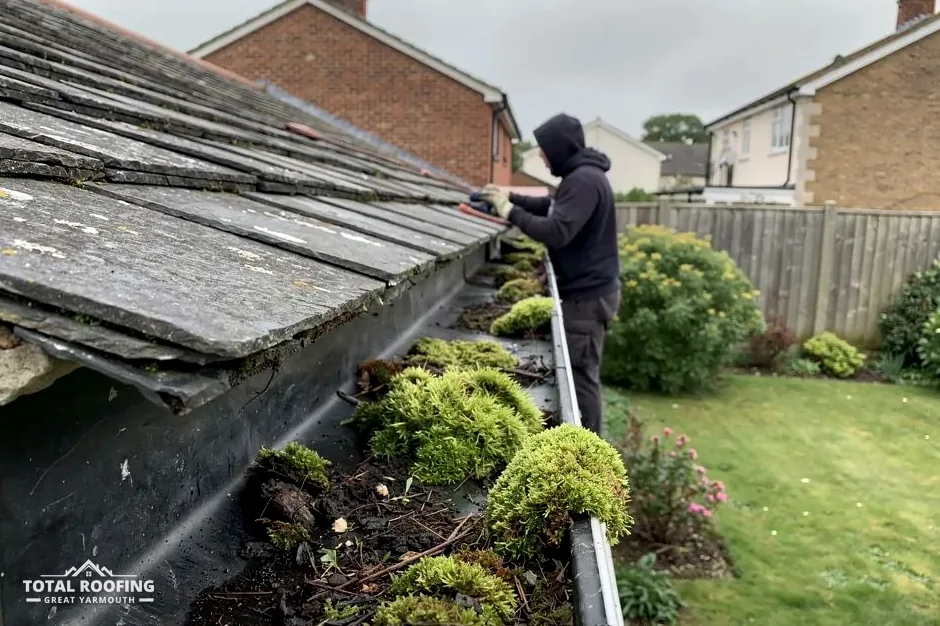
Leaves, moss washed off the tiles, grit and sometimes a tennis ball collect at the outlet, the point where the gutter drops into the downpipe. Once the outlet is partly closed, water backs up along the run and spills over the lowest part of the front lip. The giveaway is a gutter that overflows along its whole length, or at the end nearest the downpipe, while a trickle runs down the pipe.
Which? Trusted Traders give £75 to £350 for clearing a property's gutters, front and back (November 2025, excluding VAT). Our page on moss blocking gutters explains where roof moss ends up once it is washed off the tiles, and why a run below a mossy slope clogs again soon after being cleared.
A downpipe can block as well. If the outlet is clear but water stands in the channel, the blockage may sit lower down, at a bend or a shoe, and clearing the gutter alone will not reach it.
Fall in the wrong direction
A gutter has to slope gently towards its outlet. Brett Martin, a guttering maker, gives the fall as "1mm for every 600mm" towards the outlet. A run that has sagged between two brackets, or that was hung level or backwards, holds a pool of water instead of passing it along. A six metre run, for example, drops by 10 mm over its length when it is set to that ratio, which is barely visible from the ground.
The tell-tale is a gutter that stays wet for hours after the rain has stopped, or that overflows at the far end from the outlet. Water collects in the dip and tips over the nearest low point. On a plastic run, a pool also adds weight, so the dip deepens.
A slight sag can sometimes be corrected by re-fixing the brackets. A run that has bowed over a long length, or whose fascia has gone soft, needs more than that. Our page on gutter fall shows what a correct slope looks like, and the question of sagging boards has a page of its own under sagging gutters.
A channel too small, or water thrown across it
Some overflows have nothing to do with debris. The gutter is simply asked to carry more than its size allows. Three situations produce this:
- A large roof slope draining to one short run with a single outlet, so the whole slope's rain arrives at one point.
- A valley, the angle at which two roof slopes meet, which funnels their water into a stream that leaves the roof at speed and clears the front of the gutter.
- An extension or dormer added later, which sends more rain towards a run that was sized for the old roof.
Sizing and outlet positions differ from house to house, so a survey is the way to settle them on your own house. A gutter overflowing at one spot in heavy rain, in the same place beneath a valley or an extension, points to this cause rather than a blockage. A deeper profile with a second outlet can fix a capacity fault.
Working out which cause you have
A free test needs only a safe vantage point inside or under cover during a downpour: watch where the water leaves the gutter. Spilling along the whole length suggests a block. Spilling at one end suggests the fall. Spilling in one spot under a valley suggests overload. A trickle from a joint is a leak, not an overflow, and needs a different repair.
At Total Roofing Great Yarmouth the survey looks at all four causes together, and at the roof above them too, since slipped tiles or a failed valley lining can send water the wrong way and make a sound gutter look at fault. What we find is explained to you in everyday language, and the price that follows is a single written total.
A short video or a photograph of the gutter in rain, sent to us on WhatsApp, shows far more than a description does. For the other faults along the eaves, see guttering, soffits and fascias.
