
The short answer
A small flat roof repair needs no Building Regulations application normally, but a replacement of the whole covering does touch the Regulations. Under Part L a renovated roof is brought up to a better standard where feasible, and a new flat roof on an extension must comply from the start. Building control confirms the route.
The re-roofing test for repairs and small jobs
The Planning Portal's guide says re-roofing needs no application normally where "Less than 25 per cent of the total 'building envelope' (walls, floor, roof, windows, door, roof windows and roof-lights) is affected" and "Less than 50 per cent of the roof is affected." Both limits have to hold together. A patch, a strip of felt or a new edge trim sits well inside them.
Stripping and recovering the entire flat roof lands beyond the second limit, whichever material goes on, because it affects far more than half of the roof. Two other triggers bring approval into play. One is a covering that comes out 15 per cent or more heavier than the old. The other is a material that would behave very differently in a fire. Where the covering is heavier, the Portal advises asking a structural engineer or surveyor first.
Planning permission is a separate question from the Regulations. Re-roofing a house is normally permitted development under Class C, and the planning guide on this site sets out where that stops applying.
Part L: when a new covering brings the insulation with it
Approved Document L is the energy part of the Regulations. In its list of renovation, it includes "Replacing the waterproof membrane on a flat roof." Once more than 50% of the surface has been renovated, it is the whole roof that is to reach the improved standard wherever feasible, and not only the patch that was disturbed.
The numbers in AD L 2021 for an existing roof that is renovated are a threshold of 0.35 and an improved value of 0.16, in W/(m²·K). Para 4.13 allows less when the full figure cannot be reached, or when the saving would take longer than 15 years to repay: the roof then goes as low as can be achieved within a payback of 15 years.
One result is that a replacement flat roof can end up as a warm roof, with the insulation above the deck. Our page on warm roof against cold roof compares that with a cold build-up. AD L 2026 takes effect on 24 March 2027, so ask building control which edition applies to a job that starts near that date.
New roofs on extensions, and who decides
A flat roof forming part of a new extension is new building work, so the Regulations apply to all of it: the structure, the weather-proofing and the energy standard. The re-roofing test concerns existing roofs and does not reach it.
Building control is carried out by the council's building control team or by a registered building control approver. Houses inside the borough boundary come under Great Yarmouth Borough Council's building control team, and any other address goes to the council that covers it. Our page on flat roofs on extensions and dormers takes the extension case further.
- New roof on an extension: the whole roof must comply.
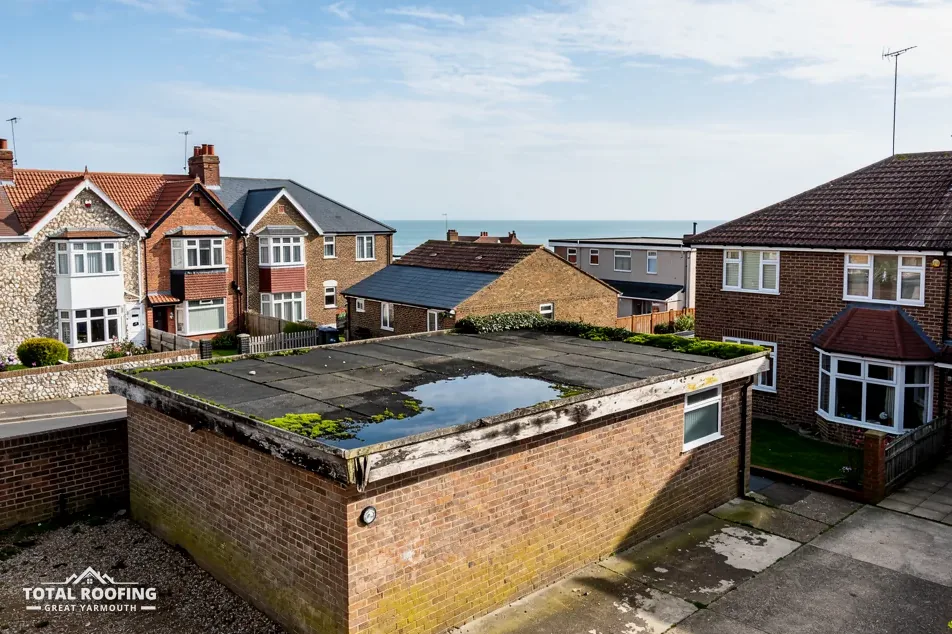
- Full replacement of an existing flat roof: the Part L renovation rules apply and the weight of the covering is checked.
- Repair or patch inside the test: no application normally needed.
- Chimney breast taken out during the job: Building Regulations approval always applies, and a shared breast means a party wall notice as well.
Asking before the work starts
The simplest course is to ask first. We check the planning or building-control route with the council ahead of any work, and the survey shows which of these cases your roof falls into. To begin, message photos to 07880 284133 on WhatsApp or ring 01493 277103.
The survey looks over the whole of the roof and names any other fault seen, so the route is worked out for the roof you actually have rather than the one on a drawing. Afterwards a single written price is given. The pages on flat roof replacement and the wider flat roofing section go further into what a new covering involves, and what the council might need to see before it starts.
Ask the council early about any chimney, rooflight or roof window that sits in the roof, since each has rules of its own and can change the route for the whole job. Mention too if the property is listed or has a conservation area around it, because listing adds a layer of consent separate from the Regulations, and a conservation area can raise an Article 4 question.
