
What taking a stack down actually means
A chimney has two parts that people mix up. The stack is the part that stands above the roof, with its pots and cap. The breast is the part inside the house, the column of brickwork that rises from the fireplace through the rooms above. Taking down the stack removes what you can see from the street. It does not remove the breast unless that is asked for as well, and the two jobs have different rules, which our guide to chimney breast removal sets out.
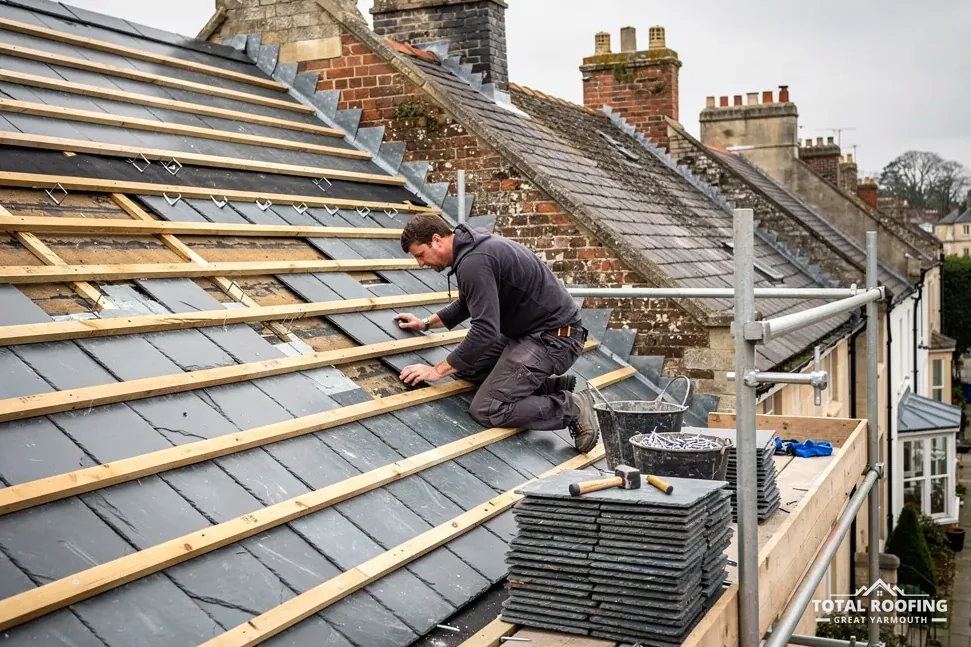
When the stack comes down, the roof has to be closed up where it stood. The brickwork comes down a course at a time, to a height settled at the survey, the opening in the roof is framed with timber, and the covering and underlay are laid across it to match the slope. If the stack sat on a ridge or against a gable, the lead and the tiles around it are rebuilt as part of the job.
The reasons for taking a stack down differ from house to house. It may have become unsafe, the brickwork may have gone beyond economic repair, it may no longer serve a fire or boiler, or it may simply be in the way of a new covering. Before deciding, it is worth looking at the other routes, because a stack that is leaking may only need repointing, a new bed or a new cap. The chimney repairs hub lists each of those jobs.
Routes to weigh before a stack comes down
- Repoint and repair the stack as it stands
- Rebuild the stack in matching brick
- Cap the flue and keep the stack
- Take the stack down to roof level
- Take down stack and breast together
Why the structure underneath comes first
A chimney is a structural element. The stack above the roof is carried by the breast below it, and in some houses the breast also helps carry floors, roof timbers or a chimney on the floor above. Taking away one part without understanding the others can leave brickwork or timbers without support, and that is why the survey includes the loft and the rooms below, not only the roof.
In a semi-detached or terraced house the picture is more complicated, because a stack can serve both properties or sit across the dividing wall. The stack above the roof can be a shared feature even when the fireplaces below belong to separate owners. Taking part of it down changes what is holding up the remainder, and a survey of the loft and both sides of the party wall is the way to see what is carried by what.
Where a structural engineer is needed, the survey says so. We describe what we found up on the roof and inside the loft, and we say plainly when a calculation or a drawing should come from someone qualified to produce it. That is not an extra step to add cost, it is the point at which a structural question stops being a roofing question.
Building control before any bricks come off
Removing a chimney breast always needs Building Regulations approval, according to the Planning Portal, because it is part of the structure. Dismantling the part above the roof is the lesser job, yet it is structural work too, and building control is consulted on the route in advance. Building control is carried out by the council's building control team or by a registered building control approver, and the check is made with whichever applies to your address. For Great Yarmouth addresses, that means checking with Great Yarmouth Borough Council's building control team, and for other addresses the same check goes to the council that serves them.
The reason for the check is that the Building Regulations cover the structure of the building, and a stack that is partly removed changes it. The check also covers what remains: the support for the part of the flue that is kept, the roof timbers around the opening and the weathering of the roof. If a flue is still serving an appliance, the removal affects that appliance as well, so a boiler or a stove is discussed with the person who services it before any work is planned.
Part of what building control looks at is how the roof is made good once the stack is gone. A new opening in the roof is framed so that rafters are supported, the timber is sized for the span it carries and the underlay and covering go on in line with the roof around them. These are details a surveyor can describe from the loft, and they go into the one written total price.
Planning permission, conservation areas and listed homes
Most alterations to a house roof are tested against Class C of the General Permitted Development Order, and that class has a carve-out. Condition C.1(d)(i) takes out of its scope work covering "the installation, alteration or replacement of a chimney, flue or soil and vent pipe". Homeowners should not assume permitted development for a stack coming down, so a call to the council comes first. Our planning guide covers the rest of the roof rules.
Location adds a second layer. In a conservation area, an Article 4 direction can remove further permitted development rights, so we check with the council first. Check with Great Yarmouth Borough Council whether an Article 4 direction applies to your address, or with the council that covers your home if it is elsewhere. Inside the Broads executive area the local planning authority is the Broads Authority, so the address is checked against that boundary as well.
A listed home brings listed building consent into the question. The stack may well be one of the features that give a listed house its character, and consent is needed for work of the kind the law describes as "in any manner which would affect its character as a building of special architectural or historic interest". With a listed house, ask the council before anything comes down, since taking down a listed stack without consent puts you on the wrong side of the law. Where an old stack is a landmark in its street, the council may ask for repair or a rebuild in matching brick in its place.
Shared walls and your neighbour
If the stack or the breast is on a wall that you share with a neighbour, the Party Wall etc. Act 1996 comes in. Section 2(2)(g) lets a building owner cut away from a party wall any footing or any projecting chimney breast, jamb or flue. Cutting into a party wall counts as party structure work, which means the neighbour must receive at least two months' notice from the building owner before the work will begin, as section 3 of the Act requires.
A surveyor is needed only if the neighbour dissents or does not reply within 14 days. If the neighbour dissents, the surveyor procedure in section 10 applies. It is not a veto. A neighbour who consents in writing can allow work to start sooner. Party wall questions go to a party wall surveyor, not to building control, and serving the notice falls to the building owner.
Even where nothing is cut into the shared wall, taking a stack down changes the weatherproofing on both sides of the dividing line. Talk to the neighbour before the work, because scaffold, noise and the lead at the junction affect both roofs. A neighbour who has been told what is happening is easier to work with than one who finds the first scaffold pole in the front garden.
Asbestos, debris and what comes off the roof
HSE guidance on older buildings reads: "If the building was built or refurbished before 2000, assume that there is asbestos in it". Some old flue pipes and linings were made of asbestos cement, and a stack that is being taken down is a job where materials are broken up. A survey checks the age of the house and its materials before anything is broken, because cutting or smashing asbestos cement turns a non-licensed material into a notifiable problem.
Under HSE guidance, a sheet of asbestos cement lifted out whole and unbroken is non-licensed work. Once the material is broken up it becomes notifiable non-licensed work, and HSE says most work on asbestos insulating board is licensed. If asbestos is found, work on that part stops until it has been dealt with properly by someone able to do it, and the written quote then reflects what is needed. Flue pipes and linings made of asbestos cement are one place where the material can turn up, so the question is asked before the first brick is struck.
Ordinary rubble and brick come down by hand and go into a skip. Use a lockable skip for asbestos, and never an open one. Norfolk addresses cannot take asbestos to a recycling centre at all, and Suffolk addresses cannot either: you cannot take it to any Suffolk Recycling Centre, so disposal is arranged separately from household waste.
Order of work for a stack coming down
- Survey the stack, loft and flue before any quote.
- Check the planning and building control route.
- Erect access, with a highway licence if needed.
- Take the brickwork down by hand, course by course.
- Frame the roof opening and relay underlay and covering.
- Rebuild lead and tiles around any remaining structure.
Published costs and the written quote
There is no single price for removing a stack, because the height, the number of flues, the access, what sits below and the covering that has to be made good all change it. MyJobQuote publishes two averages, both from its removal guide dated 3 November 2026, and neither comes with a VAT basis.
The table sets them out. Treat them as a starting point for the conversation, not as a rate card. Our written quote is one total price after the survey, and where scaffold or access is needed it is part of that single figure. The quote is written for the roof as the survey found it, not for an average one.
If a quote you have received is far from these figures, it is worth asking what it covers: whether it includes making good the roof, taking the breast down as well, and the roof timbers around the opening. Those are the places where two quotes for the same job can differ, and a plain description of the work is the way to compare them fairly. A clear line on each of those points also shows whether the quoted figure is for the work you need or for a smaller job.
Published averages for chimney removal
| Removing a chimney breast | around £2,500 |
|---|---|
| Whole stack with the breast | around £3,000 to £3,500 |
Source: MyJobQuote's guide to removing a chimney breast, dated 3 November 2026. These are its averages as printed, with no VAT basis given, and they are not Total Roofing prices.
