
Start with what the stain is telling you
Before anyone climbs a ladder, the inside of the house gives clues. Note where the damp is: on the breast wall in a room, on the ceiling beside the stack, on the wall in the loft or around the fireplace opening. Note when it appears. A mark that grows after a downpour and fades in a dry week points towards rain entering somewhere on the roof. A mark that shows up in cold weather and stays, whatever the sky is doing, may be condensation inside the flue instead.
Wind direction matters too. If the stain only appears when the rain is driven from one side, the opening is probably on that side of the stack. Photograph the stain with a date, and send the picture on WhatsApp if you like, because a survey can then start from what you have already seen.
Remember that water travels. It can run along a timber or down the inside of the brickwork for some distance before it reaches plaster, so the damp patch is a guide to the area, not a map reference for the hole. That is why the survey covers the whole roof around the stack and says plainly what else showed up, instead of fixing only the spot the stain sits under. A single leak can also have a partner: a cracked cap and a lifted flashing can both be letting rain in, and treating one leaves the other running.
Brickwork and pointing high on the stack
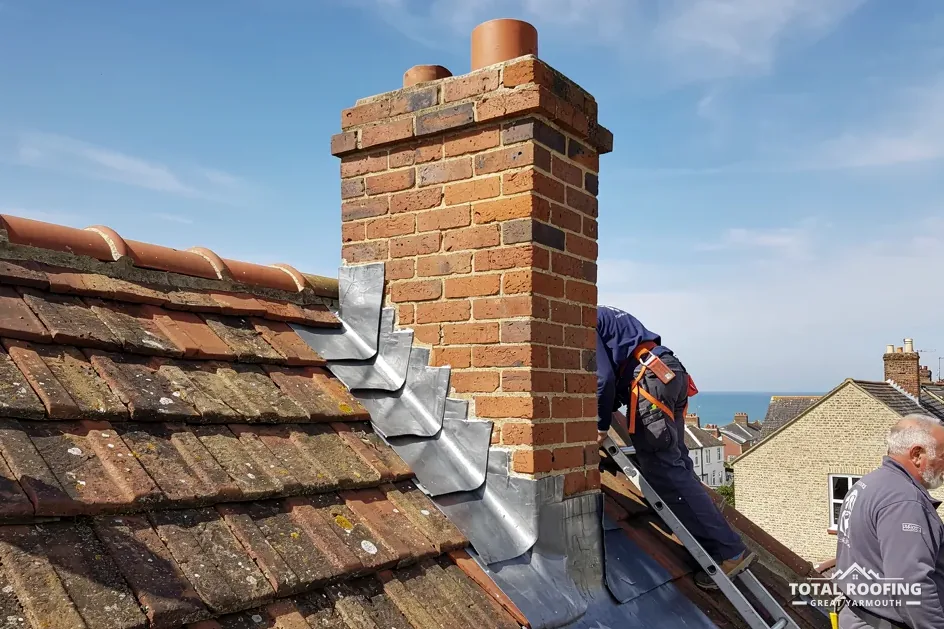
Above the roof, a chimney stack is a freestanding column of brick and mortar, exposed on all four faces to rain, wind and frost. Nothing else on the house takes that much weather on every side. Brick is porous, so it takes up water, and the mortar joints between the bricks wear back over the years until they are open or crumbling. Where the face of a brick has flaked away, the bed behind it is softer and takes up more water.
Water that enters through the brickwork can pass through the stack to the inside and show as a damp patch on the breast in the room below. It can also collect on the inside of the flue and run out at a lower level. The remedy for failed mortar is to rake out and repoint the open joints, and our chimney repointing guide covers that work.
The price of repointing a stack comes from the written quote after the survey, since the height, the access and how much of the pointing is open all change the work from one chimney to the next. Be wary of a quote that offers a coating over failing mortar without repointing it. A coating does not close a crack, and it is the cause that needs treating, not the surface.
The mortar bed and cap at the top
At the very top of the stack, a sloping mortar bed called flaunching beds the pots and carries rain outwards and away from the flue. Over the years it cracks, shrinks away from the pot or the brick, or crumbles, and water then runs down inside the stack instead of off the top. That gives rain a direct route to the flue, and the cracks can be invisible from the ground.
Where a chimney has been closed off, a slate, a stone or a cap may cover the top. If it has cracked or shifted, or if the bedding mortar under it has failed, rain can drop into the flue and soak the brickwork from within. A pot that has tilted or loosened has the same effect. Capping is a topic of its own and our guide to capping a disused chimney explains the choices.
At the head of a stack, the first look is for cracks across the bed, gaps round the pots and any sign that mortar has dropped away. These are things the surveyor sees at close range from the roof, which is another reason a quote given from the pavement alone is a guess. The flaunching and the cap are small in area, but a leak at the top of the stack can come down a long way before it reaches a visible wall.
Lead at the roof line
Where the stack comes through the roof, lead flashings close the gap where brick meets covering. If a section has lifted, split or lost its pointing, rain runs behind it and onto the timbers or the ceiling. It is a familiar suspect, which is why people say a chimney leak is a flashing problem, though the flashing is just one candidate among the six listed below.
A flashing fault shows near the roofline, in the loft beside the stack, or on the ceiling nearest to where the stack passes through. A fault at the top of the stack shows lower down the breast, or inside the flue opening. That difference is one of the clues the survey uses to narrow the search, along with the state of the soakers, the tiles around the stack and the timbers underneath, which are all checked in the same visit.
The parts of a flashing, the way lead fails and the published price figures for chimney leadwork are all set out in our guide to chimney flashing repair. If the lead looks sound and tight, with good pointing and a decent lap over the covering, the search moves on to the brickwork, the bed and the cap.
Places water can enter a stack
- Cracked or missing pointing in the brickwork
- Flaked brick faces that hold water
- Cracked flaunching or a loose pot
- Cracked or displaced cap over the flue
- Lifted or split lead at the roof line
- A slipped tile or soaker beside the stack
Damp that is condensation, not rain
Not every chimney stain is a leak. Warm, moist air from a fire or a heating appliance can condense on the cold inner wall of a flue, and the damp can work through the brickwork and appear on the breast wall. This is more likely when the stack is cold and tall and the flue is used for short periods. A disused flue closed off at the top, with no air moving through it, can collect moisture as well.
The way to tell the two apart is the pattern. Rain entry follows the weather. Condensation follows how the appliance is used and how cold the stack is. A survey of the roof can rule the rain in or out, and a stained breast with a sound roof around it points the question towards the flue. Where an appliance is connected, the flue is a separate question from the roof, and it belongs with the appliance's installer or a qualified chimney sweep.
Treating a condensation problem as a roof leak, or the other way round, means paying for work that does not stop the damp. That is why a survey rules out the roof first. If the roof is sound, you know the fix lies elsewhere, and you have not paid for lead or brickwork that was never the cause.
Rain or condensation?
Rain entry
- Follows heavy or wind-driven rain
- Dries out in a dry week
- Stain nearest roof openings
Flue condensation
- Follows cold spells
- Persists in dry weather
- Damp on the breast itself
Matching the repair to the cause
Once the opening is known, the repair follows from it, and each one is a different job. Failed pointing is repointed. A cracked bed is rebuilt and the pots rebedded. A displaced or broken cap is replaced or refixed. A lifted flashing is re-dressed or renewed, and slipped tiles beside the stack are put back. When the stack itself has moved or the brickwork has gone beyond repair, the answer may be to take part of it down and rebuild it, which is a bigger job than any of the others.
A repair at the wrong point can leave the leak running. Painting a stain, sealing the ceiling or coating the outside of the stack hides the symptom, and the damp will come back at the next heavy shower. A written quote that names the point of entry and the repair for it, as one total price, tells you the survey has found something specific rather than offering a general treatment.
Treating the cause also protects the timbers. Roof timbers that stay wet beside a leaking stack can soften, and a ceiling that stays wet can come down in time, so the sooner the opening is closed, the less the damage grows. For a leak that is already inside the house, take photographs of the damage and the stain while it is untouched, and let your insurer know.
Myth
A coat of sealant over the damp patch stops the leak.
Fact
The stain shows where water ended up; the repair belongs at the point it got in.
The order a survey traces it in
A leak is traced from the top down and from the outside in, one place at a time, because a stain can have more than one source. The order below is how a survey works through a stack. It starts where the exposure is greatest and the access is hardest, and it finishes where the water has been seen. Each step is a check, not a promise of a repair.
The result is a plain account of what was found and what each finding means, followed by a single written total price covering the work those findings call for. If the survey shows more than one fault, the quote covers the work for all of them, and you are told which one is the main cause. Where the chimney shares a wall with the house next door, work that cuts into that wall falls under the Party Wall etc. Act 1996, and the building owner serves the neighbour notice well ahead of the start date.
The top of a chimney is a poor place to work from a ladder, so access may form part of the job. If the access equipment has to be set up over the footway or the road, the county council issues a highway licence for it, and we arrange the licence with our scaffolder. Access is included in the written quote as one total. When the leak has been traced, the next step is the fix itself, and our chimney repairs hub lists each kind of work.
A tracing order for one stack
- Note where and when the stain appears indoors.
- Check the loft beside the stack for damp timber.
- Look at the cap, pots and flaunching from the roof.
- Inspect the pointing and brick faces up the stack.
- Examine the flashing and soakers at the roof line.
- Rule in or out condensation if the roof is sound.
