
Why one chimney price does not fit every stack
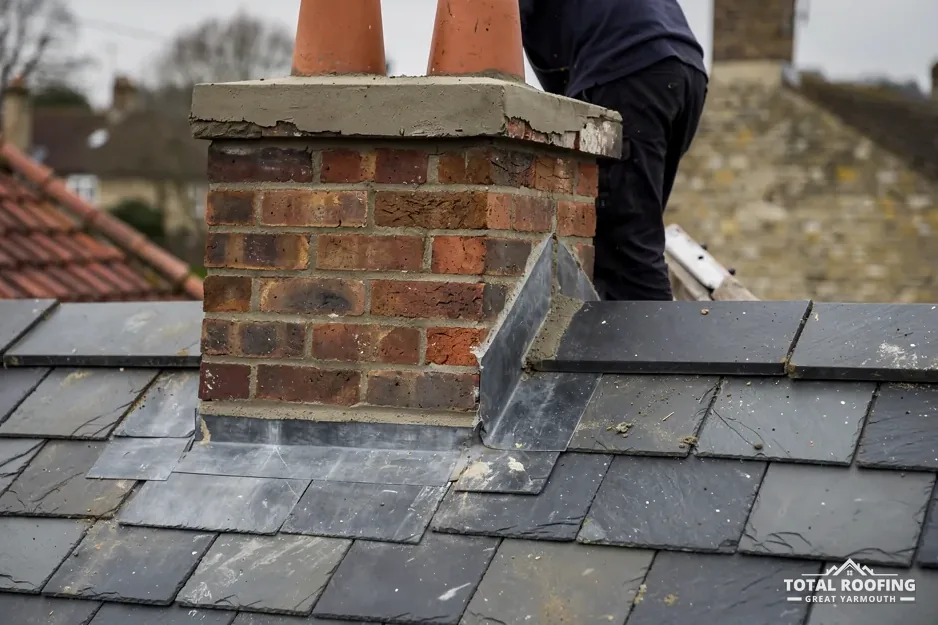
A chimney stack is a small structure with several parts, each of which can fail on its own: the pots, the mortar cap around them, the brickwork and its joints, the lead flashing round its base, and the flue inside. Two houses on the same street can need completely different work, so an honest answer to "how much does a chimney repair cost?" is a range with a list of what pushes it up or down.
Height and access move the price a great deal. A stack on a bungalow, reached from a short ladder, is a different job from one rising from a three-storey gable. A stack with a tall run of brickwork above the ridge, a stack on a terrace, or a stack tucked behind a parapet can need scaffold to be reached safely, and scaffold is a real cost in its own right. Scaffold over a footway or carriageway also needs a highway licence from the county council.
The extent of the fault matters next, and the cost of leaving it grows with time: a cracked cap or open joint lets rain into the stack and the brick behind it, and water that reaches the chimney breast shows up inside the house as damp. A hairline crack in a mortar cap is a small repair. A cap that has crumbled around the pots, joints that have eroded back from the brick face, a lean in the stack or bricks that have flaked to a powder mean more work, and the work needs deciding on the roof, not from the pavement. That is why a survey comes before a quote: a figure given only from the pavement is a guess.
- How high the stack is and how it is reached
- Whether scaffold is needed, and whether it stands on a public footway
- How many stacks and how many pots
- The condition of the brick, the joints, the cap and the flashings
- Whether the work is a repair, a rebuild or a removal
Published figures for chimney work
Cost guides put figures on a few common jobs. These are averages from MyJobQuote, each tied to the date of its page and to chimney work only, and none of them is our price.
| Job | Figure | Source and date |
|---|---|---|
| Removing a chimney breast | average around £2,500 | MyJobQuote, 3 November 2026 |
| Removing the whole stack with the breast | average around £3,000 to £3,500 | MyJobQuote, 3 November 2026 |
| Chimney lead flashing patch repair | around £200 | MyJobQuote, 22 September 2026 |
| Full chimney lead replacement | averages around £570 | MyJobQuote, 22 September 2026 |
The two lead rows describe chimney flashings and nothing else, and a flashing patch is the smallest step: it deals with a split or a lifted edge, where a full replacement strips the lead from every side of the stack and sets new lead into fresh joints. Neither row says what the brickwork behind the lead is like, and new lead pushed into mortar that has failed will not hold, so a survey looks at both. The removal rows are a different kind of job altogether, with structural and legal steps that a repair does not have. For a full chimney leadwork replacement MyJobQuote gives a range of £350 to £920, "depending largely on whether scaffolding is required", which shows how much of the swing is access. Averages hide a spread: some chimney jobs cost less than the figure and some cost more.
None of these is a quote. They set a rough expectation and say nothing about a particular stack, its access or its condition.
Chimney figures from MyJobQuote
| Removing a chimney breast | around £2,500 |
|---|---|
| Removing the whole stack with the breast | around £3,000 to £3,500 |
| Lead flashing patch repair | chimney lead, around £200 |
| Full lead replacement | chimney lead, around £570 |
MyJobQuote, removal page 3 November 2026 and chimney leadwork page 22 September 2026 (averages).
Repointing and flaunching are priced after a survey
Repointing a chimney means raking out failed mortar joints and filling them again; flaunching is the mortar cap around the pots. Both are priced after a survey, since the price turns on facts a photograph cannot show: how many joints have failed, how deep the decay goes, how much of the brick face has been damaged and how the stack is reached.
Joint failure on a stack is easy to see through binoculars from the ground, but how far it goes into the brick is not. If the mortar has eroded to the depth of a thumb, the joints are cut out to sound material, and that takes longer than a surface touch-up. If the bricks themselves are flaking, the work moves from repointing to replacing bricks, or to rebuilding part of the stack, and the price follows.
The mortar also matters. A mortar harder than the brick around it can trap water and make the brick break up instead of the joint, which is why mortar is matched to the brick, as our chimney repointing guide explains. A flaunching, the small sloping bed of mortar around the base of the pots, can be renewed on its own, as set out in our guide to chimney flaunching, but it is another reason to examine the whole stack before a price is given.
A quote that gives a single figure for repointing without having seen the stack is a prompt to ask what it assumes.
Scaffold and access
Scaffold hire is priced after the survey, and here is how it affects a chimney price. Scaffold is erected for the safety of the people doing the work, and a stack that is high, steep to reach or tight against a neighbour's wall can need a full scaffold where a lower stack needs only a roof ladder or a tower.
A licence under section 169 of the Highways Act 1980 is needed for scaffold that stands over a footway or carriageway, and it is issued by the county council, not by the district or borough council. We arrange the licence with our scaffolder. The licence is a separate permission from planning or Building Regulations, and it is a matter for the scaffold, not the chimney.
If the job needs scaffold, that is part of the written quote, which follows the survey. When you compare another firm's chimney quote with a figure from a cost guide, check what each quote covers. MyJobQuote's own chimney lead figures swing from £350 to £920 mainly on whether scaffolding is needed, so two quotes can differ simply because one covers scaffold and the other does not.
Work on a chimney shared with a neighbour can also add steps. If the work cuts away a chimney breast, or cuts a flashing into the party wall, the Party Wall etc. Act 1996 applies, and the notice goes out well before the work.
Taking a chimney down costs more than patching it
Removal is a bigger job than repair, and it carries rules that a patch repair does not. Taking out a chimney breast always requires Building Regulations approval, since the breast belongs to the structure, with the weight it carried to be supported. A chimney stack on the roof is outside Class C of the planning rules, which covers re-roofing a house and roof lights, so taking a stack down above the roof is a question to put to the council first. On a listed building, work that affects its character needs listed building consent, and in a conservation area or the Broads, the council or the Broads Authority is the one to ask.
The published figures come with their own limits. MyJobQuote's average cost of removing a chimney breast is around £2,500, and its average for removing the entire chimney stack with the breast is around £3,000 to £3,500. Both are averages dated 3 November 2026, and neither speaks for your house. Capping a chimney after removal, repairing the roof where the stack stood and making good inside all depend on the house.
A chimney that is still in use needs to keep its flue ventilated if it is capped, and a chimney that serves a heating appliance has its own Building Regulations considerations. Those are for the survey and for building control, not for a price in a guide. Our guide to removing a chimney stack sets out the routes in more detail.
If the stack is being taken down because it has become unsafe, ask for the reason in writing before agreeing, and ask whether a repair or a rebuild was priced as well, since the cheaper job on paper is not always the right one for the house.
Comparing chimney quotes
A good chimney quote names the job in words: which stack, which parts, what is being done to each, and what will be left as it is. A stack with one flaunching and a rebuilt top course is a different job from a stack that is repointed down to the roofline, and the words in the quote should show which one you are paying for. It gives one total price for the whole job. It says how the stack is reached and what happens to the old material. If one quote says "repoint stack" and another lists every joint on both stacks and a new flaunching, they are different jobs, and the price gap means little until the scope is settled.
Be careful with a quote that is much lower than the rest, and equally with a quote that cannot be explained. Ask what it covers and what it leaves out, and ask whether it assumes scaffold, a ladder or a tower. A firm that quotes without having looked at the stack, or that comes to the door saying it has spotted a loose chimney, is a firm to hold at arm's length. Our guide to reading a roofing quote sets out the checks.
Our survey covers the entire roof, so the flashing, the slopes around the base and the nearby gutters get a look as well as the stack. The written price that follows is one total, and you learn what else was seen. You can send a photo of the stack on WhatsApp on 07880 284133, or ring 01493 277103, before a survey is booked. The rest of our work is on our chimney repairs page.
