
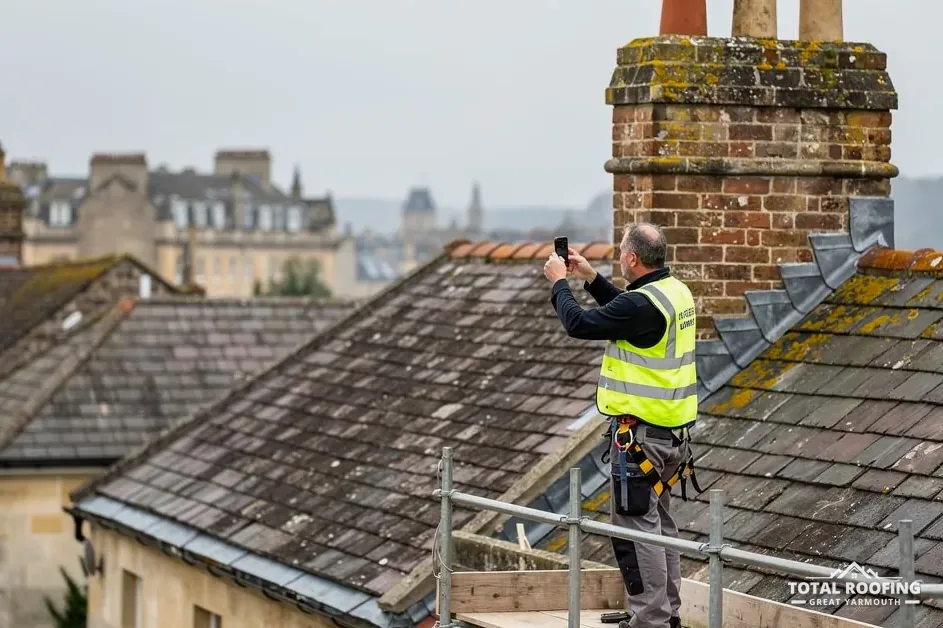
What the flashing does where stack meets slope
A chimney stack stands up through the roof like a small wall, and the roof covering stops against it on every side. The gap between the covering and the brickwork has to be closed by something that bends, because the stack and the roof do not move at the same rate. Lead flashing does that job. It is sheet metal dressed over the covering on one edge and tucked into the brickwork on the other, so that rain running down the stack is carried onto the tiles instead of behind them. It belongs to the wider family of chimney repairs, and it is one of the places a roofer looks when a stack is blamed for a leak.
Each face of the stack gets its own treatment. The face towards the eaves takes an apron, the sides take stepped flashing, and the face towards the ridge takes a back gutter. Where the roof covering is tile or slate, small pieces called soakers are often tucked in at the sides under the covering, and a flashing is dressed over them. Because the stack is a different shape on every house, the lead is cut and bent to fit on site rather than bought ready-made.
This page is about the flashing alone. If a stain has appeared and you do not yet know where the water comes in, start with our guide to why a chimney leaks, because the flashing is only one of several places to check. The top of the stack also has a sloping mortar bed, called flaunching, and the two are surveyed together.
The five lead parts, named and placed
Roofers use a handful of trade words that a homeowner may not meet until a quote arrives. The glossary below gives each one in a line. Reading it first makes a quote or a survey comment easier to follow, and it lets you name the right part when you send a photo on WhatsApp. Lead flashing is cut and dressed by hand to the shape of the stack, so two chimneys on the same street can carry quite different arrangements of the same five parts, and a stack that stands in the middle of a ridge needs a back gutter where one at a gable end may not.
The apron sits at the low side of the stack and is a single wide sheet. The back gutter sits at the high side and is a trough that sends water round the stack to either side, so it does not pool against the brickwork. Stepped flashing runs up each side of a stack, stepping with the brick courses, and each step is tucked into a joint that has been cut out for it. Lead is held in that cut joint, called a chase or a raglet, with wedges and then sealed with mortar or a sealant.
Flashing words in plain English
- ApronWide lead sheet across the low face of the stack
- Back gutterLead trough behind the stack that sends water round it
- Stepped flashingLead running up the sides, stepped with the brickwork
- SoakerSmall bent lead piece tucked under each tile course
- ChaseGroove cut into a mortar joint to hold the lead
How lead flashings fail
Lead does not rot in the way timber does, so a failed flashing is a failure of how it was fixed, not of the metal alone. The stack and the roof expand and settle at different rates, and over the years that movement works the lead loose at its edges. A raglet that was pointed in mortar can crack, and once the pointing opens the lead is no longer held, so it lifts and lets rain run in behind.
Poor detailing also shortens the life of a flashing. A flashing laid too short on the covering gives rain a path to run under it. A back gutter without enough fall holds water against the brickwork. A single long piece of lead run along a whole side can buckle as it warms and cools, because lead moves with temperature and needs steps and joints to take that movement up. Where the original fitter used sealant or a cement fillet in place of lead, that material cracks and shrinks away from the brick, and the leak starts at the crack.
None of these faults needs a ladder to explain. They are all places where two things move against each other, and where the weatherproofing depends on something staying tight. That is why a survey looks at the pointing, the fixings and the lap of the lead over the covering together, instead of only the part that is stained inside. A repair that treats one of them and leaves the other two tired can fail at the next joint along. The survey covers the roof around the stack, and anything else noticed up there is reported back in plain words.
Telling a flashing fault from other causes
A stain on the breast wall, or a brown ring on the ceiling beside it, tells you water is arriving but not where it enters. The flashing is one candidate. Others are porous or cracked brickwork, a failed mortar bed at the top, a cracked or missing cap, a slipped tile beside the stack or condensation inside the flue. Water can travel along a rafter or down the inside of the stack before it appears, so the stain may sit well away from the opening. A ceiling stain that grows after rain and shrinks in dry spells points to an opening on the roof, while one that stays damp whatever the weather may point towards condensation in the flue. Dry weather does not clear the question either: lead that has lifted at a step can sit open for months before a heavy shower tests it.
The checks below are what a surveyor looks at from the roof and from the loft. They do not prove the flashing is the cause, they narrow it down. A flashing that is lifted, split or open at a step is a clear candidate. A flashing that is tight, with sound pointing and a good lap, points the survey towards the brickwork, the flaunching or the pot and cap instead.
What the survey checks around the stack
- Lead lifted or curled at the step edges
- Pointing in the chase cracked or missing
- Splits or creases in the apron or back gutter
- Back gutter holding water against brickwork
- Soakers displaced after tile slips
- Mortar or sealant used where lead belongs
Repair, partial renewal or full replacement
A small split in an otherwise sound flashing can be repaired, and a loose edge can be re-dressed and re-fixed. The limit is the condition of the lead. Lead that has creased repeatedly and thinned, or a flashing that has been patched before, is better renewed than patched again, because each patch adds a joint and a new place for rain to run in. The pointing is renewed along with the lead, since a new flashing set into failed mortar will fail again.
Replacement is a stripped and rebuilt job: the old lead comes off, the chase is cleared and the covering around the stack is checked before new lead is dressed in. Where soakers are needed they go in as the tiles are lifted and relaid. The choice between repair and renewal is made on the roof, with the lead in front of the surveyor, which is why a quote given only from the ground can be a guess. Send photos on WhatsApp first if you like, and the survey then confirms what the photos suggest.
The figures in the table below come from third-party price guides, not from our own rates. They apply to chimney leadwork only and should not be used for lead on a flat roof, a bay or a valley. Our written quote is a single total once the survey is done, and the figures give you a sense of the range before it arrives.
Published figures for chimney lead flashing
| Chimney lead patch repair | around £200 (chimney leadwork) |
|---|---|
| Chimney lead full replacement | around £570 (chimney leadwork) |
| Full chimney leadwork replacement | £350 to £920 (chimney leadwork) |
| Lead flashing repairs, Checkatrade | £50 to £70 per metre |
The first three rows are MyJobQuote's chimney leadwork figures (page last updated 22 September 2026), which state no VAT basis and tie the £350 to £920 range largely to whether scaffolding is required. Checkatrade's repair table (June 2026) is exclusive of VAT and priced per metre.
Lead thickness, codes and how long it lasts
Lead sheet is graded by code from 3 to 8, and the grades comply with BS EN 12588. Leadworx, a lead flashing maker, says code 4 has become the standard choice for general flashing work, and it lists code 3 for soakers and light duty and code 5 for general, vertical and pitched work. The specification for the roof fixes the code for each detail, so no single code is right for every chimney.
A thicker code costs more and resists creasing better, but it is also heavier to dress around a tight corner. The right code depends on the length of each run, the exposure of the stack and what the lead has to bend around. That decision belongs to the person who has been on the roof and measured it, and it is written into the quote as part of the one total price.
Correctly installed lead flashing can last for over 80 years, according to MyJobQuote, which adds that higher codes can reach beyond 100 years. What counts is the phrase correctly installed. A good sheet fixed badly fails far sooner, and a flashing that has outlived its fixings can be re-dressed and re-pointed without the lead itself being scrapped.
Myth
Lead flashing is fitted once and lasts the lifetime of the house.
Fact
It lasts only as long as its fixings and pointing hold; renewing those can keep sound lead.
Shared walls, scaffold and the quote
If your chimney stack sits on the wall you share with a neighbour, cutting a new flashing into that wall brings in the Party Wall etc. Act 1996. Section 2(2)(j) allows a building owner to cut into the wall of an adjoining owner's building to insert a flashing or other weather-proofing. That counts as party structure work. Notice comes from the building owner, with a lead time of at least two months, and a surveyor is needed only where the neighbour dissents or stays silent for 14 days. Party wall questions go to a party wall surveyor, not to building control.
A stack on the edge of the roof or on a terrace may not be reachable safely from a ladder, so the work may need scaffold. If the scaffold must stand on the footway or carriageway, a highway licence from the county council is needed. We arrange the licence with our scaffolder, and where a job needs scaffold, it sits inside the one written total.
Repairing the flashing on an existing chimney does not change the stack, so the Planning Portal's re-roofing test is not the question here. Where the job grows into rebuilding the stack, the route is different, and our guide to rebuilding a chimney stack covers it. If you are weighing up the whole range of work on the stack, the chimney repair cost guide sets out what drives the price.
