
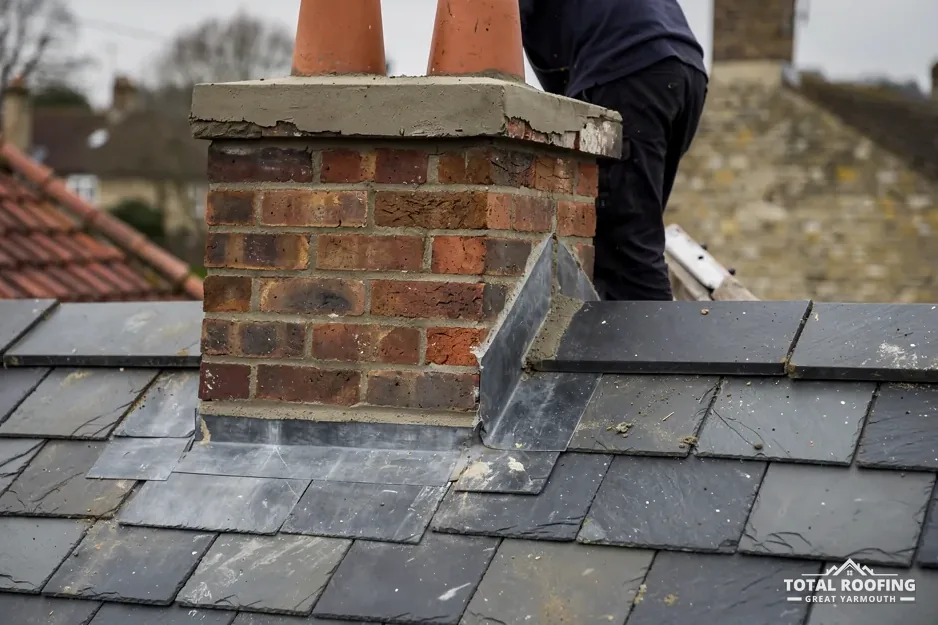
When a stack is past repair
Repointing and a new cap can keep a sound stack going for a long time, and a rebuild is more work than either. It is worth considering when the brickwork itself has failed, not just the mortar. A stack that leans, bulges or has a crack that runs through several courses of brick is no longer a surface problem. Bricks that have lost their faces to frost, so the soft inner brick is exposed and takes up water, are another sign that the material has reached the end of its life.
The survey judges this from the roof, at arm's length, and from the loft, where the lower part of the stack can be checked from behind. It also covers the slopes beside the stack, since a stack in poor condition can have let water into timbers or the ceiling below. Where the damage is limited, the stack may be rebuilt only from the roof line upwards, and the lower brickwork left alone.
Not every poor-looking stack needs a rebuild. Our guide to chimney repointing covers the cases where renewing the joints is enough, and the survey will say plainly which route fits yours. The aim is to spend money on the work that stops the problem, not on the most dramatic option.
Signs a stack may need rebuilding
- Visible lean when viewed from the street
- Cracks running through several brick courses
- Brick faces flaked off and soft inner brick showing
- Loose bricks near the top of the stack
- Mortar crumbling to the touch, not just the surface
- Repeated leaks after earlier repairs
Taking it down, and what gets reused
A rebuild starts with taking the stack down, course by course, to a level where the brickwork is sound. The bricks are removed by hand from the top, so that nothing falls onto the roof or the pavement, and each course is checked as it comes off. Bricks that are sound can be cleaned and reused in the new stack, which keeps the colour and texture of the old one. Bricks that are too damaged are discarded and replaced.
Where the stack carries on down into the loft, the point at which the old brickwork stops being sound sets the starting line for the rebuild. A stack that is cracked through the roof line may need to come down to the ceiling joists. A stack that is only damaged at the top may come down only a few courses. That depth is a judgement made with the brickwork in front of the surveyor, which is why a quote given from the ground cannot fix it.
The rebuild goes up on the old brickwork, with a new damp-proof tray or lead layer at the point where the stack leaves the roof, so that water cannot rise or run down through the masonry into the house. The flue liners are connected through, and the pots, the flaunching and the cap go on at the top. The work is slow because brick is laid in small amounts and the mortar needs time to take up.
Matching the bricks and the mortar
A new stack on an old house looks wrong if the brick is a different colour, size or texture, and the match is a matter of looking closely at what is already there. The face colour, the bond pattern and the joint profile all contribute. Reclaimed bricks from the old stack give the closest match, and where more are needed, a brick supplier can offer new bricks that match the old in colour and size.
Mortar is chosen to suit the brick. A mortar that is much harder than the brick can leave the brick, not the joint, as the part that wears, so the faces of softer bricks flake while the joints stay intact. For older brickwork the choice can be a softer, lime-based mix. The mix a particular house needs is a judgement made once the brick has been seen, and it goes into the written quote.
In a conservation area, or on a listed home, the matching is not just taste. The council may ask for brick and mortar that match the original, and listed building consent covers work "in any manner which would affect its character as a building of special architectural or historic interest". Checking before the old stack is taken down is far easier than asking for the same bricks after the new one has been built.
Brick choices for a rebuilt stack
Reused bricks
- Match the old colour exactly
- Only sound bricks qualify
- Fewer new bricks to find
New matched bricks
- Fill gaps from damaged ones
- Size and colour need checking
- Supplier lead time applies
Flues, pots, flaunching and the cap
The top of a stack is made up of several small parts, and a rebuild is the chance to renew all of them together. The flue liner runs inside the brickwork. The pot sits on top of the liner and gives the smoke or gas somewhere to leave. Flaunching, the sloping mortar bed round the pot, carries the rain outwards. A cap or cowl may then cover the pot, depending on whether the flue is in use.
Reusing pots can save money where they are sound and match the style of the street, but a pot with cracks or a chipped rim is better replaced while the stack is open. The same applies to the cap, since a cracked cap lets rain into the flue and undoes the rebuild. If the flue is no longer used, the question of whether to leave it open, cap it or ventilate it is covered in our guide to capping a disused chimney.
The terms below are the trade words you will meet on a survey or a quote. Knowing them makes it easier to ask what is being renewed and what is being kept, and to see how the written quote treats each part.
Stack parts in plain English
- Flue linerPipe or lining that runs inside the brickwork
- PotCeramic outlet fitted on top of the flue
- FlaunchingSloping mortar bed holding the pot in place
- CowlCover fitted over the pot to keep rain out
- Damp trayBarrier set in the stack where it leaves the roof
New lead at the base of the stack
A new stack needs new weatherproofing at its base. Lead flashings are dressed in as the brickwork goes up, so that the lead is built into the stack rather than added afterwards. That gives a better joint than a flashing pressed onto old brickwork, and it is a reason to renew the lead whenever the stack is rebuilt, even if the old lead looks sound.
Lead sheet is graded by code from 3 to 8 under BS EN 12588. Leadworx says code 4 has become the standard choice for general flashing work, and the specification fixes the code for each detail. The written quote for a rebuild states the lead as part of the stack, not as an extra. If you want to see how the individual pieces fit together, the guide to chimney flashing repair names the parts one by one.
Correctly installed lead flashing can last for over 80 years, according to MyJobQuote. That figure is from a page about chimney leadwork, and it is a reason to see lead as a long-term part of the roof rather than something renewed on a short cycle. A new stack with fresh lead gives the roof a clean start around the chimney, with the tiles or slates cut and dressed to suit.
Permissions: planning, listed homes and shared stacks
A rebuilt stack sits outside the better-known householder rule for roofs, because the General Permitted Development Order's condition C.1(d)(i) leaves out work taking in "the installation, alteration or replacement of a chimney, flue or soil and vent pipe". Planning for a rebuild is therefore a question for the council. A conservation area, an Article 4 direction, the Broads or a listed property can add a check of its own, and that happens before the first brick comes off.
If the stack serves two houses, or sits on a wall between them, the Party Wall etc. Act 1996 may apply, and the neighbour has to receive a notice from the building owner well ahead of the start. Party wall questions go to a party wall surveyor, not to building control. Building control is carried out by the council's building control team or by a registered building control approver, and they are asked about a rebuild that changes the structure before it starts.
Access equipment forms part of the job. Where it must sit over the footway or carriageway, a highway licence comes from the county council, and we arrange the licence with our scaffolder. The cost is folded into the written quote, one total after the survey. Our chimney repairs hub lists the related work if a rebuild turns out to be more than the stack needs.
What drives the price of a rebuild
A rebuild varies too much from one stack to the next to average, so what follows is what moves the price rather than a figure. The height of the stack above the roof, the number of flues and pots, and how far down the brickwork has to come all change the amount of work. Access matters as well, because the scaffold for a tall stack on a steep roof is a different job from a tower beside a low one.
The bricks matter too. Reusing sound bricks keeps the cost down, while finding matching bricks to make up the shortfall can take time. The lead, the pots, the flue liners and the damp tray each add to the total. A stack that is shared with a neighbour adds a party wall step, and a listed home adds consent. None of these is a reason to avoid a rebuild, but they are reasons why the number comes only after the survey.
When you receive a quote for a rebuild, check that it describes the same work. It should say how far down the old stack is coming, whether the bricks are reused or new, what happens to the lead and the pots, and how the roof is made good around the base. A quote that gives one figure and says nothing about those points leaves too much undefined.
A rebuild in order
- Survey the stack from the roof and loft.
- Check the planning and building control route.
- Erect access and take the stack down by hand.
- Rebuild in matched brick with new lead and tray.
- Fit liners, pots, flaunching and cap.
- Dress lead and covering to the new base.
