
The short answer
Yes, treat a leaning or moving stack as dangerous. Brickwork that has shifted out of plumb can fall in wind, onto the roof, the garden or the street. Keep clear of it and call for a survey, because the stack needs making safe before any repair is planned.
Why a stack leans
A chimney stack is a tall, narrow column of brick with nothing holding it at the top. Anything that weakens one side of it, such as mortar that has crumbled, can tip it the other way. A lean is a sign that something in the structure has given.
One cause is sulphate attack. Flue gases carry sulphates, and where they meet damp mortar on the side of the stack facing the weather, the mortar can swell and crack. Because the swelling is uneven, the brickwork bows and the stack can start to lean. The mortar can look sound from below while the damage runs deep inside the joints.
Other causes work alongside it. Rain entering through open joints, water soaking the lower courses after the lead or the mortar bed has failed, and the push of wind on a tall stack all add to the movement. Where the stack was never tied properly into the roof timbers, nothing stops it rocking.
Is it dangerous?
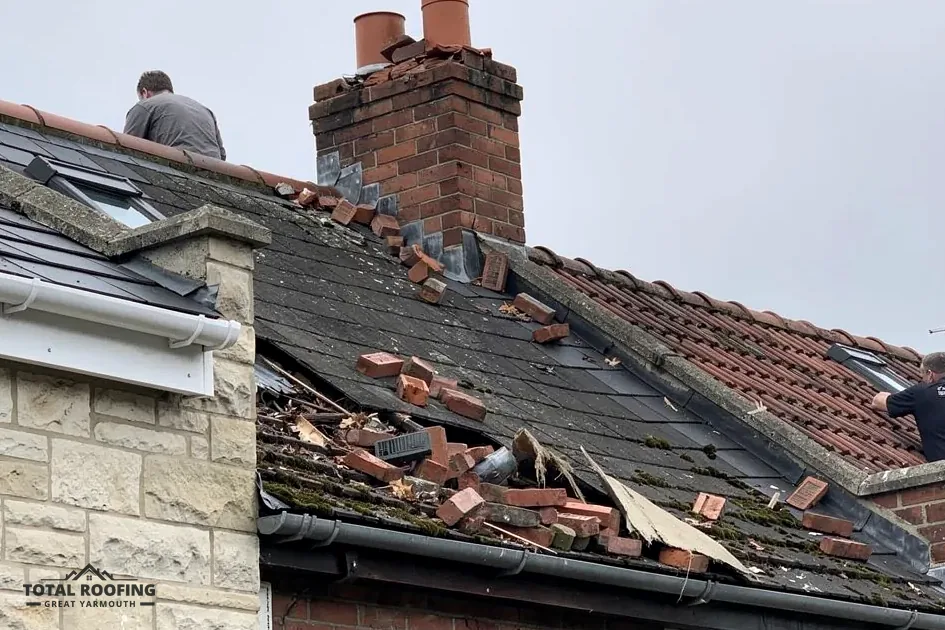
A stack that leans can fail without much notice. A chimney of brickwork and pots is heavy, and a section that comes down lands on the roof covering, the rooms below or the ground. The risk is greatest to anyone standing or walking underneath.
If the stack has visibly moved, or if you see a new crack, bricks sitting out of line or fresh gaps open at the roof line, treat it as unsafe. Keep children, pets and parked cars away from the area beneath it, and do not send anyone up to push or test it. Call 01493 277103 so we can talk through what you are seeing, or message a photo to 07880 284133.
Not every lean means a collapse is close, and the survey is where that judgement is made. Until it has been made, caution costs nothing, and the stack is better treated as unsafe than assumed to be fine. A stack that is steady today can still be weaker than it looks, because the mortar holding it together may be decayed through the middle.
Signs a stack has moved
- A visible tilt away from the upright
- A crack running across the stack or at the roof line
- A bow or bulge on one face of the brickwork
- Pots that sit crooked or have shifted in their bed
- Brick fragments or mortar dropping into the gutter
Make safe first, then decide on the repair
Making a stack safe means reducing the risk before anything else is decided. That can mean taking the unstable upper part down to a sound level, or fitting temporary support, so the stack cannot fall while the right repair is worked out. It is a safety job, not a finished repair, and it is separate from the rebuild that follows it.
Once the stack is secure, the survey looks at what is left. If the damage is in the top few courses only, rebuilding those may be enough. If the lean runs deeper, the choice is between a full chimney stack rebuild and taking the stack down altogether, which is covered in our page on removing a chimney stack.
For a sense of scale, MyJobQuote gives an average of around £3,000 to £3,500 for removing the entire chimney stack with the breast (3 November 2026). That is a removal figure from one guide, not a price for rebuilding a stack. After a survey of the roof, with the leaning stack looked at close up, your own price is given as one written total.
Consents and neighbours
Rebuilding or taking down a stack is not always a matter for you alone. Altering a listed house "in any manner which would affect its character as a building of special architectural or historic interest" needs listed building consent first. A conservation area can bring limits of its own, so planning and building control are checked with the council before any work begins.
If the stack belongs to a wall you share with the neighbours, the Party Wall etc. Act 1996 can come into play. Cutting away a chimney breast on that wall is party structure work, and the building owner must serve notice "at least two months before the date on which the proposed work will begin". A surveyor enters the picture only where the neighbour dissents or has not replied "within the period of fourteen days".
Read more about the repair side on the chimney repairs hub, which sets out the other ways a stack can fail alongside leaning.
