
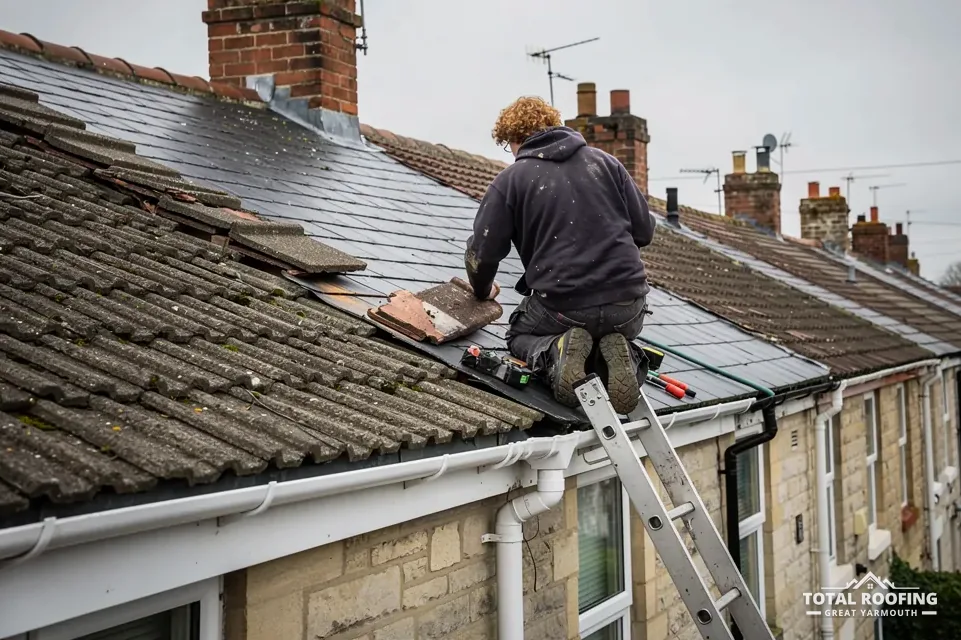
A day rate prices time, not the roof
When a roofer quotes by the day, the figure describes how long someone will be on site. It does not describe the roof in front of them, how many slopes there are, how steep they are or what lies under the old covering. Two houses on the same Great Yarmouth street can need very different amounts of work, so the same daily figure can mean a bargain on one and a loss on the other.
That is why no hourly or daily figure appears below. A figure cannot be set sensibly without seeing the roof, and a number printed in a blog post would only invite you to multiply it by guesswork. What can be set out is what a daily rate has to pay for, so that you can ask a firm what theirs includes. The roofing work we do in Great Yarmouth starts from a survey for the same reason.
Think of the rate as one ingredient. The finished price also depends on access, the materials, getting them to site, disposing of the old ones and the hours lost to weather. A firm that gives you only the ingredient has left you to work out the rest, and that is where disagreements start once the work is under way. Ask for the whole sum in writing before anyone picks up a tool, and keep the paper somewhere you can find it.
What sits inside the labour figure
A roofer's pay is the obvious part. Behind it sit the costs of getting that person to the job in a fit state to work: the van and fuel to reach a house in Gorleston or out towards Acle, tools that wear out, safety equipment for work at height and the time spent on the survey before any quote is written.
There is also time that never shows on the roof. Someone has to buy and collect materials, arrange access, deal with the customer and sort the paperwork behind the job. These tasks are paid for out of the rate, even though no tile is laid while they happen, and a firm with a full diary still has to cover them on every job.
Because those costs are spread across the working days, a daily rate can look high next to a weekend builder's figure and still be the sounder number. The test is not whether it is low. It is whether the firm can say what it covers, in plain words, when you ask.
- Travel to and from the roof
- Tools, ladders and safety equipment for work at height
- Time spent surveying and writing the quote
- Buying and collecting materials
- Time lost when the weather stops work
Costs a daily rate has to carry
- Getting people and tools to the roof
- Equipment for work at height
- The survey before the quote
- Fetching materials and arranging access
- Days the weather stops work
Access: the scaffold and the licence
Reaching a roof safely is a cost in its own right. A scaffold has to be put up, checked, kept and taken down, and the roof work cannot start until it is there. On a terraced house facing the road, the scaffold stands on the pavement, and that brings a second requirement.
Under section 169 of the Highways Act 1980, a person must not erect or retain on or over a highway any scaffolding that obstructs it without a licence. The licence comes from the county council, which is the highway authority, and the council charges a fee. The borough or district council does not issue it. On our jobs we arrange the licence with our scaffolder, and any scaffold the job needs sits inside the single written total.
This is one reason a day rate misleads. A firm that quotes you a daily figure and then adds a scaffold hire invoice, a licence fee and a collection charge has moved cost out of the headline and into later bills. When you compare firms, ask whether the figure you were given covers access or whether access arrives as a separate charge.
Our guide to scaffolding for roof work goes through the licence in more detail.
Materials, waste and the skip
Tiles, battens, underlay, lead and fixings are bought for the job, and a daily labour figure does not include them. A firm quoting by the day may add materials at cost, add a margin, or leave you to buy them yourself. Each choice changes who carries the risk if the amount is wrong.
Disposal is the part people forget. A stripped slope produces a heap of old tiles, rotten battens and torn felt, and they must be taken to a permitted site. A skip has a hire charge and a tipping charge, and the weight of old tiles adds up quickly. Ask whether disposal is part of the figure you have been given.
Old roofs can contain asbestos, and HSE's guidance reads: "If the building was built or refurbished before 2000, assume that there is asbestos in it." HSE's waste advice is: "Use a lockable skip for asbestos". A job that turns up asbestos therefore changes the work and the cost, and a day rate set before the survey could not have allowed for it.
Before you choose between two quotes, put three plain questions to each firm: who buys the materials, who pays for the skip, and what happens if the work uncovers a fault the survey could not see from outside.
Questions for a firm quoting by the day
- Ask what the daily figure covers and what it leaves out.
- Ask who buys the materials, and at what price.
- Ask who pays for the skip and the tipping.
- Ask how many days the work is expected to take, in writing.
- Ask what happens if more work turns up.
Weather days and the open roof
Rain, wind and frost stop roof work, so a day can be lost to the forecast. When a firm is paid by the day, a lost day is a question: who pays for it? A firm might charge the day anyway, charge nothing, or extend the job so the cost lands later in a different form. You will not know which applies unless you ask first, and a firm that will not answer has told you something about the job ahead.
A roof that has been opened up cannot be left as it is. The slope has to be made weathertight before people leave, and that takes time at the end of a day that a headline rate does not show. Work on an open roof is slower than the same work on a dry day, so the number of days in a quote is itself an estimate.
With a day rate, the risk of delay is shared in whatever way the two of you agreed, and sometimes that is not discussed at all. With one written total price, you have the figure the firm set after its survey, and you can ask it in writing how a lost day is treated.
| Question | Day rate | One written total |
|---|---|---|
| Weather stops work | Open to argument | Ask before you sign |
| Job runs longer | Your bill grows | Ask what the quote says |
| Comparing firms | Hard | Direct |
Why one written total is easier to compare
Two firms quoting a daily figure can look similar while planning very different jobs. One may expect three days and the other six. A total price is the only number that already has the days, the access, the materials and the disposal folded into it, so you can lay two of them side by side without doing the arithmetic yourself.
Our quote is one total, in writing, after we have surveyed the roof. The price is set to be good and fair, we take in the full roof rather than the one slope you phoned about, and we tell you straight what else we noticed. Hold any firm to that standard. Our post on how to read a roofing quote shows what the wording should cover.
Published cost guides give a sense of the scale. For replacing between one and six damaged standard tiles, Which? Trusted Traders give £75 to £400, based on a survey of 11 traders in November 2025; those prices cover labour and materials, with VAT left out. MyJobQuote says call-out costs for an emergency roofer typically range from £150 to £300, while extensive storm damage repairs can cost £1,200 or more. Neither is an hourly rate for a roofer, and neither works as a price for your roof.
A total that arrives in writing after a survey is a better basis for a decision than any per-hour figure, because it can be checked against the work.
Published figures for context
| Replace one to six standard tiles | £75 to £400 |
|---|---|
| Emergency roofer call-out | £150 to £300 |
| Extensive storm damage repairs | £1,200 or more |
Which? Trusted Traders, survey of 11 traders, November 2025, labour and materials, excluding VAT. MyJobQuote emergency roofer page, 22 October 2026, no VAT basis stated. A quote for your own roof comes after someone has surveyed it.
Checking a day-rate quote before you agree
If a firm insists on working by the day, treat it as a request for a closer look rather than a refusal. Ask the firm to put the work in writing, with the number of days, the access arrangements and what happens to the old materials. Ask whether a cap applies, and whether the firm will stop and talk to you before the job grows, because a price that can rise without a conversation is not a price at all.
Check how payment works. A deposit is a normal request on some jobs, but payment in full before work starts is a warning sign. Our post on your rights when you hire a roofer covers what the law says about contracts signed at home, including the 14-day right to cancel.
Weigh the firm as well as the figure. A low day rate from someone who has never seen your roof tells you little, because they cannot know the pitch, how sound the battens are or what lies beneath. A written description from someone who has been up and looked is worth more, even when the total is higher.
To start the process, you can ring us, message us on WhatsApp with a photo or use the quote form. The figure belongs to your roof and not to a rate card.
