
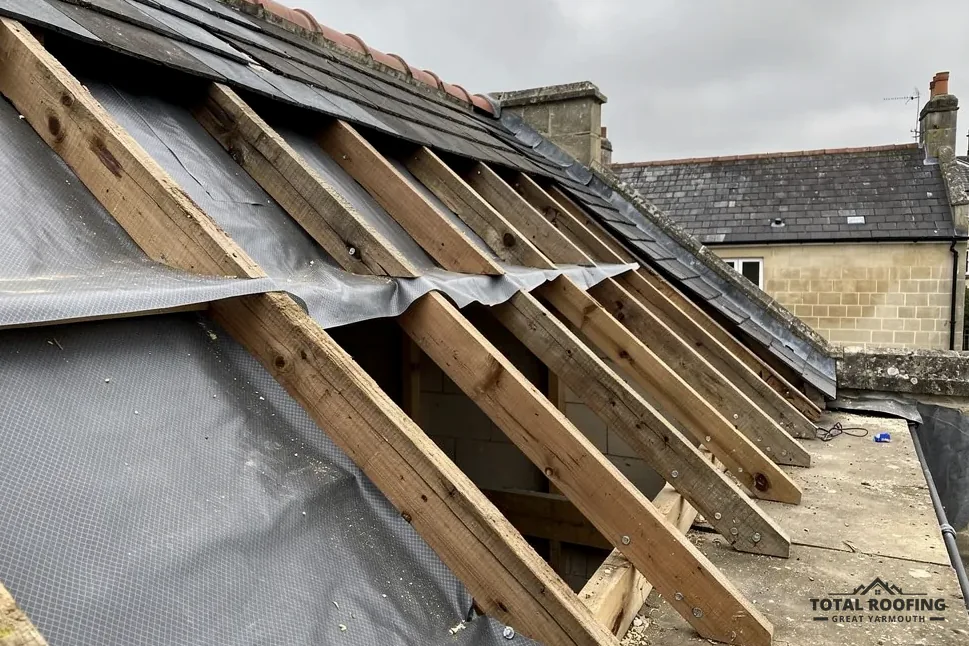
Why a roof job needs proper access
A roof is worked on from edge to ridge, with materials going up and old materials coming down. A ladder can get a person to the eaves for a look, and it is the right tool for a first survey of a gutter or a lower slope. It is not a platform to work from, because a person on a ladder has no edge protection, no place to put a tile and only one free hand.
Scaffolding solves those three problems at once. It gives a level working platform at the height of the eaves, guard rails at the edge, a safe route for people and materials, and a place to stack tiles or slates without loading the roof itself. On a pitched roof the platform at the eaves also stops anything that slides from falling onto the ground below.
The type of access follows the job rather than the other way round. The table below sets out three choices and the kind of work each one suits. A surveyor at the address can say which applies, because it depends on the height, the width of the property and what stands at the foot of the wall.
| Access | Suits | Limit |
|---|---|---|
| Ladder | A look at the gutter or lower slope | Not a working platform |
| Scaffold tower | A small, single repair near one spot | Reaches one section only |
| Full scaffold | Stripping, re-covering, chimneys, fascias | Needs a licence over a highway |
Towers, full scaffold and what each is for
A scaffold tower is a free-standing frame on wheels or feet, built up to the height needed. It reaches the spot in front of it and no more, so it suits one repair in one place: a few slipped tiles, a short run of guttering or a cracked section of fascia. Moving it along the wall to reach another section is slow, and a tower gives no edge protection along the length of the eaves.
A full scaffold is a structure that runs along the whole elevation with working platforms at one or more levels, linked by ladders and boarded lifts. It is built around the house, tied to the wall and checked by the scaffolder when it is up. Stripping and re-covering a slope, renewing a chimney stack or replacing fascias, soffits and guttering along a run all need that continuous platform.
Access can also come from a mobile platform or a hoist where the site allows. Those suit some jobs, and the survey decides whether one will do. Our approach is to look at the roof first and to decide the access afterwards, because choosing the access before seeing the roof gets the job wrong.
Where a job needs scaffold, scaffold sits within the written quote, one total price for the whole job. You are not asked to buy the scaffold separately or to find a scaffolder yourself. Our guide to how to read a roofing quote covers what any written quote should say about access.
Tower or full scaffold
Tower
- One spot only
- Quick to put up
- No run of edge guards
Full scaffold
- Whole elevation
- Edge protection
- Lifts for materials
When a scaffold needs a licence
A scaffold that stands only on your own land needs no licence from the council. A scaffold standing on the pavement or the road, or overhanging one, does. The law is section 169 of the Highways Act 1980, which says no person may "erect or retain on or over a highway any scaffolding or other structure which obstructs the highway" without a licence.
It is a scaffold licence, issued by the county council in its role as highway authority, and the district or borough council plays no part. For a Great Yarmouth address the county is Norfolk, and for Lowestoft, Beccles or Southwold it is Suffolk. A house set back behind a front garden may need none, while a terrace that opens straight onto the pavement will need one.
Scaffolding on the pavement or road needs a highway licence from the county council, and we arrange the licence with our scaffolder. That is the arrangement for every address we cover, so the application is not left to you to chase. The fee and the processing time are the county council's, and they differ between the two counties, as the next two sections set out.
A licence comes with conditions, covering matters such as a route for pedestrians and lighting or guarding. The county sets those conditions for an address, so read them before the date is fixed.
Norfolk addresses
Norfolk County Council is the highway authority for Great Yarmouth, Gorleston, Caister-on-Sea, Norwich and the rest of Norfolk, and Norfolk County Council charges £178.33 for the first 28 days of a scaffold licence over the highway, with the same £178.33 for each further 28 days. The fee is flat for each 28-day period, with no extra charge by the metre.
Norfolk asks for the application to be made each time a scaffold or hoarding is put up. A licence for one job does not carry across to the next. The council's page says: "Please allow 7 calendar days for applications to be processed." The council also asks companies that put scaffolding or hoarding on the highway without a licence to remove the structure or apply for a licence immediately.
Norfolk County Council's page sets minimum public liability cover of £5m for an application. That is the council's condition for the licence and not a statement about any other party.
Plan the licence into the start date. The seven calendar days are processing time, and they begin once an application has been made, so they sit in front of the day the scaffold goes up. A scaffold on the pavement cannot start before the licence is in place.
Suffolk addresses
Suffolk County Council is the highway authority for the East Suffolk towns, from Lowestoft and Southwold to Beccles and Bungay. Its scaffold licences are "only issued to scaffolding companies with qualified scaffolders" and "not issued to individuals". A homeowner therefore cannot apply for one, whatever the arrangement with the roofer.
Suffolk County Council charges £260 for the first four weeks and £130 for each four-week extension. Applications need 10 working days' notice to be processed, and the council requires the company's public liability insurance to carry an insured sum of no less than £5,000,000. Suffolk reviews its fees every year, so the council's current fee table is the one to read if you are checking a figure.
On a trunk road the licence is not the county's to give. Suffolk County Council's page tells applicants to contact National Highways on 0300 123 5000 if they want to apply for a licence on a trunk road. The Highways Act 1980 makes a county council the highway authority only for roads that are not trunk roads, so in Norfolk too a scaffold on a trunk road is a question for National Highways.
For all Suffolk addresses the arrangement is the same as everywhere else: we arrange the licence with our scaffolder. The ten working days of notice are a reason to settle the date of the survey early, not a reason to book a scaffolder by yourself.
Questions for the licence stage
- Does the scaffold stand on or over the highway?
- Which county is the highway authority?
- Is the road a trunk road?
- Is the start date after the processing time?
- Will pedestrians have a safe route?
Ground, walls and what stands at the foot
Before a scaffold is quoted, someone has to look at the ground it will stand on and the wall it will tie to. A scaffold needs firm, level footing, and a soft border, a sloping path or a drain cover in the wrong place changes how the base is laid out. A basement light well, a bay window or a porch roof at the foot of the wall can mean the frame has to step round it.
The wall itself matters as well. A scaffold is tied back to the building at intervals, and the ties go through window openings or into the masonry, so the condition of the wall and the frames around the windows is part of the survey. A very narrow plot, a shared passage or a house on a corner changes the position of the frame, and it can change the length of time the scaffolder needs to put it up.
Overhead lines and low branches are worth a glance too. A scaffold that is closer to a wire or a tree than it should be is an issue to deal with before it goes up and not after.
These checks belong to looking at the whole roof and the setting around it. We note them when we survey, and they shape the price we write. If something about the ground or the wall is unclear from the pavement, a photograph sent to our WhatsApp number gives us something to work from.
How long it stays up, and the neighbours
A scaffold stays up while the roof work needs it and no longer. The length depends on the job: stripping and re-covering takes more days than renewing a ridge, and weather can stop work on any roof. A licence that reaches the end of its first period does not force the scaffold down in the middle of a job, because both counties provide for extensions.
Terraced streets raise the practical questions. A scaffold on a pavement narrows the way for prams, wheelchairs and people with shopping. It can cover part of a neighbour's front window, and it can block a driveway or a bin collection point. A short word with the neighbours before it goes up saves arguments later.
A scaffold that crosses a boundary is a different matter. If it has to stand on a neighbour's land, or reach over their garden, their agreement is needed first, and a conversation over the fence is a better way to ask than a surprise on the day. The same applies to access along an alley or through a shared passage.
Where a roof job also changes a party wall, such as a chimney breast or a flashing that is cut into a neighbour's wall, the Party Wall etc. Act 1996 sets its own notice periods, which our building control guide sets out. Start at the Total Roofing Great Yarmouth home page if you want to see every type of roofing we cover, and for the access question on a particular roof, send a photograph on WhatsApp and we will take a first look.
