
The short answer
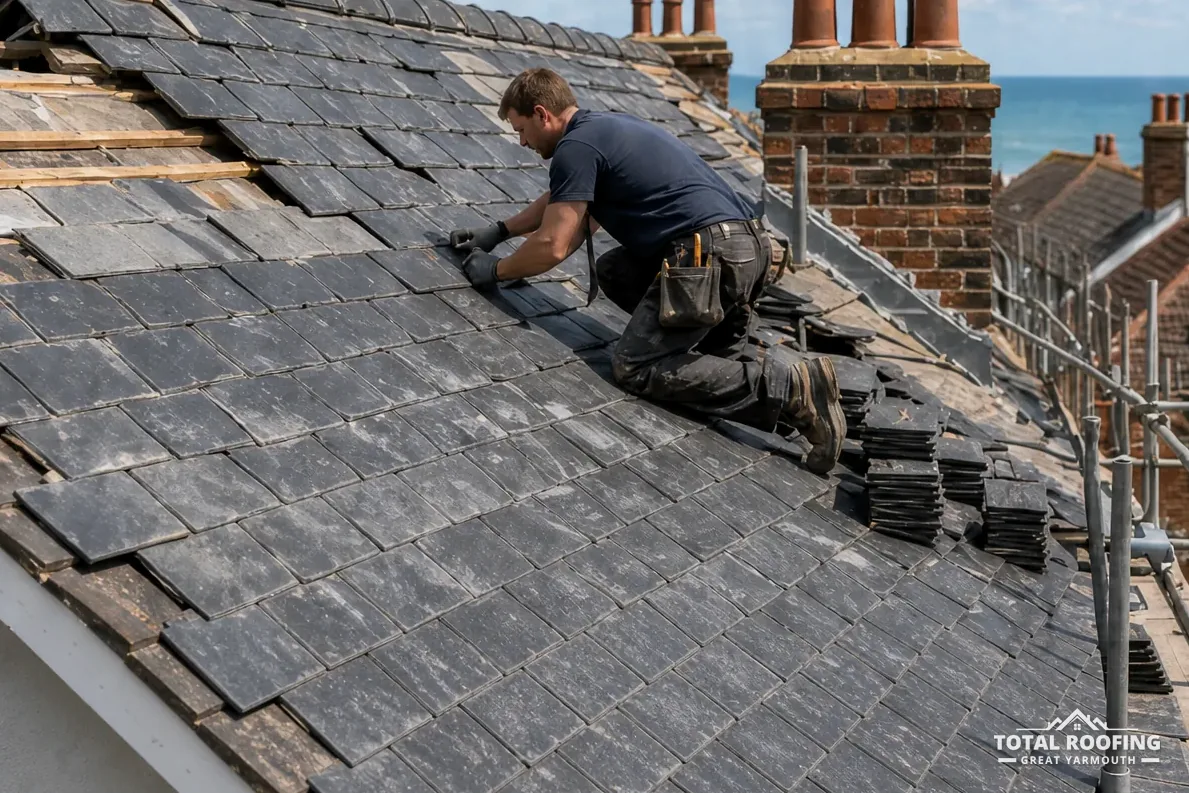
Walking on a slate roof is not advised. Slate is thin, brittle stone that can crack under a boot, and a crack you cannot see from above becomes a leak. Roofers spread their weight with a roof ladder or work from scaffold, and a householder should look from the ground instead.
Why slate cracks under a boot
A natural slate is a thin sheet of stone, split along its grain, and it is brittle. It is built to shed rain, not to carry a person, and it sits on battens a slate-length apart with the middle of each slate unsupported. A foot pressing on the middle of a slate flexes it, and the stone can split across its width.
The damage is hard to see. A slate may crack on its underside, hidden by the course above, and hold its place until rain gets into the split. Several slates can be broken in a single walk across a slope, and the occupant finds out weeks later when a stain appears on the ceiling.
There is also a safety point. Slate is smooth, and a damp or mossy slope is slippery. Pitched roofs give little warning at the edge, so a slip can carry a person off the roof. For both reasons the sound advice for a householder is not to climb on to slate at all, and not to lean a ladder against the slates themselves.
How roofers get onto slate
A roofer who has to cross a slate slope uses a roof ladder, a ladder with hooks that sits over the ridge and lies flat on the slope. It spreads the load across several courses of slate, and it gives the roofer a rung to stand on and a hold for the hands. The ladder is hooked over the ridge and rests on the slates on its rails, so the weight goes through the rails and not through a boot on one slate.
On larger jobs scaffold goes up. It gives a platform at the eaves, from which repairs along the lower courses can be reached without touching the slope. A scaffold that stands across a public footpath needs a highways licence from the county council; we arrange the licence with our scaffolder.
Even with a roof ladder, work on slate is done with care. Slates are lifted with a ripper and replaced one at a time, and a slate that has to be stepped near is laid with a board or a crawling board under it.
Looking at a slate roof safely
- Stand well back and study the slope from the pavement
- Bring detail closer with binoculars or a zoom
- Check the loft from inside for damp and daylight
- Keep ladders off the slate faces
- Send a picture to a roofer
Aerial and satellite fitters
Television aerials and satellite dishes are a recurring source of damage. A fitter who climbs a slate slope to fix a bracket can crack slates underfoot, drill through a slate to take a fixing, or leave a bracket screwed through the covering where it holds rain. A dish bolted to a gable wall or the chimney stack leaves the slates alone, while one fixed on the slope puts a foot and a drill on them.
Look for the signs. Slates around a dish can be cracked or loose, and a bracket that comes through the slates may be unsealed. A stain beneath the fitting on a ceiling or in the loft points to the same place. Where the cable passes through the roof, check how the hole was made good.
If you plan to have a dish fitted, ask the fitter where it will go and how they will reach it, and say that the slope is slate. A fixing on a wall or chimney avoids the slates altogether. Our guide to slate roof repairs explained covers how the damage is put right.
If someone has already walked on yours
If slates have been stepped on, look for fresh cracks and for slates that have shifted out of line. Check the loft for damp. A stain or a drip within a few weeks of the visit is the clue to a slate that cracked.
Photograph what you see from the ground and send it to 07880 284133 on WhatsApp. At Total Roofing Great Yarmouth the survey covers every slope, and the work it finds is priced as one written total. If cracks turn up beside a dish or along a route someone took to the ridge, they are repaired as slate replacements and the neighbours checked for the same harm. Keep any receipt or note from the fitter, because it dates the visit. A fitter's own paperwork also names the person to contact if the damage proves worse than it looked. Our slate roofing hub explains the repairs, and our guide to signs of a failing slate roof lists what else to look for.
