
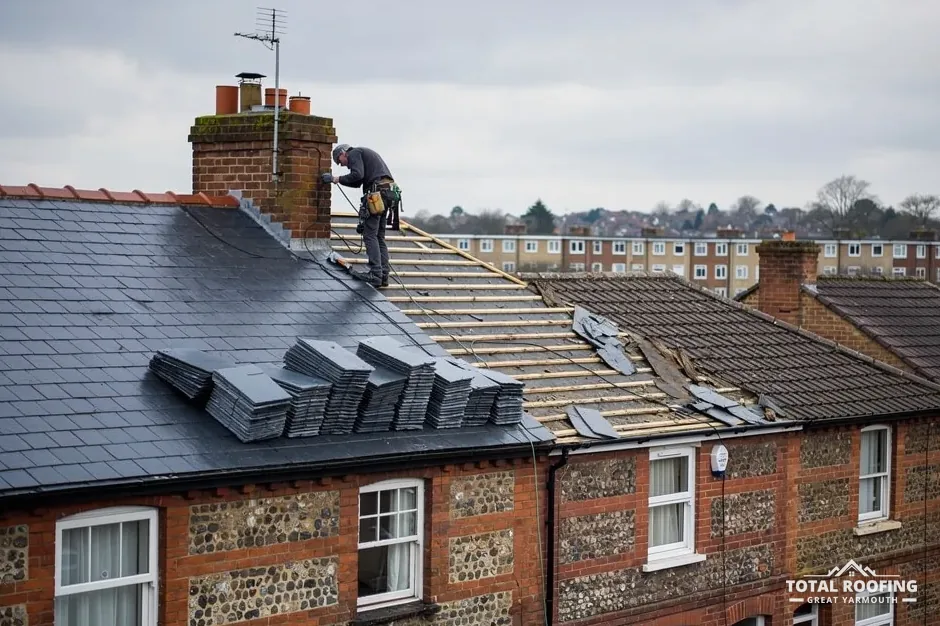
Slipped, dropped and missing slates
A slate is held by nails through two holes, or by a hook that catches it on a batten, and it lies over the slates below. When the fixing lets go, the slate slides down the slope and leaves a gap, or drops into the gutter. From the pavement this looks like a dark slot in an otherwise even slope, a slate sitting lower than its neighbours, or fragments of slate lying on a drive or among borders beside the wall.
One slipped slate is a repair. What the survey asks is why it slipped. A slate knocked loose by a branch, a ladder or a heavy boot has a single cause. Slates slipping in several places, or a whole line hanging a little out of true, point to the fixings across the slope. That difference decides between patching and re-slating, so we look over every slope and not only the one where the gap showed. Our guide to nail fatigue in slate roofs explains the fixing failure behind repeat slips.
A gap matters because slate sheds water by overlap, not by sealing. Each slate lies across the joint between two slates below it, and the headlap, the part that covers the slate two courses down, stops rain being driven up under it. Take one out and rain has a way in past the whole arrangement. Beneath the gap sit the underlay and the battens, which were never meant to be the outer face of the roof, and the timber stays damp while the gap stays open.
What to look for from the ground
- Dark slots or gaps where a slate has gone
- A slate sitting lower than the ones beside it
- Broken slate in the gutter or on the ground
- A line of slates that no longer runs straight
- Slates with a pale, powdery or layered surface
Cracked, flaking and layered slates
Natural slate is a split stone, and it can fail along its own layers. A slate that has started to delaminate shows a surface that flakes, lifts in thin sheets or turns powdery, and the lower edge may peel into several leaves. A cracked slate shows a hairline across the face, sometimes running from a nail hole. Both let water through the slate itself, not only past it, which is a different fault from a slipped slate and needs a different answer.
One cracked slate beside sound neighbours is a straightforward repair. Slates flaking across a slope suggest the covering is approaching retirement, and replacing them singly buys little because the next slate along is in the same state. Our guide to re-slating a roof sets out what a full strip and recover involves.
Age is a guide, no more. HomeBuilding (last updated 30 September 2025) gives approximate lifespans of 100+ years for Welsh slate, 75-100 years for Spanish slate and 50-80 years for reclaimed Welsh slate. Those are ranges for the stone. They say nothing about how the slates were fixed, how the roof has been walked on or what lies beneath. A roof younger than its range can need work and an older one can be sound, so each slate gets looked at individually.
Myth
A slate roof within its quoted lifespan cannot be failing.
Fact
Lifespan ranges describe the stone only; fixings, battens and leadwork can fail sooner.
Rusted nails and slates that keep slipping
The slate can outlast what holds it, which is the idea behind nail fatigue. The nail through a slate can corrode or work loose, and the slate then hangs on what is left. The slate itself looks fine. It slides only when wind, frost or a footstep disturbs it, so from the road the slope may seem sound while it sheds slates each time the weather turns.
A pattern is the sign to read. Slates that slip at random across a slope, one here and one there, are consistent with a fixing problem in the whole covering. A slate pushed back into place is not a repair, because the nail that failed is still in the batten. Some repairs use a clip or a strip of lead, called a tingle, to hold a replacement slate. That is a stopgap for a few slates, not a way to hold a slope together.
Hooks are a different fixing. Cupa, which makes slate, says hook fixings should stay off pitches under 25º, and the standard for fixing slates and tiles is BS 5534. Marley says installing to BS 5534 isn't required by law, but the fixing specification is drawn up for each site. On a failing roof, what counts is that the replacement is fixed in a way that suits its pitch and exposure.
One slipped slate or a failing slope?
A single cause
- One slate out of place
- Neighbours still tight
- Gap near a branch or ladder
A fixing problem
- Slips in several places
- Rusted nails when lifted
- Slates loose to the touch
Sagging, dips and a roof that has lost its line
Stand back across the road and look along the ridge and the eaves. A slope should read as one flat plane. A dip, a bow or a ridge that has dropped in the middle tells you something under the slates has moved: a batten has rotted, a rafter has bent, or a support has failed. Slate is heavy, and a covering carried by weakened timber pulls itself out of line.
A sag is not a slate problem, and it needs a proper survey. Re-covering a sagging slope without dealing with the timber fixes nothing, because the new slates sit on the same weak frame. From the loft side the survey inspects rafters, purlins and battens, and checks whether the slates can be lifted and relaid or the timber needs replacing first. A full re-slate also comes under the Building Regulations. The Planning Portal says no building regulations application is normally needed if "Less than 25 per cent of the total 'building envelope'" is affected and less than 50 per cent of the roof. Re-slating the lot goes beyond that second limit.
Keep off the roof itself. Wet or dry, slate is slippery and brittle, a boot can crack the slates you are trying to inspect, and a fall from a pitched roof is what the pavement view is there to avoid. Binoculars from the garden, or a photo from a window, tell you as much as a ladder. If you send a photo of a dip or a bowed line to our WhatsApp number, we will take a look.
Signs inside the house and in the loft
A brown stain on a bedroom ceiling that grows after rain, a damp patch beside the chimney, wet insulation in the loft or daylight showing through the roof when you switch the loft light off all say that the covering has a way in. None says where. Rain runs down the underside of the slates and underlay before it drips, so a mark on the ceiling points to the slope, not to one slate.
In the loft, with a torch and no need to step off the joists, check the underside of the roof for dark, damp or furred timber and for drips on the insulation. Damp rafters and rotten batten ends mean a leak has run for a while. A musty smell and a dark corner can also come from condensation, which is a ventilation matter and not a covering fault. Our hub page on slate roofing links the guides that match a repair to the fault it is meant to cure.
If the loft has been sprayed with foam insulation, the underside of the roof cannot be seen. RICS warns that foam over the roof timbers hides them from inspection, and that limit applies to a slate roof exactly as it does to any other.
A quick loft check
- Switch the loft light off and look for daylight
- Shine a torch along the underside of the roof
- Look for dark, damp or furred timber and wet insulation
- Note where any stain sits, then compare it with the slope
- Photograph it and send it to us on WhatsApp
Lead, ridges, valleys and gutters
Slates are only half of a slate roof. Lead flashings seal the slates where they meet a stack, a gable wall or a roof window, and lead lines the valleys where two slopes meet. Lead that has split, lifted or pulled away from its wall lets water in at the joint, however sound the slates around it are. MyJobQuote says correctly installed lead flashing can last for over 80 years, so a failing flashing on a roof with good slates is a job for the flashing alone.
The ridge runs along the top, and one that has cracked, shifted or lost its fixing leaves the top of every slope open. Marley says that since the 2015 amendments to BS 5534, mortar could no longer be relied upon as the only means of securing the roof covering. Crumbled mortar in the gutter is worth reading, because a ridge that has shifted is one a gust can finish off.
Look at the gutters and downpipes too. Slate fragments, moss and grit collect in a gutter under a roof that is shedding material, and an overflowing gutter wets the wall and the fascia. Marley's cleaning guidance rules out strong jetting, so do not blast a tired roof clean before it has been looked at. The survey takes in each of these parts, and we say plainly whatever else turned up.
Terms used in this guide
- HeadlapOverlap of a slate on the course two below
- TingleA lead strip that holds a replacement slate
- DelaminationA slate splitting into thin layers
- BattenThe timber strip a slate is fixed to
- UnderlayThe sheet beneath the slates and battens
Repair or re-slate: what the signs add up to
Put the signs together and they point one of two ways. A few slipped or cracked slates on sound battens and sound fixings is a repair. Slates failing across a slope, fixings that give way when touched, a sag or damp timber in the loft point to stripping and recovering, with sound slates reused where they are fit and new ones where they are not. Our guide to what a slate roof costs sets out the published figures behind each choice.
Published prices help with scale. MyJobQuote (page dated 6 October 2026) gives an average of around £7,800 for fitting a slate roof. Checkatrade (June 2026) says natural slate repairs could cost around £190 per m², against £110 to £160 per m² on a clay pitched roof, excluding VAT. Those per square metre figures come from one guide and are not totals for your roof. The written quote after our survey is one total price, and it follows what the survey found.
Whichever way the signs point, find the cause and not just the gap, and deal with damp timber before covering it up. The scaffold the job needs belongs to the written quote. A Highways Act licence from the county council is needed for scaffolding over a pavement or road, and we arrange the licence with our scaffolder.
Published slate figures
| Fitting a slate roof, average (MyJobQuote) | average around £7,800 |
|---|---|
| Natural slate repairs (Checkatrade) | around £190 per m² |
| Pitched clay tile repairs (Checkatrade) | £110 to £160 per m² |
MyJobQuote page dated 6 October 2026, no VAT basis stated. Checkatrade repair table, June 2026, exclusive of VAT. Per m² figures are not totals for a roof.
