
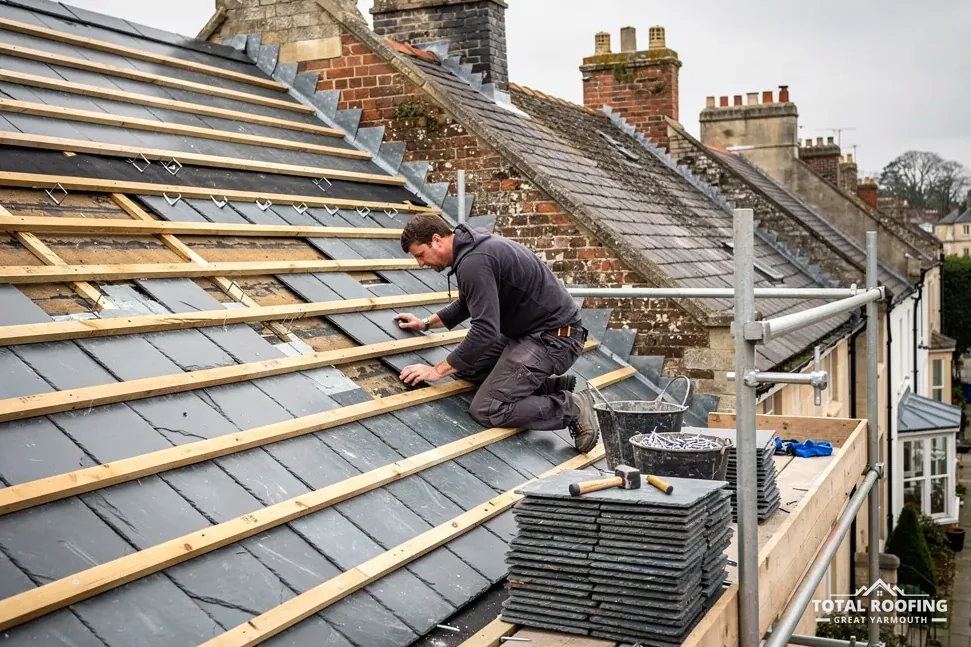
What nail fatigue actually is
Every slate on a traditional roof hangs from a batten by two nails driven through holes near its head. The nails carry the whole load: the weight of the slate, the pull of the wind and the thrust of rain trying to lift the tail. If the nail fails, the slate has nothing else to hold it, and it slides down until its tail catches on the course below, or it falls.
Nail fatigue is the name for that failure happening across a roof, not in one place. The nails corrode, their shanks thin and their heads rust off, and slates start to drop one after another. A slate that slipped a year ago was not the unlucky one. It was the first to reach the point that all its neighbours are heading for, because they were all nailed with the same iron in the same build.
It is a fault of the fixing, not of the stone. HomeBuilding gives approximate lifespans of 100+ years for Welsh slate and 75-100 years for Spanish natural slate (last updated 30 September 2025). A nail made of ordinary iron does not last as long as that, so on an older roof the covering outlives its fixings, and that gap is what nail fatigue describes.
The wider subject of the covering sits in our slate roofing hub. This page deals with one cause of slipping and the choice that follows from it. The signs are visible before a roof reaches the point of leaking, which is why spotting the pattern early gives you a choice of response instead of an emergency.
Why iron nails fail
Iron rusts when it meets damp air and water, and a roof is a damp place. Rain driven under the laps, condensation under the slates and moisture held in the timber all reach the nail. Rust is bulkier than the iron it replaces, so as the nail corrodes it swells in its hole. The swelling can crack the slate around the hole, and the nail itself shrinks to a thread until it can no longer hold the slate.
The nail shank is not the only part to go. The head, which keeps the nail from pulling through, rusts away, and the nail can then slide out of the batten when the slate shifts. Wet battens add to the damage: a batten that stays damp rots around the nail, which loosens its grip from the other end.
Modern practice avoids the problem by using nails that do not corrode, such as copper or aluminium, or an equivalent such as stainless steel. Those fixings are chosen so they last as long as the slate does. The difference is plain to see on a roof stripped after decades: a copper nail is still bright, and an iron one is a brown stub. Stainless steel is also a sound choice, and its cost is higher than steel but still small against the labour of laying a roof. Whichever metal is chosen, it should be set out in the specification so the fixing is named in the quote and not left to chance.
Weather cycles speed up the damage. Wetting, drying and freezing cycles through each winter, and every cycle works the nail a little in its hole. A slate is also moved by wind, and a loose nail is shaken further. That is why a roof can seem sound for years and then begin dropping slates over a short run of seasons.
Two kinds of nail
Iron nail
- Rusts and swells
- Thins to a thread
- Cracks the slate
Copper or aluminium
- Does not rust
- Holds its section
- Outlasts the slate
What the slope shows from below
Nail fatigue shows itself before a leak does, if you know where to look. Stand back from the house in daylight and look along each slope. A course that has slipped shows as a slate hanging lower than its row, with a visible gap above it and a tail that sticks out into the next course. A row of such slates, or several scattered across one slope, is a sign that the fixings are going.
Slate fragments in the garden or gutter are another clue, and so are whole slates on the ground. Check the gutter and the downpipe for grit and chips, which are what a cracked slate leaves behind. Inside, look at the loft with a torch: daylight through the slope, damp patches on the underside of the underlay or rust-brown stains on the battens beside the nails all point the same way.
A small number of slipped slates after a gale is a repair, and our guide to slate roof repairs covers it. A growing number across the same slope is a different story. When a slope changes, take a photograph from the ground. WhatsApp the photo to us and we will look at it before any survey. The loft is also where you can see whether the battens are dark and damp at the nail line, which is a sign the fixing there has been in contact with water for a long time.
Do not climb up to check. Slate is slippery and brittle, and a step on a weakened slope can send slates and the person down together.
Warning signs outside and in the loft
- Slates hanging below their course
- Gaps with the batten showing
- Slate chips in the gutter
- Rust stains on battens beside nails
- Daylight through the slope from the loft
Why tingles only postpone the problem
A tingle is a thin metal tab, in lead, copper or aluminium, that clips a replacement slate in place with no nail through the head. It is a proper repair for a slate that has slipped on its own, and it is quick. The trouble is what it leaves behind: the other slates on the slope are still hung from the same ageing nails, and the next gust is working on them already.
Each tingle fixes one slate. If a slope has lost a dozen in a few years, the next dozen are close behind, and a repair visit that replaces six leaves the others in place. The roof turns into a patchwork of new slates on tingles among old ones on rusting nails, and the pattern of repairs keeps growing.
Cost compounds this. In June 2026, Checkatrade's repair table gave natural slate repairs as around £190 per m², exclusive of VAT, with £110 to £160 per m² for a pitched clay tile roof. The figure is per square metre and is no total for any roof, but it shows slate repair is not cheap work to repeat. Each visit also brings the risk of cracking more slates underfoot.
None of this makes a tingle a poor repair. For an otherwise sound roof with one or two slipped slates, it is the right fix. The question is only whether the cause is one slate or the whole slope, and that is settled when the roof is surveyed. Slates cracked by the wrong boot or a ladder placed on the slope turn up in some repair histories, and they add to the bill without addressing the nails at all.
When a re-slate beats endless repairs
The point to ask is whether the slates are failing for one shared reason. If they are, repairs treat the symptoms. A re-slate treats the cause, because every slate comes off, the sound ones are sorted for reuse and everything goes back on new corrosion-resistant fixings, with fresh battens and underlay beneath.
Several things tip the decision. A slope that has lost slates repeatedly, rust on nails visible at the heads of slipped slates, soft or stained battens and an underlay that is torn or brittle all argue for a full recovering. The stone's own age matters too: if the slates are within their published range and still sound, they can be kept and relaid, which is the cheaper form of re-slate.
Our guide to re-slating a roof describes the job stage by stage. The building-control question is worth knowing about before you commit: a full re-slate takes in over half the roof, so the Planning Portal's no-application test (less than 25 per cent of the total building envelope and less than 50 per cent of the roof) is passed over, and the building-control route is checked with the council before work starts.
Money matters too. MyJobQuote gives around £7,800 on average for fitting a slate roof (page updated 06/10/26). The written quote we give is one total after the survey, and the survey also tells you whether repairs or a full job is the sounder spend.
Deciding between repair and re-slate
- Count slipped slates and note where they are
- Check the slope for rusted nail heads
- Look at battens and underlay from the loft
- Judge whether the cause is one slate or all
- Repair if the roof is sound, re-slate if not
Hooks, new nails and what replaces the old fixings
A re-slate or a large repair swaps the old fixings for ones that last. The options are corrosion-resistant nails, or hook fixings that clip over the tail of the slate. Cupa rules out hook fixings on any pitch below 25 degrees, so the slope itself decides whether a hook is an option. The detail is in our guide to slate hooks or nails.
A nail does not work if the batten beneath is soft, and a hook is no use if the slate's tail is damaged, so the fixing is only part of the answer. New battens go in alongside new fixings, because old timber that has held a rusting nail for decades is a poor place for a new one. Underlay that has perished under the slates goes at the same time.
The whole roof is looked at once the slope is bare, and what else is found is reported to you plainly. A rafter foot, a gutter bracket or the lead around a chimney may need attention, and it is far easier to see and reach with the slates off.
Once the new fixings are in, the failure mode is gone: a roof relaid with copper or aluminium nails is no longer waiting for its next round of slipped slates. The stone will go on, and the roof is judged by its slates again, not its nails. It is also worth asking what happens to the old slates. Sorted by condition, the sound ones go back and the rest are replaced, so the finished roof is a mixture in age but uniform in its fixings.
