
Slipped, cracked and missing: three different faults
People say a slate has gone when they mean one of three different things, and each has its own cause. A slipped slate has dropped down out of its course because its fixing has let go. A cracked slate is still in place but has split, so rain runs through the crack onto the underlay. A missing slate has gone altogether and leaves a gap that shows the felt or the batten.
From the ground the three look alike: a dark patch on the slope, a slate lying on the lawn or a stained ceiling inside. Up close the difference matters. A single missing slate beside sound neighbours is a repair. A row of slipped slates across one slope says something about the fixings, which is the subject of our guide to nail fatigue in slate roofs.
Slate is a natural stone split into thin sheets, so it is brittle underfoot. Walking across a slope to inspect it can crack more slates than it finds, which is one reason a survey of a slate roof is done with care and a ladder or a roof ladder spreading the load. If you spot damage, look from the ground and send us a photograph on WhatsApp first; we can take a first look at a photo before anyone climbs.
Watch for the signs inside as well. A damp brown ring on a bedroom ceiling, a drip in the loft on a wet night or daylight showing through the roof timbers all point back to the slope above. The stain can sit some way from the gap, because rain runs along the underlay before it drops. For the covering as a whole, the slate roofing hub is the place to start.
Two faults, two repairs
Slipped slate
- Fixing has failed
- Slate can be reused
- Check the neighbours
Cracked slate
- Slate is split
- Cannot be patched
- Replace the slate
How a single slate is replaced
A slate is held under the course above it, so it cannot simply be lifted out and a new one dropped in. The slater slides a slate ripper, a long flat tool with barbs, up under the slate and hooks the nail shanks, then pulls or cuts them. The loose slate slides free, and the new one is slipped into the gap.
A new slate cannot be nailed in the normal way, because the course above covers the nail holes and the head of the slate. Instead the repair uses a tingle, a thin metal strip in lead, copper or aluminium. The strip is nailed to the batten, the new slate goes in on top of it, and the free end is bent up over the tail of the slate to hold it. The turned-up end shows as a small bright tag on the slope.
Tingles are a perfectly proper repair, and they are meant for a few slates, not a whole roof. Our guide to re-slating a roof explains what happens when the count gets too high. Each tingle is a fix to one slate in one place, and the nail beside it is still the same age as the others.
Matching matters as well. A new slate beside weathered neighbours will look different for a few years, and a slate in a different thickness or colour will show on the slope. Where the right slate is not to be had new, a reclaimed one from the same stock can be the closer fit.
Replacing one slate
- Slide the ripper up under the damaged slate
- Hook the nail shanks and pull or cut them
- Slide the broken slate out
- Nail a tingle strip to the batten
- Slide the new slate in over the tingle
- Bend the tingle up to hold the tail
Verges, ridges and lead
Not every leak on a slate roof comes from the slates. The ridge, the verge and the lead flashings sit on the edge of the slope and take the weather from two directions at once. A ridge piece that has loosened lets rain in along the top of the slope, and a verge with failed pointing lets it in at the side.
Ridge repair is a question of how the pieces are bedded and fixed. Marley says installing to BS 5534 isn't required by law, but since the 2015 amendments mortar alone has not been relied on to secure the covering, so a loose ridge may be rebedded and also mechanically fixed. A separate standard, BS 8612:2018, deals with systems that hold ridge, hip and verge pieces down mechanically, with no mortar bed.
Lead flashing around a chimney, a valley or a wall abutment is the other repeat offender. MyJobQuote says correctly installed lead flashing can last for over 80 years, and MyJobQuote prices a chimney lead patch repair at around £200, with a full replacement averaging around £570 (page updated 22/09/26). Both figures apply to chimney leadwork alone. A patch is sound where the lead is whole and has only lifted; where it has split along its length, the whole piece is replaced.
When a leak is traced to a detail, the slates beside it are checked too. A leak at a flashing can mean the slates around it are loose as well, and a repair done to one without the other leaves the second fault to show itself next winter.
What repair costs, and who has priced it
Cost follows the extent of the damage, the access to the slope and whatever the survey turns up. Third-party guides put some numbers on it. Checkatrade's June 2026 repair table lists pitched clay tile roof repairs at between £110 and £160 per m², whereas repairs to a natural slate roof could cost around £190 per m², exclusive of VAT. The unit is per square metre, so it is a way to compare materials rather than a price for your roof.
MyJobQuote reckons an average roof repair in 2026 at around £650 (page updated 06/10/26). For emergencies, it says call-out costs typically range from £150 to £300, while extensive storm damage repairs can cost £1,200 or more. MyJobQuote's figures cover roof repairs in general, not slate alone, and Checkatrade's slate figure above shows slate sitting higher.
What we give you is one written total price, set after a survey of the roof. We survey the entire roof, not just the slate that prompted the call, so a worn flashing or soft batten is reported to you before you decide.
Scale changes the sums. One slipped slate beside sound neighbours is a short visit, while a slope that has lost a dozen slates needs more time on the roof, more slates and a closer look at the battens beneath. The survey is what turns a general figure into a number for your house, which is why nobody can name a price from a photograph alone.
Third-party repair figures
| Natural slate repair, Checkatrade | around £190 per m² |
|---|---|
| Clay tile repair, Checkatrade | £110 to £160 per m² |
| Average roof repair, MyJobQuote | around £650 |
| Emergency call-out, MyJobQuote | £150 to £300 |
Checkatrade repair table, June 2026, exclusive of VAT; MyJobQuote 06/10/26 and 22/10/26, no VAT basis stated. Per m² figures are not a total.
When repair stops making sense
A repair buys time for a roof that is otherwise sound. It stops making sense when the slates are failing for a shared reason, because then every repair is followed by the next failure a few metres along. The usual shared reason is the fixing: when the nails that hold the slates have rusted through, slates drop in numbers, and each tingle holds one slate while its neighbours wait their turn.
Other signs point the same way. Slates that flake in layers or crumble at the tail are at the end of their own life, and a slope where fixing a leak shows a second one behind it has a problem wider than the visible slates. If the battens are soft or the underlay has perished, a new slate goes onto timber that will not hold it.
Age is a guide, not a verdict. HomeBuilding gives approximate lifespans of 100+ years for Welsh slate, 75-100 years for Spanish slate and 50-80 years for reclaimed Welsh slate (last updated 30 September 2025). A roof nearing the low end of its range with repeated repairs is a candidate for recovering. A young roof with one slipped slate is not.
The comparison to make is the running total. A few repairs spread over several years may still cost less than a re-slate. A repair a season for the same slope probably does not, and the re-slate also replaces the battens and underlay that a repair never touches. Whichever way it falls, the written quote gives one total for the job described.
Signs repair is no longer enough
- Slates slipping in rows, not singly
- Rusted nails showing at the head of slipped slates
- Slates flaking or splitting into layers
- Soft or damp battens under the slope
- A second leak appearing after each repair
Looking after a repaired slope
Once a roof has been repaired, what you can do from the ground is simple and safe. Look at the slope after a gale, check the lawn and the paths for fragments, and keep an eye on the gutters. Pieces of slate or a gutter full of grit from the roof can show up before any stain appears indoors.
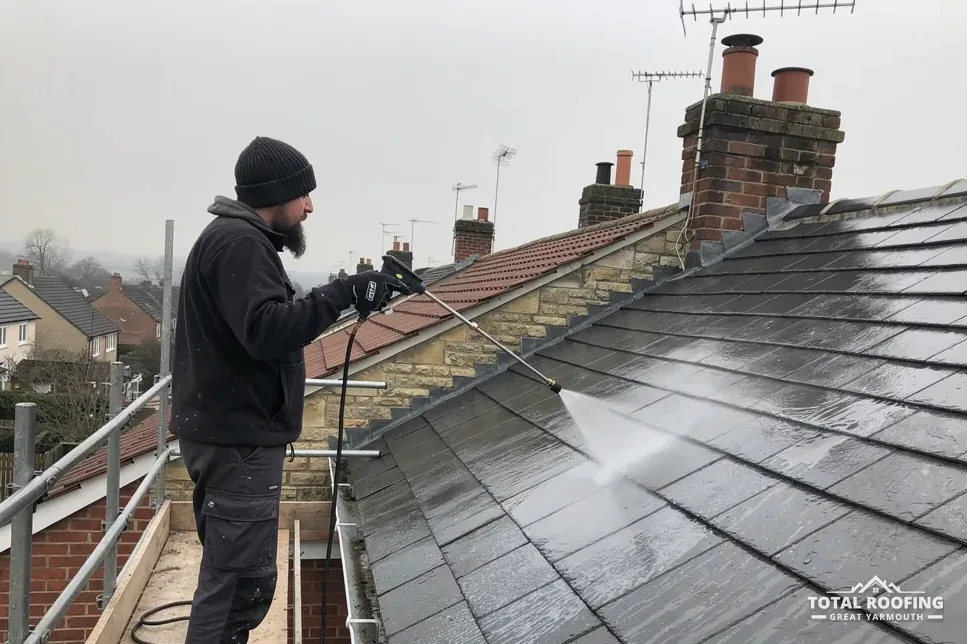
Moss and lichen settle on slate slowly, and the urge to blast them off is understandable. Marley advises against it: in its words the use of high powered jet washes is "not recommended as it can damage the surface of the slate or tile, thus reducing its expected life considerably". A soft brush from a safe position, or a specialist cleaner, leaves the surface intact. Never scrape a slope with a hard tool, because the surface of an old slate is the first thing to flake.
Foot traffic is the other hazard. Aerials, solar fittings, satellite dishes and chimney sweeping all send someone onto the slope. Whoever goes up should use a roof ladder or crawling boards that spread their weight, because a slate breaks cleanly under a heel. A cracked slate left from one visit becomes the repair of the next. The same goes for ladders: lean one against the gutter rather than the slates, and a bad gutter bracket is a risk of its own.
Keep a short note of what you see and when, if you like: a date, a photo of the slope and which part of the roof it affects. It is for you, and it makes a later conversation about the roof much easier.
Myth
Sealant over a cracked slate is a permanent fix.
Fact
Sealant hides the split; the slate still lets water through and must be replaced.
