
The short answer
Slate delamination means a slate coming apart in thin leaves that flake from its face or edge. HomeBuilding gives Welsh slate an approximate lifespan of 100+ years, so delamination on a younger roof points to a fault in the stone. A slope that is delaminating needs a survey, since repair slate by slate may not hold.
What delamination looks like
Slate is a fine-grained rock with a grain that lets it be cleft into roofing sheets, and the same grain is where trouble starts. A good slate has those layers pressed so tightly that rain and frost cannot get between them. A delaminating slate has layers that have started to separate, and the stone behaves like a stack of thin leaves coming apart.
The signs are visible if you know where to look. The surface can look scaly or blistered, with flakes lifting at the edges. The tail of a slate may have crumbled back in thin layers, so it looks shorter and ragged compared with its neighbours. Slivers and grey grit can turn up in the gutter or at the foot of the wall, and a slate may feel soft and layered where a sound one is hard.
It differs from a simple crack, which runs through a slate in a line. Delamination spreads across the face and the edge in sheets, and it can show on several slates cut from the same stock at once.
Why some slate fails early
Delamination has to do with the stone and its quality. Slate that is porous, or that carries weak seams, takes in water. Frost then expands that water inside the stone, and each freeze pushes the layers apart a little more. Over years the slate flakes away from the outside in.
That is why the type of slate matters. HomeBuilding (last updated 30 September 2025) lists "100+ years" for Welsh slate and "75-100 years" for Spanish natural slate, as approximate lifespans. A slate that flakes apart within a few decades has not behaved as those ranges assume, and the ranges are not a promise for any one roof. Ask what slate is proposed and where it comes from, since the published ranges differ by type.
Age has a part to play too. A reclaimed slate has already been through decades of weather, and an old roof's slates may have weakened where water has lain against them, for example under a tree or in a damp valley.
Myth
Flaking slate is just surface weathering that can be ignored.
Fact
Flaking that spreads across a slate means its layers are failing.
How to check your own roof
The garden or the pavement opposite gives a fair view. Look at the slope in clear light, ideally low sun. Sound slates have flat, clean faces and sharp edges. Delaminating slates look rough, with pale flakes, and edges that have rounded or crumbled back. Check the gutters and the ground by the downpipes for slivers and grit.
Look at the loft from inside as well. A slate that has flaked thin lets daylight through in places and can pass rain on to the underlay. Damp on the battens below a slope of flaking slate is a warning that the slope is no longer shedding water as it should.
Do not climb up to test a slate by pressing it with a hand or a tool. A delaminating slate can break up under your hand, and the slope around it is fragile. Our guide to signs of a failing slate roof lists what else a survey looks for.
What can be done about it
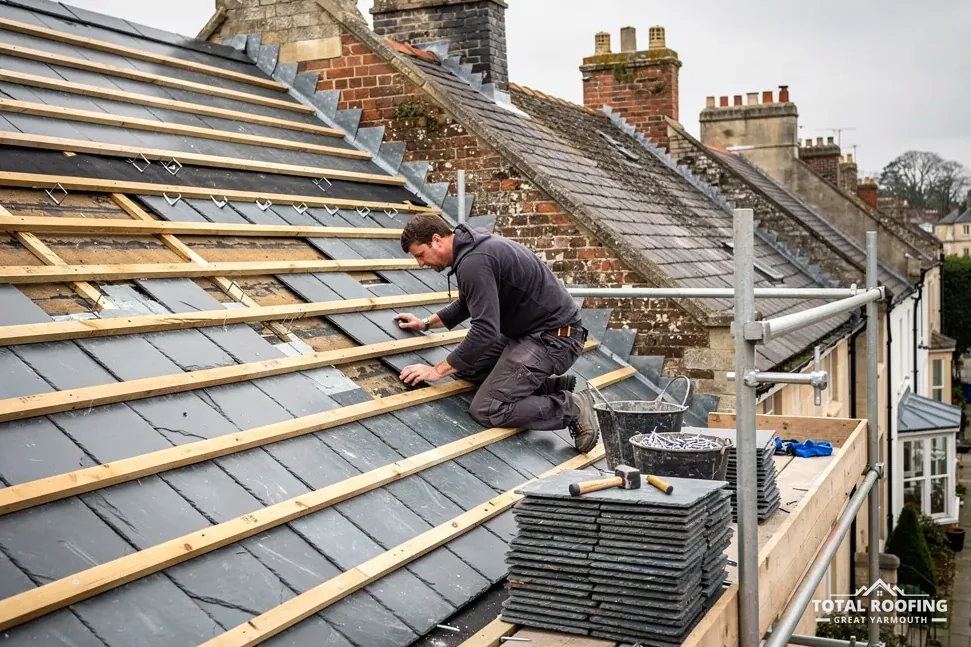
A single delaminating slate among sound ones is replaced like any other, with a slate of matching size and thickness. When many slates on a slope are flaking, replacing them one at a time is a poor use of money, because the neighbours are on the same path. In that case the slope is stripped and covered again, and our guide to re-slating a roof explains that route.
Whether the sound slates from the old roof can be reused depends on their condition, which is judged on the slope itself, slate by slate. Sound slates can sit beside flaking ones for years, so the decision rests on how far the flaking has spread across the slope and whether the nails below are still holding. At Total Roofing Great Yarmouth the whole roof is looked at, and the work comes as one written total price. The slate roofing hub covers the choices, and you can send a picture of the slope to 07880 284133 on WhatsApp for a first look. Slate that has started to delaminate is a roof-wide question, so the written price reflects the slope as a whole.
