
The short answer
It is a slate one and a half times the standard width, used at the verge, or sometimes at other edges, so that alternate courses end with a sound slate in place of a narrow strip. It keeps the half-bond pattern and holds the edge of the roof firmly.
Half-bond, and where the extra width comes from
Slates are laid so that each joint between two slates falls beneath the centre of a slate one course higher. This is called half-bond, and it stops rain taking a straight path down through the roof, because every vertical gap is covered by the slate over it. The pattern means that each course sits half a slate sideways of the course below.
Now follow that to the edge. Call the width of a standard slate W. If one course starts at the verge with a full slate, covering from 0 to W, the next course has to start half a slate in from it. Two ways exist to do that. A half slate, 0.5W wide, can be placed at the edge, or a slate one and a half times as wide can start the course, covering from 0 to 1.5W. Either way the joints in the two courses fall half a slate apart, as half-bond needs.
That wider piece is the slate-and-a-half. It is used on alternate courses, which is why a verge shows a full slate on one course and the wider slate on the next.
How alternate courses finish at a verge
- Odd courses: a full-width slate at the edge
- Even courses: a slate-and-a-half at the edge
- Joints stay half a slate apart across the slope
- Every vertical gap sits under a slate above
Why not use a half slate?
A half slate would do the geometry, but it is a narrow strip, and a narrow strip at the exposed edge of a roof is a weak point. It has little area to hold the nails, it is the first piece the wind meets from the side and it has a joint right beside the verge where water can be driven in. A slate-and-a-half puts the extra material where it is wanted, in a piece wide enough to take a pair of nails and to sit firmly.
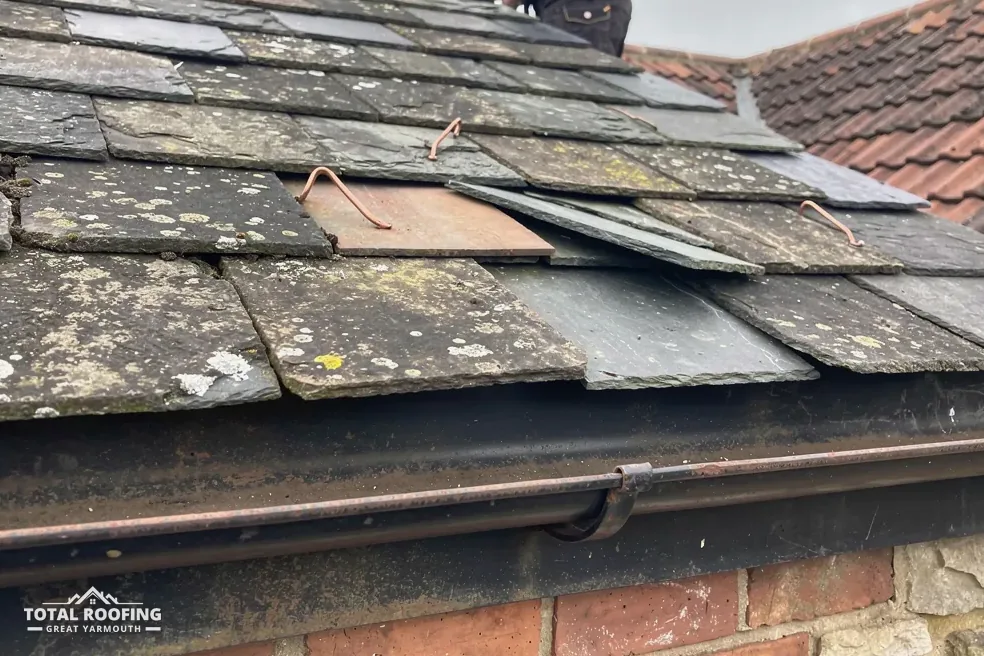
That is also why the verge is a good place to look when a roof is surveyed. A verge slate that has slipped or cracked lets wind and water get in at the side of the roof, and the loose piece can be tracked back to its nails.
The point is the same on a dry verge system, where BS 8612:2018, which BSI lists as current, covers the dry-fixed ridge, hip and verge parts that finish the edge. Even there, the courses beneath still run in half-bond, and the slate-and-a-half sits behind the verge cap.
Other places a wider slate is used
The same idea turns up wherever a course meets a fixed edge: against a wall at an abutment, beside a chimney, at the sides of a dormer or roof window and along valleys and hips, where the slates are cut to the line. At each, the courses have to finish on something sound, and a slate cut from a wider one is better than a sliver.
Slates are matched to the roof, and a roofer cutting a wider slate for a particular edge may need a template taken on site, so a slate-and-a-half for an older roof can be a made-to-fit job and not an off-the-shelf piece. Reclaimed slates sometimes supply the right width; see reclaimed roof slates.
Cupa rules out hooks on pitches beneath 25º, and an odd-sized slate at an edge is another reason to look closely at the fixings used. Our guide to slate hooks against nails compares them.
What to check on your own roof
Stand where you can see the verge and look at the pattern. Alternate courses should finish at the edge with a wider slate, and the slates should lie in line with no gaps or tilted pieces. Cracked, slipped or missing edge slates are worth reporting, because a loose verge slate lets wind lift the next one along. Where the verge is capped, check the cap is tight and the joints between pieces are closed. Our re-slating a roof guide shows how the edges are set out in a new covering.
A photograph of the verge, sent on WhatsApp to 07880 284133, lets us see what is visible before a survey. At Total Roofing Great Yarmouth the survey takes in the verges, the hips and the abutments, and the quote is one written total price. The slate roofing hub lists the work we do, with guides on each part of a slate roof.
